
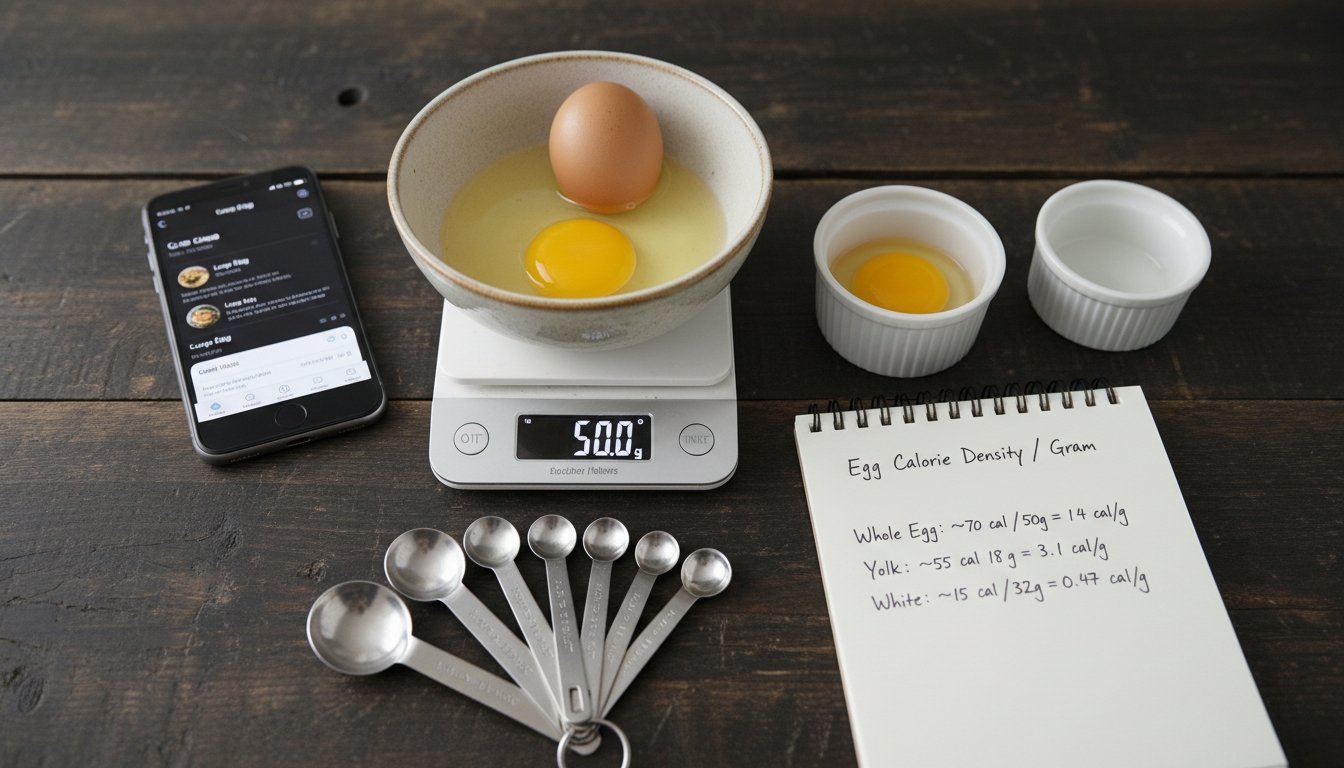
Weigh the egg (or its parts) on a digital scale, note the grams, then divide the known calories—about 72 kcal for a whole egg, 17 kcal for the white, 55 kcal for the yolk—by that weight to get kcal / g. Use the same method for any size; the density stays near 1.4 kcal/g for whole eggs, while whites are ~0.6 kcal/g and yolks ~2.8 kcal/g. Adjust for cooking method (boiling keeps weight, frying adds fat) and ignore shell weight for accuracy. This quick calculation lets you compare eggs to other proteins, and the next section shows how to fine‑tune portions for your diet.
What Is Egg Calorie Density and Why It Matters?
Ever wondered how many calories you actually get from each gram of egg? Egg calorie density tells you the energy you’ll receive per gram of the food, usually expressed as calories per gram (kcal/g). Knowing this figure helps you compare eggs to other protein sources, control portion sizes, and fit eggs into a balanced diet without guessing. Since eggs vary in size and composition, the density stays relatively stable—about 1.4 kcal per gram for a whole egg—so you can estimate intake even when you only have a weight estimate. This matters for weight management, because tracking calories accurately prevents under‑ or over‑eating. It also guides macro‑nutrient planning: if you aim for a specific protein‑to‑calorie ratio, understanding density lets you adjust the number of eggs you consume. In short, egg calorie density is a simple, reliable metric that empowers smarter, more precise nutrition decisions.
Measure Egg Weight Accurately for Calorie Density
Knowing the calorie density of an egg is only half the story; you also need its exact weight to turn that density into a reliable calorie count. First, pick a digital kitchen scale that measures to the nearest gram. Zero it with the container you’ll use, then place the egg gently on the platform. Record the reading before any cracks or cooking, because heat can evaporate moisture and alter mass. For consistency, weigh several eggs and use the average, especially if you’re comparing different sizes or breeds. This practice eliminates guesswork and lets you apply the density figure directly to each egg’s actual weight, yielding precise calorie totals for any recipe or nutrition plan.
- Zero the scale with a small bowl.
- Place the raw egg in the bowl.
- Note the exact gram reading.
- Repeat with multiple eggs and average the results.
Calculate Egg Calorie Density per Gram (Whole, White, Yolk)
How much energy does each gram of an egg actually deliver? First, weigh the portion you’re analyzing—whole egg, white, or yolk—using a kitchen scale. Then, look up the calorie count for that portion; a typical large egg contains roughly 72 kcal, its white about 17 kcal, and the yolk around 55 kcal. Divide the calories by the weight in grams to get calorie density. For example, if a whole egg weighs 50 g, its density is 72 kcal ÷ 50 g = 1.44 kcal/g. A 30‑g white yields 17 kcal ÷ 30 g ≈ 0.57 kcal/g, while a 20‑g yolk gives 55 kcal ÷ 20 g = 2.75 kcal/g. Record these figures in a table for easy comparison. The higher the kcal/g, the more energy you’ll get per bite, which helps you tailor portion sizes to meet dietary goals.
Verify Your Numbers With Egg Nutrition Labels
After you’ve calculated the kcal/g for each egg component, cross‑check those figures against the nutrition label on the carton. The label gives total calories and weight per serving, so you can derive an independent kcal/g value. Compare that to your component‑by‑component results: if they diverge, revisit your assumptions about yolk‑white split or moisture loss during cooking. Remember that labels round to the nearest 5 kcal and may list a “large egg” serving size that differs from your actual egg weight. Use the label as a sanity check, not a definitive source, and adjust your calculations accordingly.
- Open the carton, locate the “Nutrition Facts” panel, and note the calories per serving.
- Find the serving weight (grams) printed beneath the calories.
- Divide calories by weight to get label‑derived kcal/g.
- Align this figure with your own component averages and flag any outliers.
Large vs. Medium vs. Small Eggs: Density Comparison
Ever wondered how the size of an egg changes its calorie density? You’ll find that a large egg packs roughly 70 kcal in about 57 g, yielding ~1.23 kcal/g. A medium egg holds around 60 kcal in 49 g, about 1.22 kcal/g. A small egg contains roughly 55 kcal in 44 g, giving ~1.25 kcal/g. The differences are minimal; the calorie‑to‑gram ratio stays near 1.2 kcal/g across sizes.
To compare, weigh each egg type, note its label’s calorie count, then divide calories by weight. This simple calculation shows that size alone doesn’t dramatically alter density; the protein‑fat composition stays consistent.
When you’re portion‑counting, you can treat large, medium, and small eggs as virtually interchangeable in terms of calories per gram, adjusting only for the total weight you consume.
How Boiling, Frying, and Scrambling Change Egg Calorie Density
Do you know how cooking methods shift an egg’s calorie density? Boiling keeps the shell intact, so water adds no calories; the egg’s mass stays roughly the same, and its density stays near the raw value. Frying introduces oil, which the the egg’s weight and boosts calories per gram. Scrambling often uses butter or milk, each adding fat and water, further diluting the protein and raising the overall calorie count per gram.
- Boiled egg – firm white, yolk centered, no added fat, density unchanged.
- Sunny‑side‑up fry – oil‑slicked surface, crisp edges, extra fat clings, density rises.
- Pan‑scrambled egg – fluffy curds, butter‑coated, moisture‑laden, calories spread thinly.
- Deep‑fried egg – batter‑covered, saturated with oil, mass spikes, density peaks.
Quick Reference Table: Egg Types vs. Calories per Gram
You’ll first see a quick overview of common egg types and their typical calorie‑per‑gram values.
Then the table shows how we calculate those numbers using weight and energy content.
Finally, the tips help you pick the right egg for your diet and adjust portions on the fly.
Egg Types Overview
Which egg type packs the most calories per gram? You’ll notice that larger eggs naturally carry more energy, but the shell’s thickness and yolk‑to‑white ratio also matter. A medium chicken egg delivers roughly 1.3 kcal/g, while a jumbo pushes that to about 1.5 kcal/g. Duck eggs, with their richer yolks, climb to 1.7 kcal/g, and quail eggs sit near 1.1 kcal/g because they’re tiny and have proportionally more white. Visualize these differences as a gradient of fuel density, helping you choose the right egg for your diet or recipe.
- Chicken (medium) – 1.3 kcal/g
- Chicken (jumbo) – 1.5 kcal/g
- Duck – 1.7 kcal/g
- Quail – 1.1 kcal/g
Calorie Calculation Method
Wondering how to quickly compare egg calorie densities? First, grab a kitchen scale and weigh your egg in grams. Then, locate the calorie‑per‑gram value in the reference table: large chicken (≈57 kcal/100 g → 0.57 kcal/g), medium duck (≈78 kcal/100 g → 0.78 kcal/g), small quail (≈16 kcal/100 g → 0.16 kcal/g), and so on. Multiply the egg’s weight by its specific kcal/g factor to get total calories. For example, a 60‑g chicken egg yields 60 × 0.57 ≈ 34 kcal.
Use the same process for any egg type; the table lets you swap values instantly, so you can compare densities without manual calculations. This method keeps your nutrition tracking fast and accurate.
Practical Usage Tips
Looking for a fast way to compare egg calories? Grab the quick‑reference table and match each egg type to its calorie‑per‑gram value. Use the numbers to size portions, plan meals, or swap ingredients without guessing. Keep the table handy on your phone or fridge; the visual cue cuts calculation time to seconds. When you’re cooking, glance at the gram weight on the package, multiply by the listed density, and you’ll know exact calories instantly.
- Visualize a large chicken egg (≈ 60 g) as ~ 1.6 kcal/g → 96 kcal total.
- Picture a medium duck egg (≈ 70 g) as ~ 1.5 kcal/g → 105 kcal.
- Imagine a small quail egg (≈ 9 g) as ~ 1.8 kcal/g → 16 kcal.
- Envision a boiled egg white (≈ 33 g) as ~ 0.5 kcal/g → 16 kcal.
Common Mistakes When Comparing Egg Calorie Density
Ever notice how easily you can misjudge an egg’s calorie density? You might weigh a raw egg, then compare it to a boiled one without accounting for water loss, or you could ignore the yolk‑to‑white ratio that shifts calories per gram. Assuming all eggs are identical leads to skewed charts, and using volume instead of weight inflates errors. Forgetting to subtract shell weight or to standardize cooking method adds noise, making your diet plan unreliable.
| Mistake | Why it hurts |
|---|---|
| Ignoring water loss | Overestimates calories |
| Using volume not weight | Misrepresents density |
| Skipping yolk‑white split | Skews macro balance |
| Forgetting shell weight | Adds unnecessary grams |
Frequently Asked Questions
How Does Egg Storage Temperature Affect Calorie Density?
You’ll find that storage temperature doesn’t change an egg’s calorie density; the calories per gram stay the same whether you keep them cold or at room temperature, as long as they remain fresh.
Do Different Chicken Breeds Produce Eggs With Varying Calorie Densities?
You’ll find that some breeds lay slightly richer eggs, but the differences are minimal; most variations stem from diet and size, not genetics, so calorie density per gram stays roughly consistent.
Can Adding Oil or Butter During Cooking Alter the Gram‑By‑Gram Calorie Count?
Yes, adding oil or butter raises the gram‑by‑gram calorie count. The fat you introduce mixes with the egg, so each gram now contains more calories than the plain egg alone.
Is There a Notable Calorie Density Difference Between Free‑Range and Cage‑Free Eggs?
You’ll find the calorie density almost identical; free‑range and cage‑free eggs differ by less than a percent, so any variation is negligible for gram‑by‑gram comparisons.
How Does the Age of an Egg Influence Its Weight and Calorie Density?
You’ll notice older eggs weigh slightly less because moisture evaporates, so their calorie‑per‑gram ratio rises a bit; the total calories stay roughly constant, but the density increases as the shell ages.
Conclusion
Now you’ve got a clear method to compare egg calorie density, so you can pick the right size and preparation for your diet. By weighing each egg, using the per‑gram formulas, and checking labels, you’ll avoid guesswork. Remember that cooking methods shift the numbers, and the quick reference table lets you spot the healthiest choice in seconds. Use this knowledge to stay on track and make smarter, protein‑packed decisions.


No Comments