
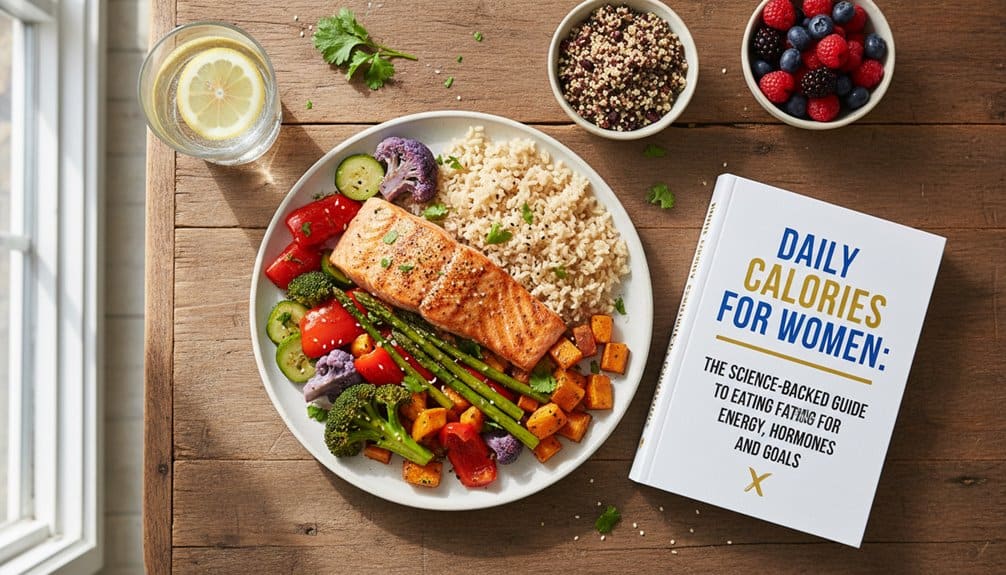
Daily Calories for Women: The Science-Backed Guide to Eating for Energy, Hormones, and Goals
Your daily caloric needs aren’t fixed—they shift with your menstrual cycle, age, and activity level in ways most diets don’t address. During your luteal phase, you’ll burn 100-300 extra calories, while perimenopause can slash your metabolism by up to 300 calories daily. Whether you’re aiming for fat loss with a 300-500 calorie deficit or muscle building with a 250-350 surplus, matching your intake to your hormones and goals transforms results completely.
Table of Contents
Key Takeaways
- Women’s basal metabolic rate is 5-10% lower than men’s due to naturally less muscle mass and more body fat.
- Caloric needs fluctuate throughout menstrual cycles, increasing 100-300 calories during the luteal phase when metabolism rises 5-10%.
- Calculate daily needs by multiplying basal metabolic rate by activity factor: 1.2 for sedentary lifestyles, up to 1.9 for athletes.
- Fat loss requires a 300-500 calorie deficit while maintaining 0.8-1g protein per pound bodyweight to preserve muscle.
- Track progress weekly and adjust intake by 100-150 calories if expected changes don’t occur after two weeks.
The Science of Female Metabolism: Why Women’s Caloric Needs Differ From Men’s

Your metabolism works like a finely-tuned engine that runs differently from a man’s, and understanding these differences can transform how you approach your daily nutrition. You naturally have less muscle mass and more body fat than men, which means you’ll burn fewer calories at rest. Your basal metabolic rate typically sits 5-10% lower than a man’s of similar size.
Your hormones create unique metabolic patterns. Estrogen and progesterone fluctuations throughout your menstrual cycle directly affect how you process nutrients and store fat. During your luteal phase, you’ll burn about 100-300 more calories daily.
Circadian rhythm impacts affect your metabolism differently too. You’re more sensitive to meal timing disruptions, which can alter insulin sensitivity. Your gut microbiome considerations also matter more – hormonal changes influence bacterial diversity, affecting how you extract calories from food. These sex-specific factors mean you can’t simply scale down men’s caloric recommendations. You need an approach tailored to your female physiology.
Calculating Your Personal Caloric Requirements: Age, Activity, and Body Composition Factors
Determining your exact caloric needs requires more than generic charts—it demands attention to your unique variables. Your basal metabolic rate (BMR) forms the foundation, representing calories burned at complete rest. Age decreases this rate by 2-3% per decade after thirty, while lean muscle mass significantly boosts it—each pound burns approximately six calories daily at rest.
Here’s what shapes your personal equation:
- Age Factor: Younger women naturally burn 100-200 more calories daily than those over fifty
- Activity Multiplier: Sedentary lifestyles require BMR x 1.2, while athletes need BMR x 1.9
- Body Composition: Higher muscle-to-fat ratios increase daily caloric burn by 15-20%
- Lifestyle Variables: Standing jobs, fidgeting, and non-exercise movement add 200-400 calories
You’ll calculate most accurately by tracking your current intake and weight changes over two weeks. If you’re maintaining weight, that’s your maintenance level. Adjust from there based on your specific goals.
Hormonal Phases and Energy Needs: From Menstrual Cycles to Menopause
The female body’s caloric needs fluctuate dramatically throughout different hormonal phases, creating energy demands that shift like tides. During your follicular phase, you’ll typically need fewer calories as estrogen rises gradually.
But once ovulation fluctuations kick in mid-cycle, your metabolism increases by 5-10%, demanding an extra 100-300 calories daily during the luteal phase.
These hormonal changes don’t stop with monthly cycles. Pregnancy skyrockets your needs by 340-450 calories in later trimesters, while breastfeeding demands an additional 500 calories daily.
As you approach perimenopause, declining estrogen slows your metabolism by roughly 50 calories per day, year after year.
You’ll notice increased hunger before your period isn’t just psychological—it’s your body legitimately requiring more fuel. Menopause brings the most significant shift, often reducing your metabolic rate by 200-300 calories daily.
Understanding these patterns helps you adjust your intake strategically rather than fighting your body’s natural rhythms.
Strategic Eating for Your Goals: Matching Calorie Intake to Performance, Body Composition, and Wellness Objectives
Beyond hormonal fluctuations, achieving specific wellness outcomes requires deliberate caloric adjustments that align with what you’re trying to accomplish. Your daily calorie target isn’t fixed—it’s a flexible tool you’ll adjust based on your current priorities.
Your Goal-Based Calorie Framework:
- Fat loss strategies: Create a 300-500 calorie deficit through reduced intake and increased activity while maintaining protein at 0.8-1g per pound bodyweight
- Performance enhancement: Add 200-300 calories on training days, emphasizing carbohydrates pre and post-workout
- Muscle building nutrition: Establish a 250-350 calorie surplus with strategic protein timing every 3-4 hours
- Metabolic restoration: Gradually increase calories by 50-100 weekly after prolonged dieting to rebuild metabolic capacity
You’ll need to track your progress weekly, adjusting intake based on actual results rather than predictions. If you’re not seeing expected changes after two weeks, modify your approach by 100-150 calories. Remember, sustainable transformations happen when you match your eating strategy to your current goal while maintaining nutritional quality.
Frequently Asked Questions
Can I Eat the Same Number of Calories Every Day?
You don’t need to eat the same number of calories every day. In fact, flexible calorie intake can prevent metabolic adaptations that slow your metabolism when you’re too rigid.
Your body’s needs change based on activity, stress, and hormonal fluctuations. Varying your calories naturally – eating more on active days and less on rest days – keeps your metabolism responsive and helps you maintain energy while supporting your goals.
Should I Count Calories From Beverages and Condiments?
Yes, you should count calories from beverages and condiments since they significantly impact your daily intake. That splash of creamer, juice, or salad dressing adds up quickly and affects your macronutrient ratios.
You’ll be surprised how portion sizes of seemingly innocent additions like ketchup or sugary drinks can contribute hundreds of calories. Track everything you consume to maintain accurate calorie counts and balanced macronutrient ratios for your goals.
How Accurate Are Calorie Tracking Apps and Food Labels?
Calorie tracking apps and food labels aren’t perfectly accurate – they can be off by 20% or more. Your food logging accuracy depends on weighing portions rather than eyeballing them.
You’ll get better results focusing on nutrient density importance alongside calorie counts. Don’t stress about small discrepancies; instead, track consistently and watch trends over time. If you’re not seeing expected results, adjust your targets accordingly rather than obsessing over precision.
Is It Safe to Eat Below 1,200 Calories Daily?
No, you shouldn’t eat below 1,200 calories daily. This extreme restriction triggers metabolic adaptation, where your body slows down essential functions to conserve energy.
You’ll damage your hunger regulation system, making it harder to recognize natural fullness and hunger cues. Your hormones become imbalanced, muscle mass decreases, and nutrient deficiencies develop.
You’re also more likely to binge eat later, creating an unhealthy cycle that sabotages your long-term goals.
Do I Need to Adjust Calories When Taking Birth Control?
You don’t necessarily need to adjust calories when taking birth control, but you should monitor your body’s response. Birth control effects vary between individuals – some women experience increased appetite or slight metabolic changes.
Your hormonal calorie needs might shift slightly, potentially requiring 50-100 extra calories daily if you notice increased hunger. Track your weight and energy levels for the first few months, then adjust your intake accordingly.
Conclusion
You’ve learned how your metabolism differs from men’s, how to calculate your personal caloric needs, and how hormones impact your energy requirements throughout life. Now you’re equipped to match your eating to your unique goals. Remember, there’s no one-size-fits-all number. Your ideal calorie intake changes with your activity, age, and hormonal phase. Use this knowledge to fuel your body properly, whether you’re building strength, improving performance, or optimizing your overall wellness.


No Comments