
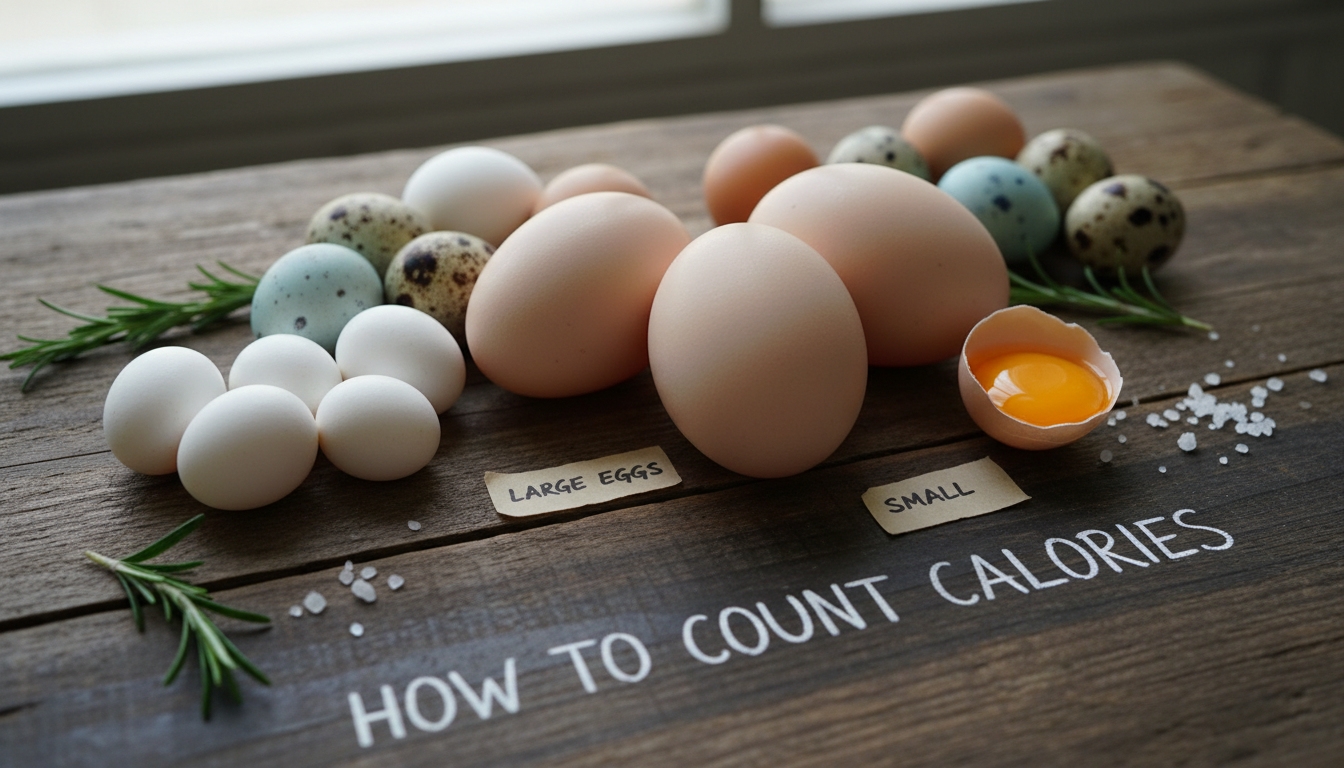
Treat a large egg (≈50 g) as about 70 kcal and a small egg (≈38 g) as roughly 54 kcal, then log each as its own unit in your app. Use the “egg, whole, large” entry for the 70‑kcal count and either adjust the serving size or create a custom entry for the 54‑kcal small egg. Remember that cooking method matters—boiling adds nothing, while a teaspoon of oil for frying adds ~45 kcal. If you keep tracking like this, you’ll discover more ways to fine‑tune your macros.
Table of Contents
How Many Calories Are in a Large Egg Versus a Small Egg?
Wondering how many calories a large egg packs compared to a small one? A typical large egg (about 50 g) contains roughly 70 kcal, while a small egg (around 38 g) offers about 54 kcal. The difference stems mainly from the extra protein and fat in the larger yolk and white.
If you’re tracking intake, treat a large egg as a 70‑calorie unit and a small egg as a 54‑calorie unit. Remember that cooking method can add calories—boiling adds none, whereas frying in oil adds roughly 40–50 kcal per teaspoon of oil.
To keep counts accurate, weigh your eggs if you’re unsure of size, or use the USDA’s standard values as a guide. By noting the size and preparation, you’ll maintain precise calorie logs without guessing. This simple comparison lets you adjust recipes and meals confidently.
Why Egg Size Matters for Daily Calorie Tracking?
Why does egg size matter for daily calorie tracking? You’re counting every gram, so a size‑difference shifts your macro tally. A small egg (~45 g) supplies roughly 55 kcal, while a large egg (~57 g) delivers about 70 kcal. That 15‑kcal gap adds up across meals, influencing your total intake and nutrient ratios. When you log meals, the size you actually eat determines protein, fat, and cholesterol numbers, which affect satiety and energy balance. Ignoring size can cause under‑ or over‑estimation, skewing progress toward goals like weight loss or muscle gain. Use the table below to visualize the impact of swapping sizes in a typical three‑egg breakfast.
| Egg Size | Approx. Calories |
|---|---|
| Small | 55 kcal |
| Medium | 63 kcal |
| Large | 70 kcal |
| Extra‑Large | 78 kcal |
| Jumbo | 90 kcal |
How to Log Egg Calories in Popular Diet Apps?
How do you make sure your egg intake is accurately reflected in MyFitnessPal, Cronometer, or Lose It?
First, search the database for “egg, whole, large” and note its 70‑80 kcal value. If you eat a small egg, adjust the portion size to 0.75 × the large‑egg entry, or manually type the exact calories (≈55 kcal).
In MyFitnessPal, tap “Add Food,” paste the custom entry, and set the serving to one egg.
Cronometer lets you create a custom food: enter the weight (≈50 g for a large egg) and let the app calculate calories.
Lose It offers a similar “Create Food” feature—enter the brand, size, and macro breakdown, then save it for future logs.
Always double‑check the label: raw vs. cooked, boiled vs. scrambled, because added fats change the total. Sync your phone after each entry to keep daily totals consistent.
Swap Large for Small Eggs Without Ruining Nutrition Goals?
Balancing your macros is simple when you swap a large egg for a small one—just adjust the calorie and protein count by roughly 25 %. A large egg provides about 70 kcal and 6 g protein; a small egg offers ~52 kcal and 4.5 g protein. If your goal is to stay within a 2,000‑kcal budget, replace one large with one small and subtract 18 kcal and 1.5 g protein from your daily tally. Track the change in your app, and you’ll see the impact instantly.
When you’re counting macros for muscle gain, the slight protein drop can be offset by adding a half‑cup of Greek yogurt or a scoop of whey. For weight loss, the calorie reduction helps create a modest deficit without sacrificing satiety. Keep an eye on the total egg count—four small eggs equal the protein of three large ones, so you can maintain volume while tweaking size. Adjust portions, stay consistent, and your nutrition goals stay on track.
Frequently Asked Questions
Can I Replace Egg Whites With Whole Eggs for Calorie Counting?
Yes, you can swap egg whites for whole eggs, but remember whole eggs add roughly 70 calories and fat per large egg, so adjust your total calorie count accordingly and track your macros.
Do Egg Yolk Colors Affect Calorie Content?
You won’t see any noticeable calorie difference; yolk color comes from diet, not fat or protein. So whether it’s deep orange or pale yellow, the calorie count stays essentially the same.
How Does Cooking Method Change Egg Calories?
You add calories when you fry or scramble eggs with butter or oil, because the fat absorbs into the egg. Boiling or poaching keeps the calories unchanged, since no extra fat is introduced.
Are Free‑Range Eggs Nutritionally Different From Conventional Eggs?
You’ll find free‑range eggs have slightly more omega‑3s and vitamin D, but overall protein, calories, and fat match conventional eggs; the differences are modest and vary by feed and farm practices.
What Is the Calorie Difference Between Organic and Non‑Organic Eggs?
You’ll find organic eggs roughly the same—about 70 kcal for a large—so non‑organic ones, maybe a calorie or two less; the tiny variance doesn’t affect overall nutrition.
Conclusion
You’ve seen that a large egg packs roughly 70‑80 calories, while a small one holds about 55‑60. That difference adds up if you’re counting every bite, but it’s easy to adjust your logs and keep your macros on track. By swapping a large for a small egg, you shave a few calories without sacrificing protein or nutrients—so stay flexible, track the change, and keep your nutrition goals intact.


No Comments