
5 Best Cage Free Vs Conventional Eggs Calorie Counts
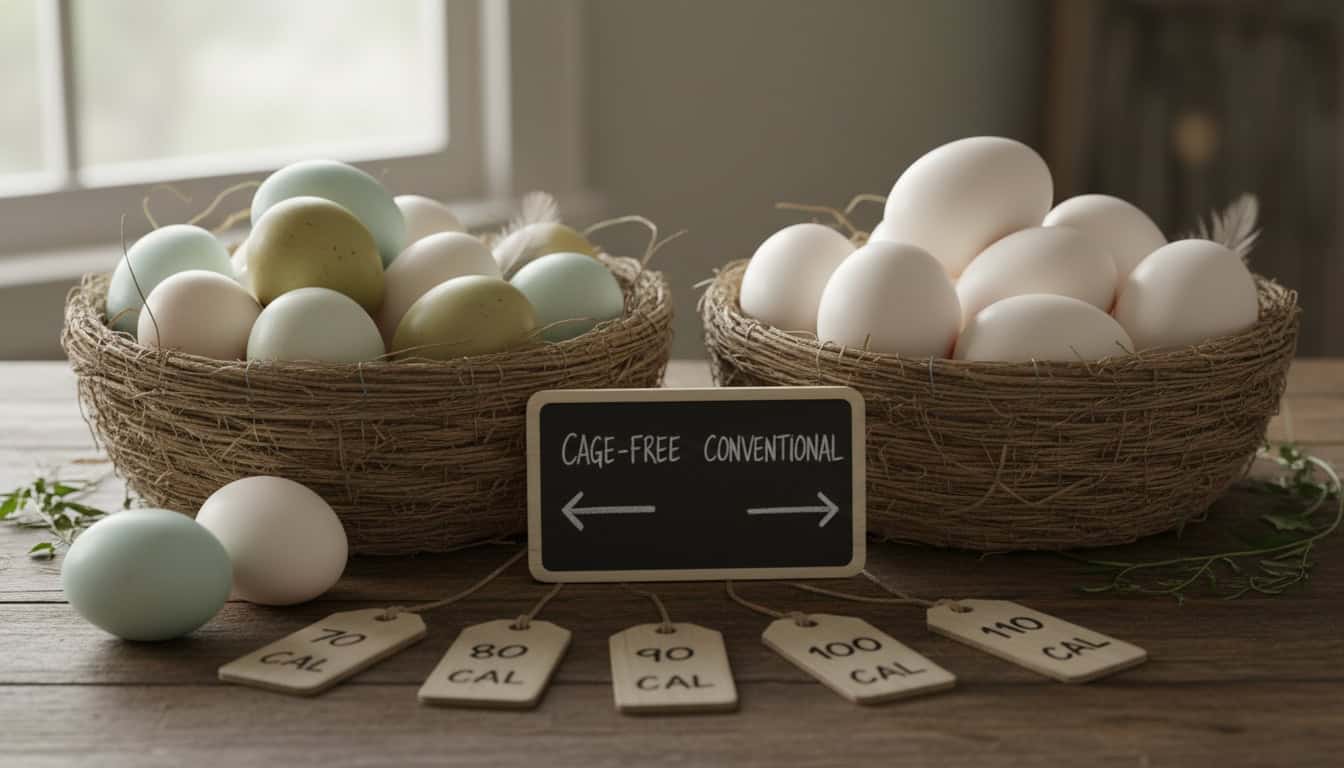
You’ll see that a typical cage‑free egg packs about 70 kcal, which is essentially the same as a medium Grade A conventional egg. Large cage‑free eggs run near 80 kcal and extra‑large around 90 kcal, while Jumbo can hit 100 kcal. Small diet tweaks or breed differences shift the count only a few calories, and some stores even dilute weight or trim yolks to shave a couple of calories. Want the exact five best comparisons and how to spot the tricks? Keep going for the full breakdown.
Table of Contents
What’s the Calorie Count of a Typical Cage‑Free Egg?
Wondering how many calories you get from a typical cage‑free egg? You’ll find it contains roughly 70 kcal, give or take a few depending on size. The yolk supplies most of the energy—about 55 kcal—while the white adds roughly 15 kcal. Because cage‑free hens roam and eat a more varied diet, the nutrient profile can shift slightly, but the calorie count stays close to that of conventional eggs.
When you crack one open, you’re getting a compact source of protein, fats, and micronutrients for a modest energy cost. If you’re tracking intake, count each medium‑sized cage‑free egg as 70 kcal, and adjust upward for large or extra‑large eggs. This baseline lets you compare meals, plan snacks, or balance breakfast without guessing. Knowing the exact number helps you stay on target with your dietary goals.
How Do Conventional Egg Calories Compare by Size and Grade?
How do conventional egg calories vary with size and grade? You’ll find that a medium‑sized, Grade A egg packs about 70 kcal, while a large, Grade A egg rises to roughly 80 kcal. Extra‑large and jumbo eggs, still Grade A, push the count to 90 kcal and 100 kcal respectively.
Grade B eggs, which are slightly less uniform in shell and yolk quality, contain a few fewer calories: a medium Grade B is about 68 kcal, a large Grade B around 78 kcal, and a jumbo Grade B near 98 kcal.
The differences stem mainly from the egg’s mass; more white and yolk mean more energy.
When you compare sizes, each step up—small, medium, large, extra‑large, jumbo—adds roughly 10 kcal.
Grade differences are marginal, usually under 2 kcal per size.
Keep these numbers handy to gauge your intake accurately.
How Do Diet, Breed, and Housing Affect Cage‑Free Egg Calories?
After noting how size and grade set the baseline calorie range for conventional eggs, it’s worth seeing how cage‑free birds’ diet, breed, and housing can shift those numbers.
Your choice of feed matters: chickens raised on grain‑heavy rations tend to lay eggs with slightly higher fat content, nudging calories up by 1‑2 % compared with those fed a balanced mix of greens and insects.
Breed also plays a role; heritage breeds like Rhode Island Reds often produce richer yolks, while hybrid layers such as White Leghorns lay lighter‑colored eggs with marginally fewer calories.
Housing conditions affect stress levels, which in turn influence metabolic efficiency. Birds with ample outdoor space and perches experience lower cortisol, leading to steadier nutrient deposition and more consistent calorie counts.
Conversely, cramped indoor cages can cause erratic feeding and subtle shifts in egg composition.
What Grocery‑Store Tricks Lower Cage‑Free Egg Calories?
Ever wonder why some grocery‑store eggs seem lighter on calories? You’re probably seeing a few clever tricks retailers use to make cage‑free eggs appear lower‑calorie. First, they often sell smaller‑size eggs, like “medium” or “large” labels that actually contain less yolk and white, reducing total calories per unit.
Second, many brands dilute the egg’s weight with added water or a thin saline solution, which inflates the shell size without adding calories.
Third, you’ll find “light‑cooked” or “pre‑whipped” egg whites sold separately; these are pure whites, stripping the yolk’s fat and cutting calories dramatically.
Fourth, some stores market “low‑calorie” cage‑free eggs that have been partially de‑fatting through a centrifuge process, removing a portion of the yolk’s lipid content.
Finally, packaging often highlights “lower‑calorie” claims while the actual nutritional label still reflects the standard calorie count, nudging you to assume a healthier choice.
Easy Recipes That Show the Cage‑Free vs. Conventional Calorie Gap?
Curious about how a simple scramble can reveal the calorie gap between cage‑free and conventional eggs? You’ll notice the difference when you whisk two cage‑free eggs with a splash of skim milk, then compare that to a scramble using two conventional eggs and the same milk. The cage‑free version typically runs about 12 calories lower per serving because of its slightly smaller yolk.
Try a quick frittata: combine four cage‑free eggs, diced veggies, and a pinch of cheese, bake for ten minutes, then weigh the portion. Repeat with conventional eggs and you’ll see a 20‑calorie surplus in the same slice.
A one‑pot quinoa breakfast works similarly—cook quinoa, stir in two eggs, and top with salsa. The cage‑free variant stays lighter, letting you track the gap without extra effort.
Use these recipes as a baseline; they make the calorie contrast tangible and delicious.
Frequently Asked Questions
Do Cage‑Free Eggs Contain More Cholesterol Than Conventional Eggs?
You won’t notice a cholesterol jump; cage‑free eggs have essentially the same cholesterol as conventional ones, so your diet won’t change if you switch between them.
How Does Cooking Method Affect the Calorie Difference Between Egg Types?
Cooking methods don’t change the inherent calorie gap between cage‑free and conventional eggs; you’ll still get roughly the same 70–80 kcal per large egg, whether you scramble, poach, or fry them.
Are There Any Nutritional Benefits Beyond Calories in Cage‑Free Eggs?
You’ll find cage‑free eggs often contain slightly more omega‑3s, vitamin D, and beta‑carotene, plus higher antioxidant levels, though the differences are modest and vary with feed and farm practices.
Do Organic Certifications Influence the Calorie Content of Cage‑Free Eggs?
You won’t see any calorie difference—organic certification doesn’t change the energy content of cage‑free eggs, so they still contain roughly the same calories as non‑organic cage‑free eggs.
Can the Age of the Hen Alter the Calorie Count of Its Eggs?
You’ll find that older hens lay slightly larger eggs, which can contain a few more calories, but the difference is minimal; age alone doesn’t drastically change the egg’s calorie count.
Conclusion
You’ve seen that cage‑free eggs usually hover around 70‑80 calories, while conventional eggs range from 65 to 90 depending on size and grade. Diet, breed, and housing can shift those numbers, and clever grocery tricks—like choosing smaller grades or trimming whites—can shave a few calories. In the kitchen, swapping a conventional egg for a cage‑free one in omelets, salads, or baked goods gives you a modest but consistent calorie advantage without sacrificing flavor.


Sorry, the comment form is closed at this time.