

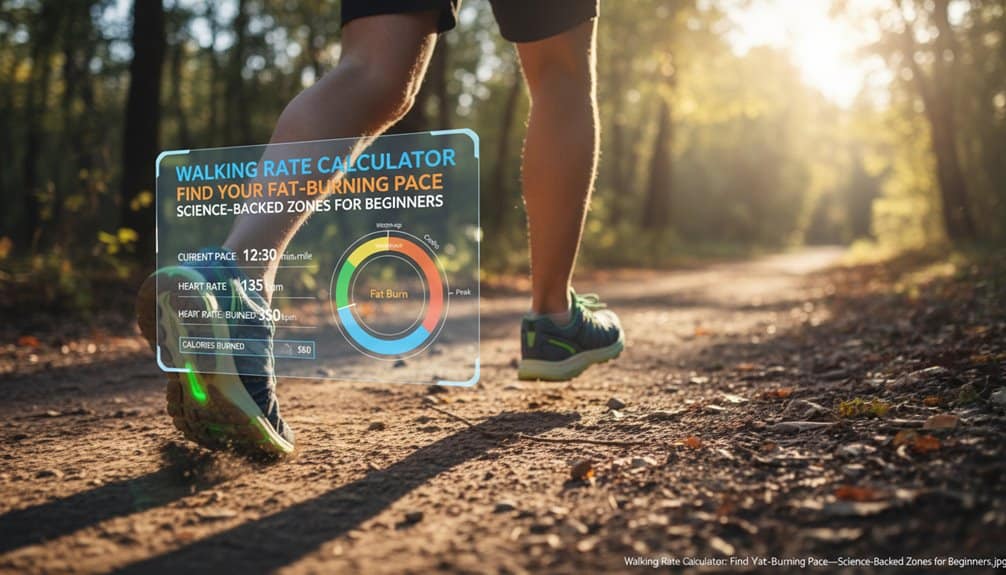
Walking Rate Calculator: Find Your Fat-Burning Pace—Science-Backed Zones for Beginners
You’ll find your fat-burning walking pace by calculating 60-70% of your maximum heart rate, which equals 220 minus your age. For example, if you’re 40, your target zone is 108-126 BPM, typically achieved at 3-4 mph. Start walking and check your pulse after five minutes—you should breathe harder but still maintain conversation. Most beginners hit this sweet spot with a cadence of 100-130 steps per minute. Master these calculations to transform your daily walks into powerful fat-burning sessions.
Key Takeaways
- Calculate your fat-burning zone by multiplying your maximum heart rate (220 minus age) by 0.6-0.7 for optimal walking intensity.
- Most people reach their fat-burning zone walking at 3-4 mph with a cadence of 100-130 steps per minute.
- Test your pace after five minutes: you should breathe harder but still maintain conversation without gasping.
- Moderate-intensity walking targets 50-70% of maximum heart rate, varying by age from 100-140 BPM (20s) to 80-112 BPM (60+).
- Increase baseline pace by 0.2 mph every three days and add 30-second speed intervals every five minutes for progression.
Calculate Your Fat-Burning Walking Rate in 3 Steps
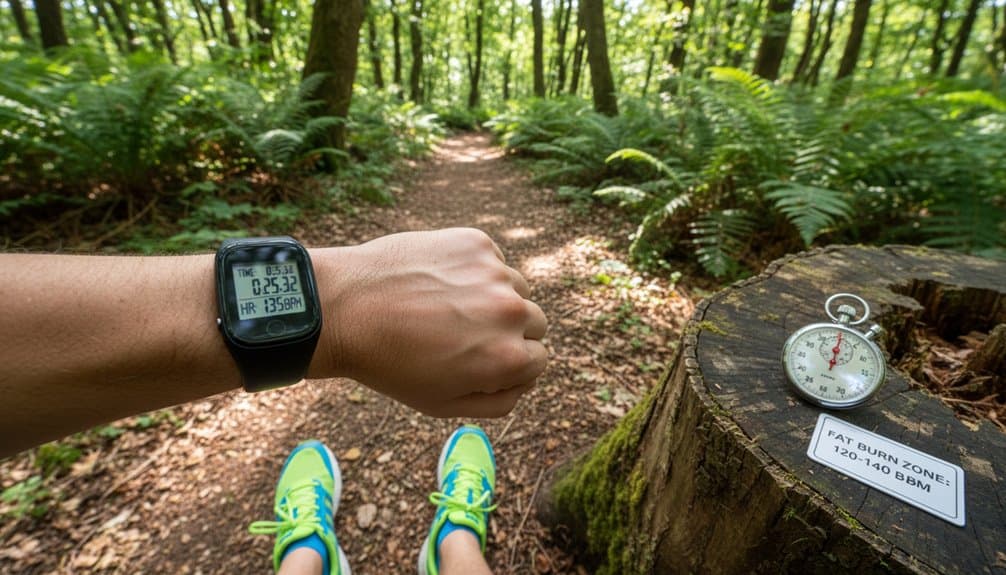
How fast should you walk to maximize fat burning during your workout?
You’ll need to find your optimal pace through three simple calculations that determine your personal fat-burning zone.
First, calculate your maximum heart rate by subtracting your age from 220.
If you’re 40, that’s 180 beats per minute.
Second, multiply this number by 0.6 and 0.7 to find your fat-burning zone’s lower and upper limits.
Using our example, that’s 108-126 beats per minute.
Third, translate this heart rate into walking speed using pace cues.
Start walking and check your pulse after five minutes.
Can’t hold a conversation? You’re walking too fast.
Breathing normally? Speed up.
Most people hit their zone at 3-4 mph.
For step accuracy, use a fitness tracker or smartphone app to monitor your cadence.
Aim for 100-130 steps per minute.
Adjust your stride length rather than frequency to fine-tune your pace within the fat-burning zone.
Why Walking Rate Calculators Beat Generic Fitness Advice?
When’s the last time generic fitness advice actually matched your unique body and fitness level? Generic recommendations like “walk 10,000 steps daily” or “exercise 30 minutes” ignore critical factors that make you different from everyone else.
Walking rate calculators eliminate the evidence gaps found in one-size-fits-all approaches. They consider your age, weight, fitness level, and heart rate zones to create a customized plan.
While generic advice assumes everyone burns calories at the same rate, calculators recognize that a 25-year-old athlete and a 60-year-old beginner need completely different walking intensities.
The personalization benefits extend beyond accuracy.
You’ll avoid overtraining injuries from pushing too hard or wasting time with ineffective low-intensity walks.
Your calculator-based plan adapts as you progress, ensuring you’re always in the optimal fat-burning zone.
Instead of guessing whether you’re working hard enough, you’ll know exactly what pace delivers results for your specific metabolism and cardiovascular capacity.
Find Your Target Heart Rate Walking Zones by Age
Ever wondered why your walking workout feels too easy or leaves you gasping for air?
You’re probably not hitting your target heart rate zone.
Your optimal walking intensity changes with age, and knowing your specific zone transforms random walks into effective workouts.
For moderate-intensity walking, you’ll want to reach 50-70% of your maximum heart rate.
Calculate yours by subtracting your age from 220.
If you’re 40, that’s 180 beats per minute maximum, making your target zone 90-126 BPM.
Different age ranges require adjusted pulse thresholds.
Twenty-somethings should aim for 100-140 BPM during moderate walks, while those in their 50s target 85-119 BPM.
Sixty-plus walkers work best at 80-112 BPM.
You don’t need fancy equipment—just find your pulse at your wrist for 15 seconds and multiply by four.
When you’re in the zone, you’ll breathe harder but can still hold a conversation.
That’s your sweet spot for burning fat and building endurance.
Adjust Your Walking Rate Calculator for Faster Results
Tweaking your walking rate calculator settings can shave weeks off your fitness goals. Start by increasing your baseline pace by 0.2 mph every three days. This gradual algorithm tweak prevents injury while pushing your cardiovascular system to adapt faster.
You’ll see quicker results by adding 30-second speed intervals every five minutes. Your calculator should track these bursts separately from your steady-state pace. Input your perceived exertion level after each interval to refine future recommendations.
Don’t forget to update your weight weekly since even small changes affect calorie burn calculations. Most calculators store this information locally, ensuring data privacy while maintaining accuracy. You can also adjust terrain settings—walking on a 2% incline burns 20% more calories than flat surfaces.
Fine-tune your step length measurement by walking 20 steps and dividing the distance by 20. This precision improves distance tracking by up to 15%, giving you more accurate progress reports.
Frequently Asked Questions
How Long Should I Walk at Fat-Burning Pace for Weight Loss?
You’ll want to walk 30-60 minutes at your fat-burning pace for effective weight loss.
Duration guidelines suggest starting with 30 minutes if you’re new to exercise, then gradually increasing to 45-60 minutes as you build endurance.
Don’t worry about pace variability during your walk—it’s natural to speed up and slow down slightly.
You’re still burning fat as long as you maintain that moderate-intensity sweet spot throughout your session.
Can I Use a Walking Rate Calculator if I Have Knee Problems?
You can use a walking rate calculator with knee problems, but you’ll need to modify your approach.
Start with shorter distances and slower paces than recommended.
Monitor your joint pain levels carefully during and after walks.
Consider wearing knee support for added stability.
If pain increases, reduce your pace or duration immediately.
You’re better off walking consistently at a comfortable speed than pushing through pain and risking further injury.
Should I Eat Before or After My Fat-Burning Walking Session?
You’ll burn more fat walking on an empty stomach, but meal timing depends on your goals.
If you’re walking for under 60 minutes, you don’t need to eat beforehand.

For longer sessions, have light fuel choices like a banana 30 minutes prior.
Post-walk, eat within two hours to aid recovery.
Morning walkers often prefer fasted sessions, while evening exercisers benefit from afternoon snacks to maintain energy throughout their fat-burning pace.
What’s the Difference Between Fat-Burning Zone and Cardio Zone?
The fat-burning zone operates at 50-65% of your maximum heart rate, while the cardio zone pushes you to 70-85%.
These intensity differences activate different energy systems in your body.
You’ll burn a higher percentage of fat calories in the lower zone, but you’ll torch more total calories in the cardio zone.
Your fat-burning zone feels comfortable and sustainable, whereas the cardio zone leaves you breathing harder and unable to maintain conversation easily.
Is Walking on an Incline Better for Burning Fat Than Flat Surfaces?
Yes, you’ll burn significantly more fat walking on an incline.
Your incline effectiveness increases calorie burn by 30-50% compared to flat surfaces, forcing your muscles to work harder while maintaining fat-burning heart rate zones.
Your terrain selection matters—even a modest 5% grade doubles the intensity.
You’ll engage more muscle groups, especially glutes and calves, while staying in that optimal fat-burning zone longer than high-intensity flat running.
Conclusion
You’ve discovered how to calculate your optimal walking rate and target heart rate zones for maximum fat burning. Now you’re equipped with personalized data instead of generic fitness advice. Remember to adjust your pace as your fitness improves and track your progress weekly. Start with your calculated baseline, stay consistent, and gradually increase intensity. Your customized walking rate isn’t just a number—it’s your roadmap to sustainable weight loss and better cardiovascular health.


Table of Contents








No Comments