
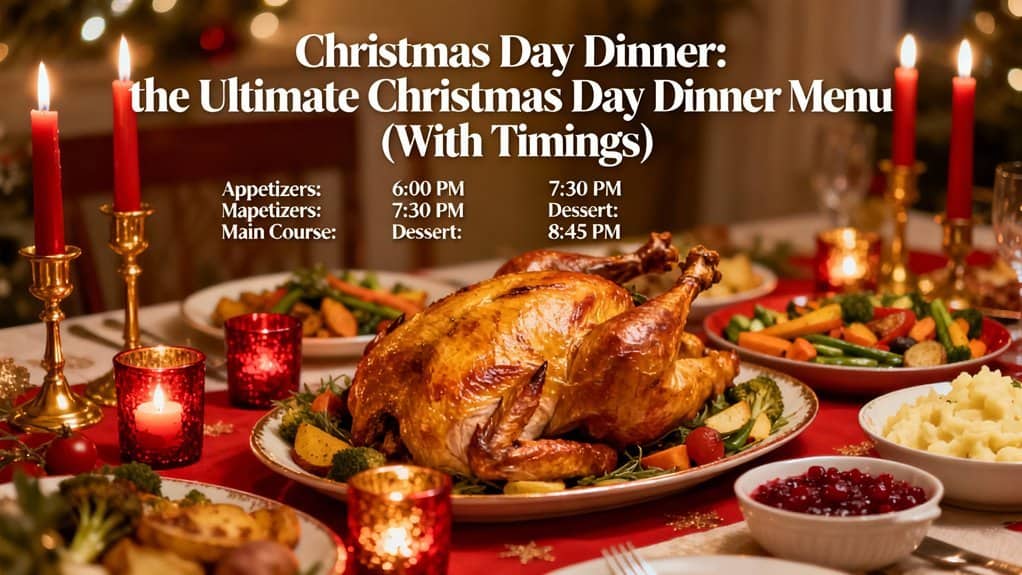
The Ultimate Christmas Day Dinner Menu (With Timings)
Start your Christmas dinner prep two weeks ahead by selecting your menu theme and confirming guest numbers. Three days before, make cranberry sauce, pie crusts, and prep hardy vegetables. On Christmas Eve, set your table by 4PM and assemble make-ahead dishes. For a 2PM dinner, you’ll begin at 8AM—seasoning and roasting your turkey while coordinating sides using multiple ovens and slow cookers. Your perfectly timed feast awaits with every detail planned.
Table of Contents
Key Takeaways
- Start cooking at 8:00 AM for a 2:00 PM dinner service, allowing proper time for roasting, resting, and final preparations.
- Roast turkey at 325°F for approximately 15 minutes per pound, then rest for 30-45 minutes before carving.
- Stagger side dishes: potatoes at 11:30 AM, roasted vegetables at 12:30 PM, using warming drawers and slow cookers to maintain temperature.
- Set the table by 4:00 PM Christmas Eve and prep vegetables, stuffing, and cocktail bases the night before.
- Remove desserts from refrigeration 30 minutes before serving; warm plates briefly and serve chilled desserts at optimal temperatures.
Planning Your Christmas Menu Timeline Two Weeks Before
Two weeks before Christmas marks the perfect starting point for your dinner planning, giving you enough time to organize without feeling rushed.
Start by establishing your theme selection – whether you’re going traditional with turkey and all the trimmings or trying something modern like prime rib or seafood. Your theme will guide every decision from decorations to side dishes.
Next, tackle budget allocation.
Determine how much you’ll spend on proteins, sides, beverages, and desserts. Don’t forget to account for serving pieces, decorations, and unexpected guests.
Create a detailed shopping list divided into non-perishables you can buy now and fresh items for later.
Count your confirmed guests and add two extra settings for last-minute additions.
Review your cookware, serving dishes, and linens to identify what you’ll need to borrow or purchase.
Finally, scan recipes and note special ingredients that might require ordering online or visiting specialty stores.

Essential Shopping Lists and Prep Work Three Days Ahead
With your two-week planning complete, you’ll now shift into action mode three days before Christmas.
Start by conducting a thorough pantry inventory to identify what you already have versus what you need.
Create two shopping lists: one for non-perishables and another for fresh ingredients you’ll buy closer to Christmas Day.
You’ll want to begin prep work that can be done ahead.
Chop hardy vegetables like carrots and celery, storing them in airtight containers.
Make cranberry sauce, pie crusts, and cookie dough now—they’ll keep perfectly.
Start labeling containers with contents and dates to avoid confusion later.
Clear your refrigerator and freezer to make room for incoming ingredients.
Set up your serving dishes, check your table linens, and polish silverware.
You’ll also need to confirm guest counts and dietary restrictions one final time.

This three-day window transforms your plans into tangible preparations, ensuring you’re not scrambling on Christmas Eve.
Christmas Eve Preparation Schedule and Make-Ahead Dishes
By Christmas Eve morning, you’ll tackle the final preparations that’ll make tomorrow’s dinner seamless.
Start by reorganizing your freezer organization system—move tomorrow’s proteins to the fridge’s bottom shelf for overnight thawing.
Clear prime refrigerator space for completed dishes.
Mix your make ahead cocktails between 10-11 AM.
Batch cranberry Moscow mules or mulled wine base in pitchers, then refrigerate.
You’ll simply add garnishes tomorrow.
Prep your vegetable sides next: blanch green beans, roast root vegetables until just tender, and store them covered.
They’ll need only quick reheating.
Assemble stuffing in its baking dish, wrap tightly, and refrigerate.
Roll pie dough if making homemade, or prep crumble toppings for desserts.
By 4 PM, set tomorrow’s table completely—plates, silverware, glasses, and centerpiece.
This eliminates morning chaos when oven space becomes precious.
Finally, review tomorrow’s cooking schedule and post it on the fridge.
You’re now perfectly positioned for success.
Christmas Morning Tasks and Early Start Times
Generally, you’ll want to set your alarm for 6:30 AM on Christmas morning to maintain your cooking timeline without feeling rushed.
Start with your usual coffee routines – you’ll need the energy boost before diving into kitchen duties.
While the coffee brews, remove your prepped vegetables from the fridge to bring them to room temperature.
By 7:00 AM, preheat your oven and take the turkey out to rest for an hour before roasting.
This temperature adjustment ensures even cooking.
Complete your morning rituals quickly, then return to stuff the turkey and prepare your roasting pan.
At 8:00 AM, season the bird generously and get it into the oven.
Set multiple timers for basting intervals and side dish preparations.
Delegate simple tasks to early-rising family members – they can set the dining table or arrange serving platters.
You’ve front-loaded the work, so now it’s about executing your timeline while maintaining quality control throughout the morning.
The Main Event: Roasting Times for Turkey, Beef, or Ham
You’ll need precise timing to get your centerpiece meat perfectly cooked, so keep temperature and time charts handy for quick reference throughout the cooking process.
Whether you’re roasting a 20-pound turkey at 325°F for 4 hours or a prime rib at 450°F initially then 325°F, these guidelines ensure your meat reaches safe internal temperatures without drying out.
Don’t forget to factor in a 15-30 minute resting period after cooking, which allows juices to redistribute and makes carving easier while keeping the meat moist.
Temperature and Time Charts
Check your meat thermometer and set your timer—getting the temperature and timing right for your main course can make or break your Christmas dinner.
You’ll need precise guidelines for each protein type.
Turkey requires 325°F for 15 minutes per pound, reaching 165°F internally.
Beef roasts cook at 450°F initially, then 325°F, targeting 135°F for medium-rare.
Ham needs 325°F throughout, hitting 140°F at the thickest point.
Don’t rely on color scales alone—they’re misleading indicators of doneness.
Instead, use interpolation methods to calculate cooking times between standard weights.
If your turkey‘s 18 pounds and charts show 15 and 20-pound timings, you’ll estimate proportionally.
Always factor in resting time: 20 minutes for turkey, 15 for beef, 10 for ham.
This ensures even heat distribution and perfect slicing.
Resting Period Guidelines
After removing your roast from the oven, the resting period becomes critical for achieving restaurant-quality results. You’ll need to tent your turkey with foil and let it rest for 30-45 minutes, while beef roasts require 15-20 minutes, and ham needs about 15 minutes.
During this time, carryover cooking continues raising the internal temperature by 5-10 degrees, ensuring your meat reaches its target doneness without overcooking. This process also allows juice redistribution throughout the meat’s fibers. When you cut into meat immediately after cooking, the juices haven’t settled and will run onto your cutting board. By waiting, you’re giving those flavorful juices time to reabsorb, creating more succulent slices. Don’t skip this step—it’s the difference between dry, disappointing meat and perfectly moist results.
Coordinating Side Dishes for Perfect Simultaneous Serving
When you’re juggling multiple side dishes for Christmas dinner, timing becomes your most critical skill.
You’ll need to orchestrate each dish’s cooking time while considering oven space and stovetop availability.
Start by listing completion times backward from serving.
Master these coordination strategies:
- Stagger prep times – Complete cold dishes first, then move to items that hold well
- Use warming drawers – Keep finished vegetables at serving temperature without overcooking
- Batch similar techniques – Roast all root vegetables together on one sheet pan
- Deploy slow cookers – Free up oven space for temperature-sensitive dishes
Consider portion scaling when planning quantities—you don’t need full servings of every side.
Focus on flavor balancing by pairing rich dishes with acidic or fresh accompaniments.
Write cooking times on sticky notes and arrange them on your counter in order.
You’ll transform chaos into a synchronized dinner where everything arrives hot and perfectly timed.
Dessert Timing and Last-Minute Finishing Touches
You’ll want to start your dessert prep about an hour before serving, giving pies time to cool slightly and allowing frozen desserts to soften.
Complete final touches like whipping cream, dusting powdered sugar, or drizzling sauce just minutes before bringing desserts to the table.
Remember that warm desserts taste best at 110-120°F while chilled ones should sit out for 5-10 minutes to reach their ideal serving temperature.
Dessert Prep Schedule
By mid-afternoon on Christmas Day, you’re ready to shift focus to desserts—and timing becomes everything.
Your prep schedule ensures each sweet course arrives perfectly timed without kitchen chaos.
Follow this streamlined dessert timeline:
- 2:30 PM – Remove cheesecakes and tarts from refrigeration; they’ll need 30 minutes to reach optimal serving temperature
- 3:00 PM – Whip cream for toppings and prepare any last-minute flavour pairings like berry compotes or caramel sauces
- 3:30 PM – Warm Christmas pudding; check ingredient substitutes are ready (dairy-free cream or gluten-free options)
- 4:00 PM – Plate cold desserts, torch brûlées, dust with powdered sugar
This schedule accommodates multiple dessert options while maintaining quality. You’ll serve everything at its peak without rushing or compromising presentation.
Final Plating Steps
The final fifteen minutes before serving dessert determine whether your sweets look homemade or restaurant-worthy.
You’ll want to remove chilled desserts from the refrigerator now, letting them temper slightly for optimal texture.
Warm your serving plates in a low oven for thirty seconds—this prevents ice cream from melting too quickly.
Consider your plate composition carefully. Place your main dessert slightly off-center, creating visual interest.
Add height with a dollop of whipped cream or a tuile cookie standing upright.
Your garnish placement shouldn’t be random; cluster berries in odd numbers, drizzle sauce in deliberate patterns, and dust powdered sugar through a stencil for precision.
Keep mint leaves between damp paper towels until the last second.
You’ve worked hard on these desserts—these finishing touches ensure they’re memorable.
Serving Temperature Tips
How long should your Christmas pudding rest after removing it from its steaming bath?
You’ll want to wait 5 minutes before turning it out—this prevents cracking and ensures it holds its shape perfectly.
Your servingware choices affect heat retention significantly.
Here’s what you need to know:
- Warm plates in a 150°F oven for 10 minutes before plating desserts
- Keep sauces at 140°F using double boilers or slow cookers on warm settings
- Rest pies for 15 minutes after reheating to prevent runny fillings
- Serve ice cream at 6-10°F by tempering it for 5 minutes before scooping
Different reheat methods work best for specific desserts.
Microwave individual portions of sticky toffee pudding for 30 seconds.
Steam Christmas puddings for 30 minutes if made ahead.
Sample Timeline for a 2PM Christmas Dinner Service
Creating a successful Christmas dinner requires careful timing, and you’ll want to start your preparations around 8 AM for a stress-free 2 PM service. You’ll need to coordinate cooking times, guest arrival, and your entertainment timeline to ensure everything flows smoothly.
Here’s your essential timing guide:
| Time | Task |
|---|---|
| 8:00 AM – 10:00 AM | Prep vegetables, stuff turkey, start cooking |
| 10:00 AM – 12:00 PM | Turkey in oven, prepare sides, set table |
| 12:00 PM – 2:00 PM | Final cooking, rest turkey, warm plates |
Plan for guest arrival at 1:30 PM, giving you breathing room before service. You’ll want appetizers ready by 1:15 PM and drinks chilled earlier. Start your roasted vegetables at 12:30 PM while potatoes go in at 11:30 AM. Rest your turkey for 30 minutes before carving. Keep your entertainment timeline simple—cocktails upon arrival, dinner at 2 PM, and dessert around 3:30 PM. This schedule ensures you’re not rushing and can actually enjoy hosting.
Frequently Asked Questions
What Can I Serve for Guests With Dietary Restrictions or Allergies?
You’ll want to prepare allergen free mains like roasted vegetable Wellington or stuffed portobello mushrooms that everyone can enjoy.
Don’t forget to include vegan sides such as maple-glazed carrots, herb-roasted potatoes, and dairy-free green bean almondine.
You’re creating an inclusive feast by offering quinoa stuffing, gluten-free gravy, and nut-free desserts.
Label each dish clearly so guests know what’s safe for them to eat without asking repeatedly.
How Many Pounds of Meat Should I Buy per Person?
You’ll want to plan for about 1 to 1.5 pounds per person when buying bone in portions like prime rib or whole turkey. This accounts for the weight of bones and ensures generous servings.
If you’re serving boneless cuts, reduce that to 8-12 ounces per guest. Don’t forget leftover planning – buying extra means you’ll have delicious sandwiches and casseroles for days after.
Consider your side dishes when calculating final amounts.
What Wines Pair Best With Traditional Christmas Dinner Courses?
You’ll want bold reds like Cabernet Sauvignon or Pinot Noir for roast pairings with turkey or beef – they complement the rich, savory flavors perfectly.
For ham, try a Riesling or Gewürztraminer.
Start with crisp whites like Sauvignon Blanc for appetizers.
Dessert wines like Port, Moscato, or ice wine beautifully enhance Christmas pudding and mince pies.
Don’t forget Champagne for toasting – it’s versatile enough to work throughout your meal.
How Do I Keep Everything Warm if Dinner Runs Late?
You’ll want to keep your oven at 170°F (75°C) to hold dishes warm without overcooking them.
Cover everything tightly with foil and rotate items as needed.
Use insulated carriers for sides like mashed potatoes and stuffing – they’ll maintain temperature for hours.
Your slow cooker’s “warm” setting works perfectly for gravy and sauces.
Don’t forget warming drawers if you’ve got them, and tent your carved meat with foil.
Can I Use Frozen Turkey Instead of Fresh for Christmas Dinner?
You can absolutely use frozen turkey for Christmas dinner.
Just remember that thawing times require proper planning – allow 24 hours for every 4-5 pounds in your refrigerator.
While some claim flavor differences exist between fresh and frozen, you won’t notice much distinction if you thaw correctly and don’t overcook.
Frozen turkeys are often more affordable and convenient since you can buy them weeks ahead.
They’ll deliver excellent results when prepared properly.
Conclusion
You’ve got everything you need to create the perfect Christmas dinner without the stress. By following this timeline and preparing dishes in advance, you’ll actually enjoy the day instead of being stuck in the kitchen. Remember, it’s about bringing people together, not achieving perfection. Trust your planning, stick to the schedule, and don’t forget to pour yourself a festive drink. Your guests will remember the warmth and laughter long after the last bite.


No Comments