
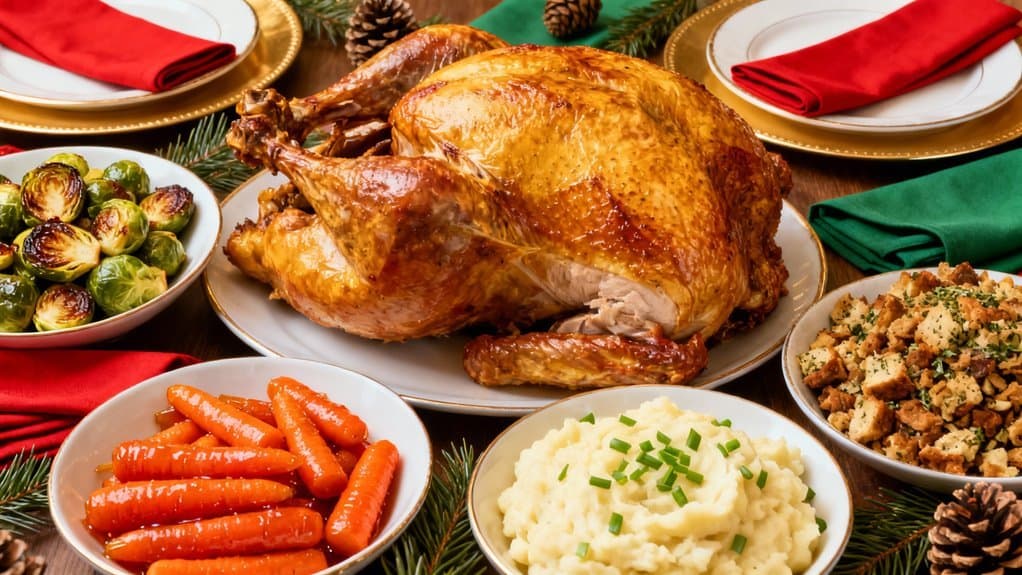
Foolproof Christmas Turkey Dinner With All the Trimmings
You’ll master a foolproof Christmas turkey dinner by selecting your bird two weeks early and planning one and a half pounds per person. Thaw properly using the refrigerator method, then season 12–24 hours ahead for flavor penetration. Roast at 450°F for 15 minutes, then 325°F, targeting 165°F in the thickest thigh. Rest your turkey 20 minutes before carving. Build umami-rich gravy from pan drippings, prepare traditional stuffing with quality broth, and craft cranberry sauce ahead. Your complete holiday spread awaits with deeper techniques.
Table of Contents
Key Takeaways
- Plan 1.5 pounds per person and purchase fresh turkey within three days of cooking or allow adequate thaw time for frozen.
- Start roasting at 450°F for 15 minutes, reduce to 325°F, and target 165°F in thickest thigh; rest 20 minutes before carving.
- Build umami-rich gravy by deglazing pan drippings with wine, adding mushroom powder and soy sauce, then thickening with cornstarch slurry.
- Season turkey 12–24 hours ahead using dry rub or herb butter under skin; use cavity aromatics for internal steam flavor.
- Prepare chestnut stuffing, cranberry sauce, and roasted root vegetables ahead; time sides coordination so everything finishes before carving.
Selecting the Perfect Turkey for Your Holiday Feast
When should you start shopping for your turkey?
You’ll want to begin about two weeks before Christmas.
This timing ensures you’ll find quality birds before supplies dwindle.
Start by checking labels carefully.
You’re looking for fresh or frozen options, noting the processing date and any additives.
Heritage breeds offer superior flavor and texture compared to conventional turkeys.
These birds, raised on farms using traditional methods, deliver richer taste that’ll impress your guests.
Consider your oven space and guest count when selecting size.

A good rule: plan one and a half pounds per person.
If you’re choosing fresh turkey, purchase it within three days of cooking.
For frozen birds, allow three to five days for thawing in your refrigerator.
Don’t overlook local farms or specialty butchers.
They often stock heritage breeds and provide expert advice about preparation.
Reading labels thoroughly helps you avoid turkeys injected with sodium solutions, ensuring you control your dish’s seasoning.
Essential Prep Work: Thawing, Cleaning, and Seasoning Your Bird
You’ll need to plan ahead for thawing, as a whole turkey requires approximately 24 hours for every 4-5 pounds in your refrigerator.
Once thawed, you can apply your chosen seasoning technique—whether you prefer a dry rub, brining, or herb butter under the skin—to infuse maximum flavor throughout the bird.
Proper timing and seasoning preparation now will set you up for a delicious roasted turkey on dinner day.
Thawing Methods and Timeline
How long does it actually take to thaw a frozen turkey? You’ll need proper planning to maintain cold chain logistics and ensure microbial safety. Here are your thawing options:

| Method | Time | Temperature |
|---|---|---|
| Refrigerator | 24 hours per 4-5 lbs | 40°F or below |
| Cold Water | 30 minutes per lb | Change water every 30 min |
| Microwave | Varies by wattage | Follow manufacturer guidelines |
| Hybrid | Combination approach | Refrigerator first, then cold water |
| Room Temperature | Not recommended | Bacterial growth risk |
The refrigerator method’s your safest bet, though it demands advance planning. If you’re short on time, submerge your turkey in cold water, changing it frequently. Never thaw at room temperature—bacteria multiply rapidly in the danger zone between 40°F and 140°F. Microwave thawing works in emergencies but requires immediate cooking afterward. Plan accordingly based on your bird’s size and available time.
Seasoning Techniques for Flavor
Once your turkey’s properly thawed and cleaned, seasoning’s where you transform a good bird into an exceptional centerpiece.
You’ll build layers of flavor that’ll impress your guests and elevate your holiday meal.
Here’s your seasoning strategy:
- Apply toasted spices inside and outside the cavity—they’re more potent than raw spices
- Rub herb butter under the skin for moisture and even distribution
- Season 12-24 hours ahead so flavors penetrate deeply into the meat
- Finish with finishing salts just before serving to enhance natural juices
Don’t overlook the cavity—it’s prime real estate for aromatics like citrus, garlic, and fresh herbs.
You’ll create a flavorful steam that seasons the bird from within.
This methodical approach ensures every bite delivers consistent, restaurant-quality taste throughout your Christmas dinner.
Mastering the Roasting Process for Golden, Juicy Results
The difference between a dry, disappointing turkey and one that’s golden and succulent comes down to technique and attention during roasting.
Position your oven rack in the lower-middle section so heat distributes evenly around the bird without burning the top.
This placement prevents the breast from cooking faster than the thighs.
Probe placement is critical for accuracy.
Insert your meat thermometer into the thickest part of the thigh without touching bone—this area takes longest to cook.
You’re aiming for 165°F, which ensures food safety while preserving moisture.
Start roasting at 450°F for 15 minutes to jumpstart browning, then reduce to 325°F for the remainder.
Tent the breast loosely with foil if it’s browning too quickly.
Check your thermometer every 30 minutes during the final hour.
Remove your turkey when it reaches temperature—don’t overcook it.
Let it rest 20 minutes before carving, allowing juices to redistribute throughout the meat.
Achieving Crispy Skin and Moist Meat Every Time
While mastering temperature control gets you halfway there, you’ll need to focus on skin preparation and moisture retention to truly nail both texture and juiciness.
Here’s your game plan:
- Pat the skin completely dry before roasting—moisture prevents browning and crispness
- Use sous vide searing to cook your turkey evenly, then finish with high heat for golden skin
- Apply a blowtorch finish strategically to achieve restaurant-quality crispiness without overcooking the meat
- Brine your bird for 12-24 hours to lock in moisture throughout cooking
These techniques work synergistically.
Brining seasons the meat deeply while keeping it tender.
Sous vide ensures even cooking, preventing dry white meat while thighs reach proper doneness.
The blowtorch finish delivers that coveted crackling exterior without drying out your carefully prepared poultry.
Your turkey will emerge with mahogany, crackle-worthy skin and succulent, juicy meat underneath—the hallmark of a perfectly executed holiday centerpiece.
Crafting Restaurant-Quality Gravy From Pan Drippings
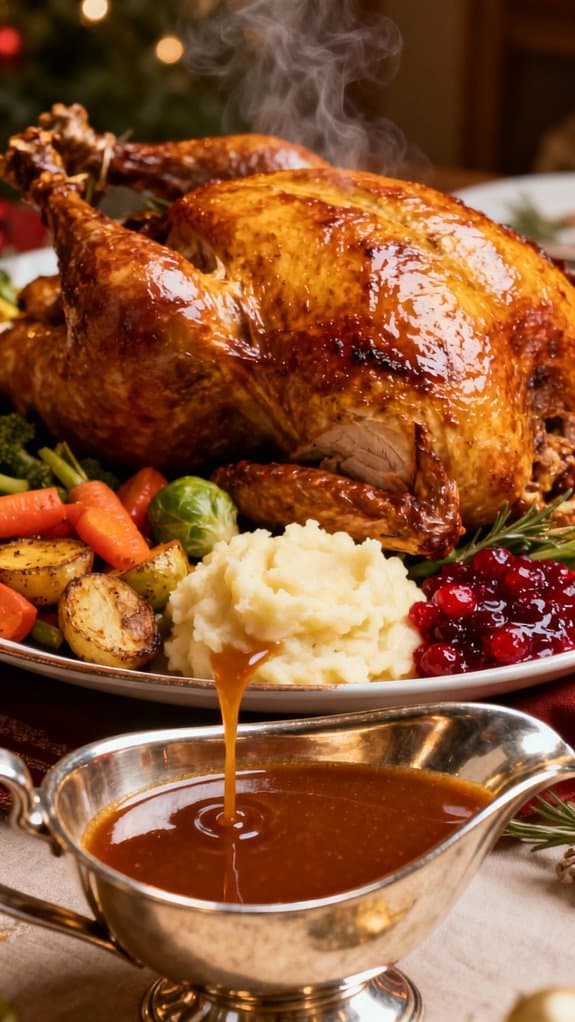
You’ll transform your turkey’s flavorful pan drippings into silky gravy by straining out solids and deglazing the roasting pan with broth to capture every savory bit.
Building umami depth requires layering flavors—incorporating tomato paste, soy sauce, or mushrooms alongside your drippings to create complexity that rivals any restaurant sauce.
Finally, you’ll achieve the perfect consistency by whisking in a slurry of cornstarch and broth, adjusting until your gravy coats the back of a spoon without lumping.
Straining and Deglazing Technique
Capturing the rich, flavorful essence of your roasted turkey starts with properly straining and deglazing the pan drippings.
This technique has historical origins in classical French cuisine, where chefs perfected methods for extracting maximum flavor from cooking vessels.
Follow these steps for restaurant-quality results:
- Pour drippings into a fat separator or allow them to rest so fat rises naturally
- Strain solids through fine mesh, maintaining tool maintenance by cleaning immediately
- Return strained liquid to the pan over medium heat
- Deglaze by pouring wine or broth while scraping browned bits from the pan bottom
These flavorful browned particles, called fond, dissolve into your liquid, creating the foundation for exceptional gravy.
Your deglazing technique transforms simple drippings into sophisticated, complex-tasting sauce that elevates your entire holiday meal.
Building Umami Depth Layers
Once you’ve deglazed your pan and dissolved the fond, it’s time to build umami depth—the savory fifth taste that’ll transform your gravy from good to extraordinary.
Layer umami systematically using complementary ingredients. Start by whisking in mushroom powder, which amplifies savoriness without adding moisture. Next, incorporate a pinch of dried kombu—its glutamates intensify the broth’s complexity. These additions work synergistically with your turkey drippings’ natural amino acids.
| Ingredient | Function |
|---|---|
| Mushroom Powder | Adds concentrated umami |
| Dried Kombu | Boosts glutamate depth |
| Turkey Drippings | Provides foundational richness |
| Soy Sauce | Enhances savory notes |
Stir continuously for two minutes, allowing flavors to marry. Your gravy now possesses restaurant-quality depth—rich, complex, and impossibly savory.
Achieving Perfect Gravy Consistency
Now that you’ve layered in umami complexity, your gravy’s flavor profile’s complete—but consistency determines whether it’ll coat your turkey or pool thin on the plate.
You’ll achieve the ideal texture through precise starch selection and temperature control.
Here’s your roadmap:
- Choose your thickener wisely—cornstarch creates glossy elegance, while flour offers traditional body
- Create a slurry first—whisk starch with cold stock to prevent lumps
- Maintain steady heat—simmer at 180-190°F, never boiling, which breaks down thickeners
- Whisk constantly—ensures even incorporation and silky consistency
The magic happens during the final two minutes.
Your gravy should coat the back of a spoon without dripping excessively.
If it’s too thick, thin with warm stock.
Too thin? Whisk in a cornstarch slurry and simmer another minute.
Preparing Traditional Stuffing and Savory Side Dishes
The stuffing and side dishes you’ll prepare can elevate your turkey dinner from ordinary to memorable.
You’ll want to master a few classic options that complement your bird perfectly.
Start with a traditional Chestnut Stuffing, which adds elegance and depth to your meal.
Toast your chestnuts first to enhance their nutty flavor, then combine them with dried herbs, celery, and onions.
You’ll achieve the ideal moisture by using quality broth—not too wet, not too dry.
Don’t overlook Apple Chutney as your secret weapon for brightness.
Its sweet-tart notes cut through rich turkey meat beautifully.
Simmer diced apples with vinegar, spices, and a touch of ginger until you’ve created a glossy condiment.
Round out your spread with roasted root vegetables and creamed corn.
You’ll want these sides ready before carving, so plan your timing carefully.
These dishes transform your dinner into an unforgettable feast.
Rounding Out Your Spread With Cranberry Sauce and Buttered Vegetables
Beyond the traditional stuffing and chutney, you’ll want to master two essential components: cranberry sauce and buttered vegetables.
For cranberry variations, you’ve got flexibility. Consider these options:
- Classic tart sauce with orange zest and cinnamon
- Spiced version incorporating ginger and cloves
- Chunky berry blend with whole cranberries
- Smooth, seedless consistency for easier serving
Prepare your cranberry sauce ahead—it actually improves after sitting overnight.
Regarding vegetable presentation, roasting brings out natural sweetness while maintaining texture.
Toss your selections in butter, salt, and pepper.
Brussels sprouts, carrots, and parsnips work beautifully together.
The key is cutting vegetables uniformly so they cook evenly.
Both components deserve attention because they brighten your plate’s visual appeal and balance the turkey’s richness.
These sides complement each other perfectly, with tart cranberry notes cutting through buttery vegetables.
Together, they transform your spread from adequate to memorable.
Frequently Asked Questions
How Far in Advance Should I Plan and Shop for My Christmas Turkey Dinner?
You’ll want to start planning three weeks before Christmas.
First, you’ll conduct a pantry audit to identify what you’ve already got.
Two weeks out, you’ll establish your timeline milestones—when you’re buying the turkey, produce, and specialty items.
One week prior, you’ll tackle your main shopping trip.
This approach prevents you from overlooking ingredients and ensures you’re not scrambling last-minute for essential components.
What Wine Pairings Complement a Traditional Christmas Turkey Meal Best?
You’ll find Crisp Whites like Pinot Grigio or Sauvignon Blanc pair beautifully with turkey’s delicate flavor.
They won’t overpower your meal’s subtle notes.
For richer sides like stuffing and gravy, you’ll want Earthy Reds such as Pinot Noir or Burgundy.
These wines complement the savory elements without competing.
Consider serving both options—your guests can choose based on their preferences and which dish they’re enjoying most.
How Do I Safely Store Leftover Turkey and Reheat It Properly?
You’ll want to refrigerate leftover turkey within two hours of cooking. Use proper cooling techniques by slicing the meat and placing it in shallow containers for faster chilling.
Store it at 40°F or below for up to four days. When reheating, conduct temperature checks to ensure it reaches 165°F throughout. You can reheat turkey in the oven, microwave, or stovetop, depending on your preference and available time.
Can I Prepare Any Components of the Meal the Day Before?
You can absolutely prep components the day before.
Your prepped sides like stuffing, cranberry sauce, and vegetables can be assembled and refrigerated.
Overnight marinades work wonderfully for brining your turkey, ensuring it’s perfectly seasoned and moist.
You’ll also want to chop herbs, measure spices, and prepare your gravy base ahead.
This advance preparation dramatically reduces your cooking day stress and lets you focus on timing everything perfectly.
What Temperature Should the Turkey Rest Before Carving for Optimal Results?
You’ll want your turkey resting at around 140-145°F before you carve it. This temperature allows carryover cooking to complete while preventing the meat from cooling too much.
The resting period—typically 20-30 minutes—enables juice redistribution throughout the meat, keeping it moist and tender. You’ll notice the turkey continues cooking slightly during this rest, so don’t let it drop below 140°F for food safety.
This approach ensures you’re carving perfectly cooked, juicy turkey every time.
Conclusion
You’ve now got everything you need to pull off a spectacular Christmas turkey dinner. From selecting your bird to mastering the roasting technique, you’re equipped to create a meal that’ll rival any restaurant. You’ll impress your guests with crispy skin, tender meat, and restaurant-quality gravy. Don’t forget those cranberry sauce and buttered vegetables to round it all out. You’ve got this—enjoy your foolproof feast!


No Comments