
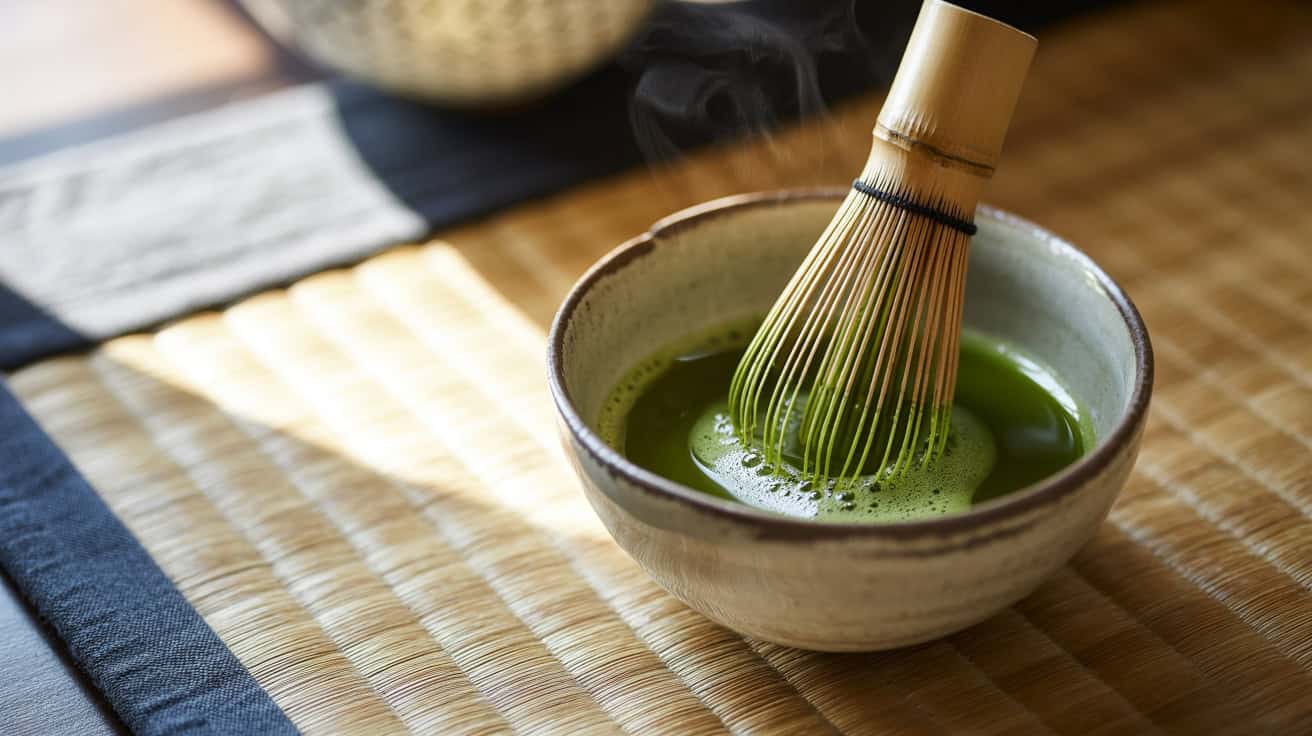
You need a bamboo chasen because it transforms powdered matcha into a silky, even suspension and delicate microfoam you can’t get with a spoon or frother. Its fine, flexible tines break clumps, aerate gently, and let you sculpt texture and mouthfeel while preserving vegetal umami. Whisk size, tine count, and technique change foam quality, so choosing and caring for the right whisk matters. Keep going to uncover practical tips and precise techniques for better results.
Table of Contents
Key Takeaways
- A chasen aerates matcha, producing silky microfoam that enhances mouthfeel and flavor clarity.
- Fine bamboo tines break clumps and fully disperse powder, preventing gritty pockets and uneven taste.
- Manual whisking with a chasen gives tactile feedback for rhythm, pressure, and bowl compatibility, improving consistency.
- Proper whisking temperature and technique—using a chasen—preserve umami and prevent bitterness from overextraction.
- A bamboo chasen produces silkier froth than spoons or electric frothers and is traditional, sustainable, and repairable with care.
What Is a Chasen and Why It Matters
The chasen—a finely carved bamboo whisk—is the essential implement for preparing authentic matcha. You handle its delicate tines and immediately sense centuries of purpose; chasen history shows artisans refined form for whisking powdered tea into luminous suspension.
When you choose a chasen, you’ll note variations in tine count, curvature, and stiffness, each tailored to teas and techniques. Chasen materials matter: single-piece yotsu-take bamboo yields resilience, while thin-tined kusenaoshi models offer swift froth.
You’ll care for it gently, rinsing and drying to preserve shape and prevent splintering. Its balance and responsiveness let you control tempo and wrist motion with minimal effort.
In daily ritual, the chasen becomes an extension of your intent—precise, efficient, thoughtfully made—so every bowl you whisk reflects both tradition and your steady hand.
You’ll find that selecting quality craftsmanship rewards you with durability, a refined aesthetic, and consistent performance that honors matcha’s delicate character and tradition.
How a Chasen Improves Matcha Texture
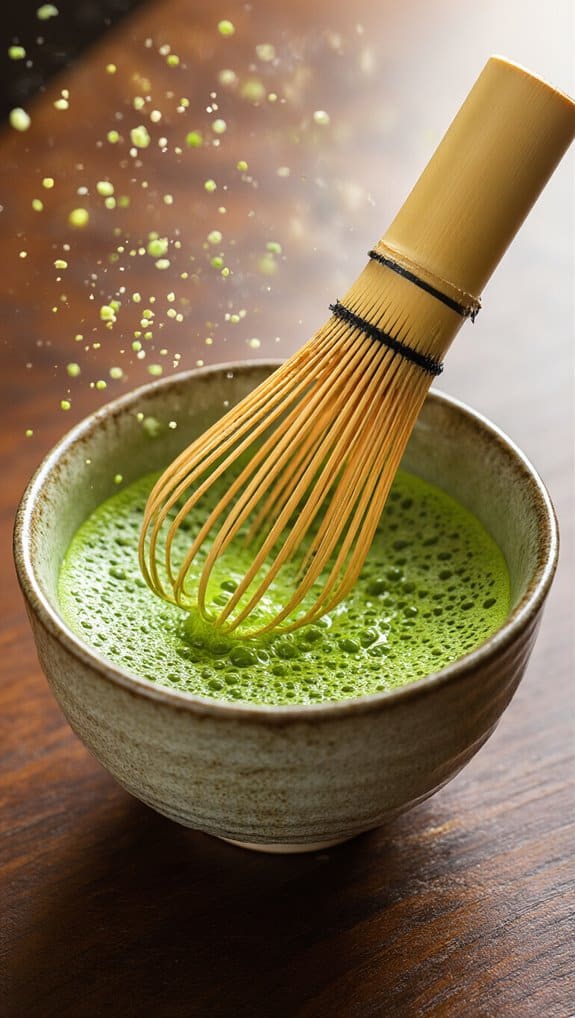
When you whisk with a chasen, its fine tines swiftly break apart stubborn clumps of matcha, freeing powder to integrate with water fully.
That thorough dispersion prevents gritty pockets and ensures an even mouthfeel.
As you continue to whisk rapidly, the chasen teases out a delicate, creamy microfoam that softens the flavor and adds a silken texture.
Breaks Up Clumps
Whisk briskly with a chasen and you’ll shear apart stubborn agglomerates, turning dense clumps into a fine, even suspension. You control pressure and angle, employing short, rapid strokes that break particle bonds for reliable clump prevention and consistent matcha consistency. The whisk’s tines separate particles, releasing aroma and ensuring uniform dissolution. With practice, you’ll sense when granules disperse and pause to judge texture. Use small circular motions near the surface, then a brief vigorous zigzag to finish. The result is a smooth, homogeneous bowl ready for tasting, without gritty pockets.
| Motion | Effect | Cue |
|---|---|---|
| Rapid | Breaks bonds | Uniform |
| Circular | Even dispersion | Smooth |
| Finish | Integrates solids | Ready |
Trust the chasen; your hands calibrate rhythm and force, producing flawless texture without overworking the tea. each time, reliably.
Creates Creamy Microfoam
As you flick the chasen just beneath the surface, its fine tines shear air into ultrafine bubbles and fold them into the liquid, producing a dense, velvety microfoam that clings to the bowl and tongue.
You guide rhythm and pressure to coax a uniform slurry into a satin layer; you’ll notice a creamy texture and elevated foam stability that heightens aroma and mouthfeel. The whisk’s shape and angle control bubble size, preventing collapse and promoting persistence.
- Tine density: creates consistent microbubbles.
- Wrist cadence: regulates aeration and viscosity.
- Bowl contact: polishes surface for lasting crema.
Practice refines your motion; soon your matcha shows a glossy cap and balanced sip. Each brief session hones your technique, delivering reliably smooth, enduring cups every time.
Whisking Techniques for Silky Froth
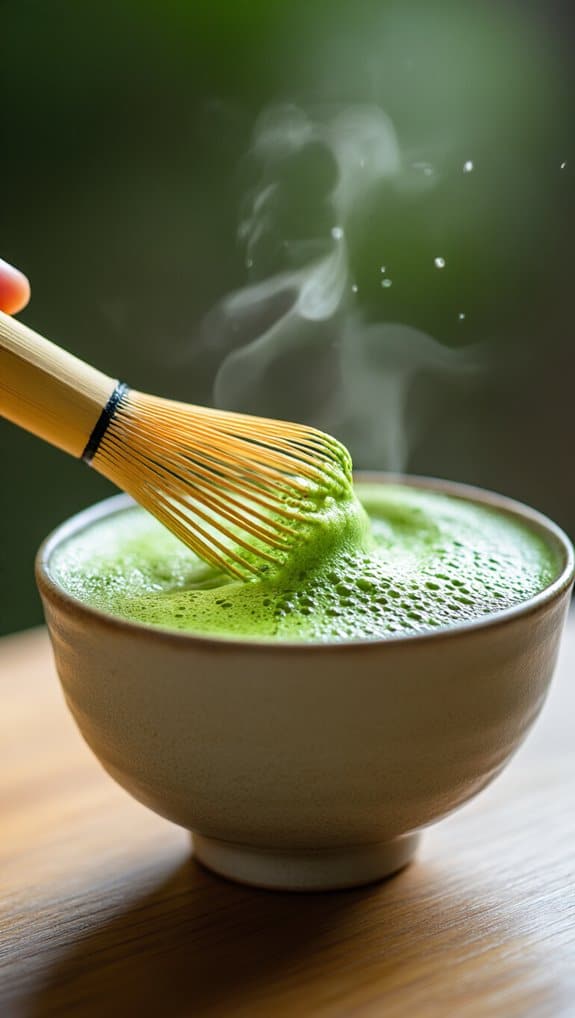
How do you coax a silky froth from matcha? You begin by assessing temperature and water volume, then position the chaise lightly at a slight angle. Use a brisk, controlled M-shaped motion, keeping whisking speed steady—too slow yields flatness, too fast splashes.
Shorten strokes as foam builds, and finish with tiny back-and-forth pulses to polish the surface. Watch for uniform bubbles: aim for a fine, mirrored sheet rather than large, airy pockets. This attentiveness refines froth consistency and lifts aroma without overworking leaves.
Hold the bowl securely with one hand and let your wrist lead; that freedom produces an even whirl. Clean, confident movements produce microfoam that feels creamy on the lips and gleams on the surface.
With practice, your hands learn the tempo that turns powder and water into a restrained, velvety crema. Rotate slightly between strokes to distribute energy and avoid overwhipping the blend too quickly.
Differences Between Usucha and Koicha Preparation
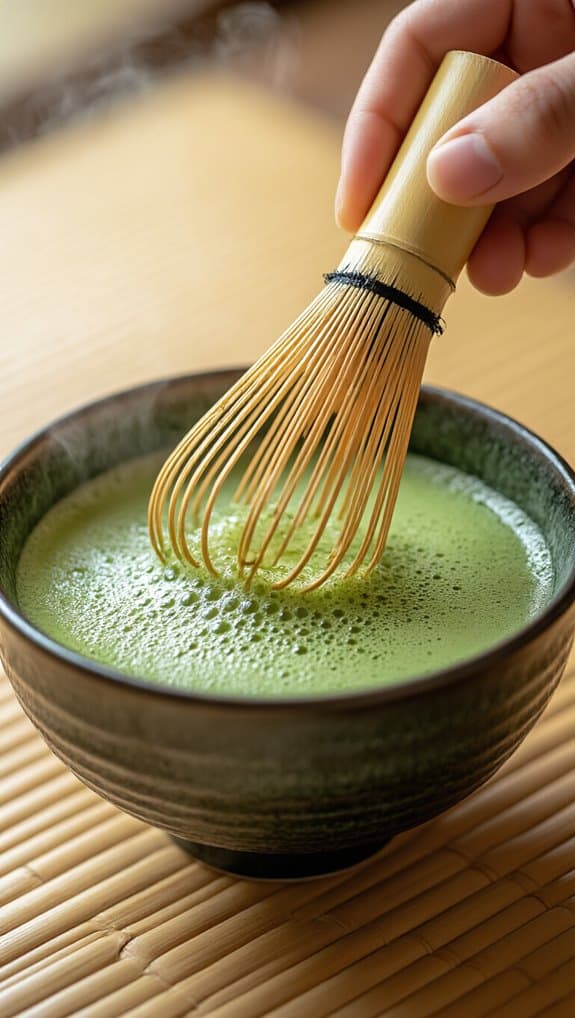
After mastering the tempo that yields silky froth, you’ll notice Usucha and Koicha call for almost opposite gestures and proportions.
You choose lighter whisking and more water for usucha preparation: sift one to two grams per sixty to eighty milliliters, then whisk briskly in a zigzag to form airy crema and a bright, thin liquor.
For koicha preparation, you shift to a thicker slurry: use three to four grams with minimal water, pressing and folding the powder into a viscous paste without foam to coax depth and umami.
Attend to rhythm, pressure, and bowl temperature; each motion alters mouthfeel and concentration. Mind sifted powder, exact measurement, and brief intervals between steps.
The three essentials to contrast both methods are:
- Ratio: powder to water balance.
- Motion: vigorous froth versus gentle kneading.
- Texture: light, bubbly usucha versus velvety, dense koicha.
Now practice deliberately to refine each variant’s character.
Why a Bamboo Whisk Beats Spoons and Electric Frothers
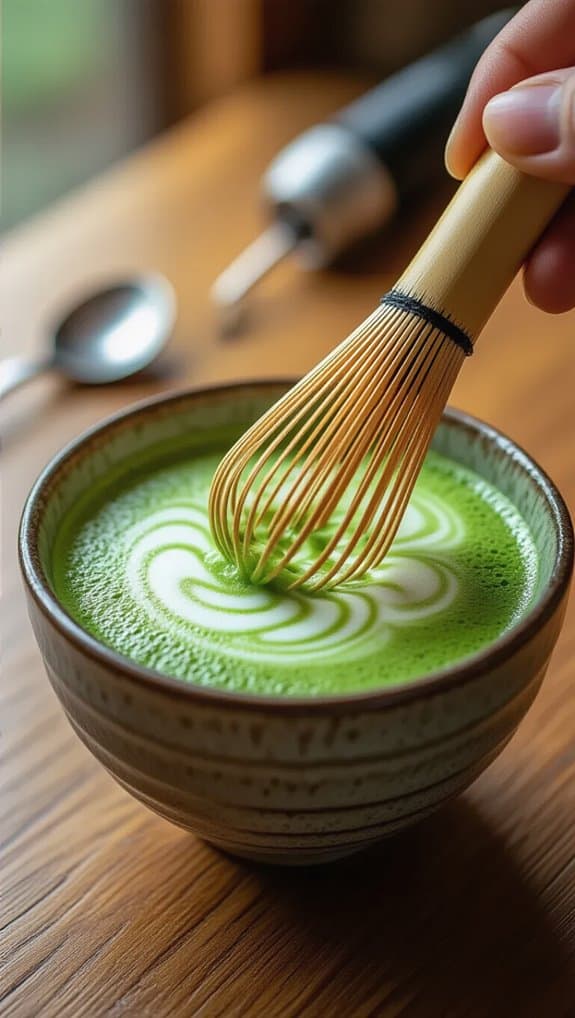
You’ll notice a bamboo whisk produces a silkier, more stable froth than a spoon or electric frother. Its fine tines aerating tea evenly without harsh bubbles.
It also preserves the matcha’s subtle vegetal and umami notes by avoiding overheating and over-agitation. Relying on a chasen lets you coax the ideal mouthfeel and pure flavor from each bowl.
Superior Froth Texture
Because a bamboo whisk‘s dozens of thin, flexible tines shear matcha and entrain air with rhythmic, controlled motion, it creates a silkier, finer foam than the coarse agitation of a spoon or the turbulent churn of an electric frother.
You feel the difference: the whisk’s delicate resistance lets you sculpt a microfoam that supports aromatic clarity and a velvety mouthfeel. In matcha preparation, you coax microbubbles that settle into a stable, glossy cap instead of the large, collapsing bubbles spoons and motors leave behind.
Use the whisk deliberately to tune texture:
- Rapid wrist flicks produce dense, fine froth.
- Gentle, sustained strokes yield a glossy surface.
- Short bursts combine aeration with smoothness.
Trust the tactile feedback; you’ll craft consistently superior frothy texture now.
Preserves Matcha Flavor
Using a bamboo whisk not only sculpts microfoam but also preserves the matcha’s delicate flavor profile, because its gentle, measured agitation extracts and holds volatile aromatics without overworking the leaf particles.
When you whisk with fine tines, you release matcha aroma gradually, so bitter compounds stay subdued and sweetness and umami remain balanced. You won’t bruise the powder as a spoon or whirring frother might; instead you coax flavor out with rhythm and minimal heat.
This precision gives you consistent flavor preservation across bowls, letting subtler notes—hay, seaweed, chestnut—speak. Practice controlled strokes, keep the water temperature moderate, and you’ll taste the difference: clearer, cleaner matcha that’s true to the tea rather than to mechanical aggression.
You’ll appreciate the nuanced cup each careful whisk delivers.
Caring for and Maintaining Your Chasen
When you finish whisking your matcha, rinse the chasen gently under cool water to remove tea residue without scrubbing its delicate tines.
Let it breathe: shake off excess water and position the whisk upright on a stand or lay it on a breathable cloth.
You’ll use simple cleaning techniques—no soap, just water and occasional gentle brushing with your fingers—to preserve bamboo integrity and flavor.
Drying at room temperature prevents cracking; avoid heat or sealed containers while moist.
Follow storage tips to prolong life: keep it in a dry, ventilated place away from sunlight and strong odors.
Every few weeks, inspect the tines for splintering and restore shape by soaking briefly in warm water before gentle reshaping.
With attentive care, you’ll maintain performance and aesthetic, ensuring each bowl of matcha benefits from a well-cared-for chasen.
- Rinse and air-dry.
- Gentle, soap-free cleaning.
- Store ventilated, away from heat.
Choosing the Right Chasen for Your Needs
How do you choose a chasen that suits your ritual and palate? Start by matching whisk size to your bowl and serving volume: small bowls need compact whisks for concentrated froth, larger bowls benefit from fuller tines to aerate more liquid.
Consider chasen materials—the bamboo variety affects flexibility, longevity, and the subtleties of foam; softer bamboo yields a gentler whisk, while denser bamboo offers resilience and brisker agitation.
Pay attention to tine count and spacing; more tines create finer microfoam for thin, delicate matcha, fewer produce bolder, creamier textures for koicha.
Test the balance and handle feel: you’ll whisk more smoothly with a well-centered grip and responsive spring.
Finally, factor in care and frequency of use—if you prepare matcha daily, choose a durable, finely crafted chasen that harmonizes with your preferred whisk size and desired mouthfeel.
Select thoughtfully to elevate each bowl with consistent, beautiful texture and flavor.
The Role of Tradition in Matcha Preparation
You’ll notice how the rhythms of the Japanese tea ceremony shape the pace and posture of matcha preparation, turning each whisk into a ritualized gesture.
Centuries of etiquette define when and how you whisk, sip, and present the bowl, imparting a measured grace to every step.
Many chasen and utensils are passed down or reproduced according to lineage, so the tools you use carry both practical purpose and cultural memory.
Tea Ceremony Influence
Although steeped in ritual, the Japanese tea ceremony shapes every motion in preparing matcha, guiding your hand from whisk selection to the measured, rhythmic strokes that produce a silken, persistent foam.
You encounter a tea ritual that demands mindfulness: each gesture frames taste, texture, and the quiet exchange between host and guest. The ceremony’s cultural significance teaches restraint and reverence, so you adopt calibrated motions that honor lineage without copying notation.
Precision matters: tempo, wrist angle, bowl tilt, and breath influence crema and aroma. Your whisk becomes an extension of intent.
- Tempo: measured strokes to cultivate stable foam.
- Angle: subtle wrist adjustment for creaminess.
- Breath: paced timing to harmonize focus and flavor.
You’ll find practice refines both technique and appreciative silence.
Tools Passed Down
When elders hand you a chasen, they pass more than bamboo—they transfer a living technique honed by generations, its tines shaped by use and memory. You learn rhythm, pressure, and temperature by watching and practicing, absorbing cultural significance in each motion. The whisk is a mnemonic: its wear records ceremonies, family traditions, and pauses for respect. You feel lineage in the grip and follow precise gestures that yield texture and taste. This inheritance frames how you approach tea, grounding modern methods in ritual discipline. Below is a simple comparison to honor that continuity:
| Item | Meaning | Practice |
|---|---|---|
| Chasen | Lineage | Morning whisking |
| Cloth | Care | Post-use cleansing |
| Bowl | Gathering | Shared servings |
You inherit responsibility and care.
Troubleshooting Common Whisking Problems
If your matcha comes out frothy but flat, you can usually trace it to temperature, technique, or powder quality. You’ll diagnose quickly by isolating variables: water warmth, whisking techniques, and the matcha itself.
Start with water around 70–80°C; too hot dulls flavors, too cold reduces foam. Use your chasen with brisk, controlled W or M motions, keeping your wrist loose; common mistakes include pressing the whisk to the bowl or stirring slowly.
- Check temperature and powder freshness — stale or clumped matcha won’t emulsify.
- Refine your motion — faster, light strokes create microfoam; avoid scraping the bowl.
- Clean and season your whisk — residue and brittle tines hamper aeration.
With precise adjustments, you’ll restore clarity, aroma, and the delicate crema that marks expertly whisked matcha.
Practice short sessions, note small changes, and you’ll build confident, repeatable results without guessing. Attend to rhythm, pressure, and powder dose each time.
Simple Recipes to Practice Your Whisking Skills
Because practice works best with clear goals, start with a handful of straightforward recipes that each train a specific skill—speed and foam, concentration and texture, or milk integration—so you can focus on one variable at a time.
Begin with a thin usucha: 1g matcha to 60ml water at 75°C; use quick back-and-forth wrist motions to build microfoam—this refines whisking techniques for speed and even suspension.
For thicker koicha, double the powder and slow the strokes; you’ll learn control and texture as the paste smooths.
Try a chilled matcha lemonade to test flavor clarity and cooling effects on foam.
Practice a matcha latte with steamed milk to master milk integration, alternating froth-heavy and gentle folds to see how texture melds.
Rotate these simple matcha variations in short sessions, note time, motion, and outcome, and you’ll tighten technique steadily without overcomplicating your routine.
Repeat daily; note progress for elegant improvement.
Frequently Asked Questions
Can a Chasen Be Used to Whisk Other Powdered Beverages?
Yes, you can use a chasen for other powdered beverages; its chasen versatility lets you whisk cocoa, protein powders, and instant matcha blends smoothly, producing fine foam and eliminating clumps.
You’ll appreciate the delicate tines for gentle aeration and rapid suspension, though stiff or grainy powders may wear the bamboo faster.
Clean it promptly and dry properly to preserve form and performance for continued elegant preparation and extended useful life.
Are There Safety Concerns for Children Using a Bamboo Chasen?
Yes, you should supervise children using a bamboo chasen because child safety matters: the delicate bamboo materials can splinter, break, or present small parts that pose choking hazards.
You’ll prevent injury by inspecting the whisk for cracks, trimming rough edges, and restricting use to older kids who understand gentle handling.
Store the chasen safely after drying to avoid mold and accidental contact.
Consider choosing a sturdier synthetic whisk for toddlers.
Can I Legally Import a Traditional Chasen From Japan?
Yes, you can legally import a traditional chasen from Japan, but you’ll need to follow import regulations and confirm customs rules in your country.
Check whether bamboo items require phytosanitary certificates or treatment, and verify any restrictions on plant materials.
Choose a reputable seller who understands international shipping, provides documentation, and declares contents accurately.
That’ll minimize delays, unexpected fees, and ensure your handcrafted whisk arrives safely and compliantly every time.
Is Gifting a Chasen Appropriate for Formal Occasions?
Yes, gifting a chasen can be appropriate for formal occasions; you should ensure it reflects chasen etiquette and the recipient’s role in formal tea.
Choose a high-quality, traditionally crafted whisk, present it with respectful wrapping, and include a note explaining provenance and care.
You’ll convey appreciation for ceremony and artistry, and avoid impropriety by matching the gift’s formality to the event and the recipient’s familiarity with tea practice and etiquette.
How Do I Display a Chasen as Kitchen Decor Without Damage?
Place your chasen on a dedicated shelf or cabinet away from sunlight and humidity; use display ideas like a bowl or wall-mounted shadow box to protect tines.
Choose decorative stands made of wood or acrylic that cradle the base and prevent warping.
Rotate it occasionally, dust gently with a soft brush, and don’t expose it to heat.
These measures preserve form and beauty while integrating the whisk into refined decor.
Conclusion
You’ll notice the chasen transforms matcha from powder to silken foam, coaxing out aroma and depth with each measured stroke. Using the right whisk, technique and patience, you’ll achieve airy usucha or velvety koicha, respecting tradition while enjoying consistency. Avoid shortcuts—spoons and electric frothers can’t replicate its nuanced rhythm. Practice gently, choose quality bamboo, and you’ll savor every cup’s texture, flavor and quiet ritual as an elegant daily pleasure that elevates your morning routine gracefully.


No Comments