

You’ll find Kindle matcha books that steep history, ritual, and practical craft into each page, teaching you to suss soil, scent, and whisk technique. They’ll guide your hands through sifting, bamboo whisks, and bolstering umami in pastries, while offering science-backed benefits and memoirs that smell of steam and travel. Photo-rich guides and small-press essays invite quiet tasting sessions and book-club conversation. Keep exploring and you’ll uncover more recipes, rituals, and stories to enrich every cup.
Table of Contents
Key Takeaways
- Look for Kindle titles covering tea history, culture, and ceremony to deepen appreciation of matcha’s origins and rituals.
- Choose practical guides and how-to books that teach preparation, tools, grades, and storage for authentic matcha brewing.
- Read memoirs and travelogues by tea masters or enthusiasts for personal stories, techniques, and cultural context.
- Pick recipe and pairing ebooks showcasing matcha in drinks, desserts, and savory dishes to expand culinary uses.
- Join Kindle book-club editions or annotated guides to share discussions, recipes, and brewing tips with fellow tea lovers.
Origins and Rituals: Histories That Brew Deeper Meaning
When you lift a warm bowl of matcha to your lips, you taste centuries of terroir and ceremony: the bright, vegetal hit of finely ground leaves, the chalky sweetness from stone mills, and the lingering umami that monks and tea masters prized.
You trace origins across misted hillsides where cultivars were selected for shade and depth, and feel how rituals crystallized practice into art.
Reading about tea ceremonies, you encounter choreographed movements, bamboo implements, and seasonal poems that turn preparation into contemplation.
Books that map lineage and pilgrimage reveal how Zen monasteries, courtly salons, and merchant houses shaped taste and transmission.
You move through accounts that emphasize social codes, aesthetic refinement, and the historical significance of matcha as currency of culture.
The narratives don’t just inform; they let you hear clinking bowls, smell roasted seaweed tang, and recognize how every sip connects soil, scripture, and social ritual together.
Matcha Basics: Practical Guides for Beginners
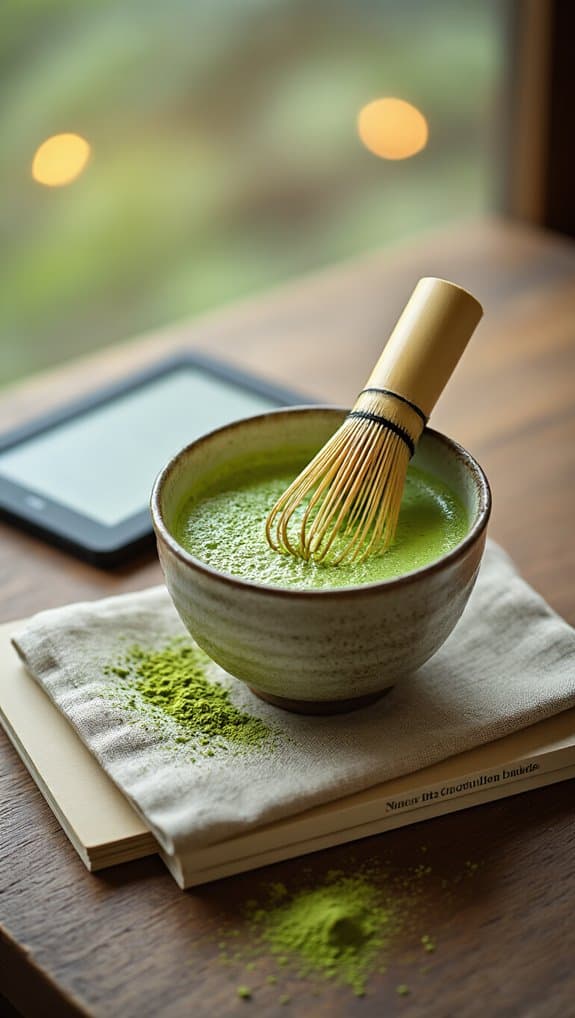
You’ll learn what matcha is—finely ground green tea whose powder smells of spring and tastes intensely vegetal.
You’ll learn to judge quality by bright emerald color, a silky texture that dusts like smoke, and clear single-origin labeling.
You’ll practice preparing traditional matcha—sifting, whisking with a bamboo chasen into a creamy froth, and savoring each warm, umami-rich sip.
What Is Matcha?
Powdered green tea, matcha’s vibrant jade powder dissolves into a frothy, umami-rich drink with grassy, sweet, and slightly bitter notes that hit your tongue all at once.
You’ll learn it’s stone-ground, shaded before harvest, and whisked to suspend whole-leaf powder—so you ingest the leaf and its concentrated health benefits.
You can sense vegetal aroma, silky texture, and lingering sweetness that lingers like green light.
Matcha varieties range from ceremonial to culinary, each suited to ritual or recipes, and you’ll appreciate their intensity and aroma.
- Ceremony: delicate, creamy, grassy.
- Culinary: bold, bitter, bakes well.
- Blends: flavored, approachable, versatile.
- Organic: pure, focused on origin and processing.
You’ll find reading about preparation heightens appreciation and encourages mindful sipping, connecting you to centuries of tea craft and history.
Choosing Quality Matcha
Having savored matcha’s jade sheen and silky mouthfeel, you’ll want to pick a tin that actually delivers those cues.
Look for vibrant green, fine texture, and a sweet vegetal aroma; they signal younger leaves and careful shading.
Understand matcha grades: ceremonial yields grassy-sweet, umami-rich cups for sipping, while culinary suits blends for lattes and baking.
Read origin notes and harvest dates—freshness preserves delicate amino acids and color.
Smell before you open: stale hay or bitterness means lower quality.
Trust vendors who list stone-milled production and single-harvest sourcing.
Matcha’s flavor profiles range from brisk and astringent to creamy and umami; choose based on how you like intensity and sweetness.
Store it cold, dark, and sealed to protect that vivid green and nuanced taste and aroma.
Preparing Traditional Matcha
Start with three essentials: a fine sifter, a bamboo scoop (chashaku), and a fresh-bent whisk (chasen), and you’ll already be halfway to a proper bowl.
Sift one to two scoops, pour 70–80°C water, then whisk briskly until the froth rises. You’ll taste emerald aroma, feel silk texture; matcha utensils make ritual tactile.
Practice whisking techniques—short, rapid M motions—to lift foam without bitterness. Keep chasen clean and air-dry on a holder.
As you whisk, listen to bamboo whisper, watch tiny bubbles gather, and inhale vegetal sweetness; each movement refines mouthfeel, revealing delicate umami layers and green tea’s memory; savor slowly and pause.
- Sift powder
- Measure with chashaku
- Add hot water
- Whisk in M motions
Advanced Techniques: Whisking, Sifting, and Ceremony
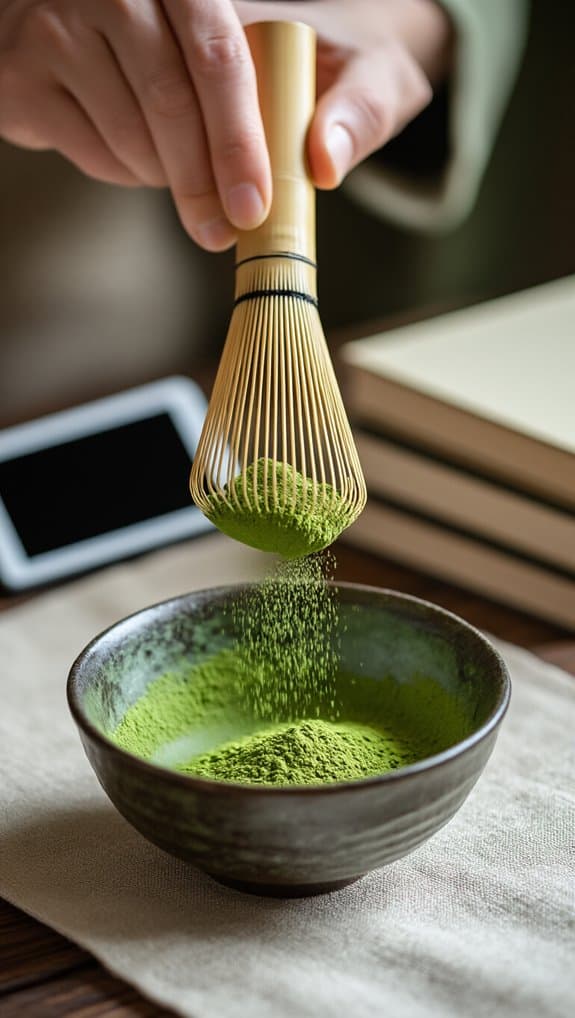
Three precise gestures—sifting, whisking, and the slow choreography of ceremony—turn the bright green dust into a fragrant, velvety bowl you can feel on your tongue.
You begin by measuring with intent, then employ sifting methods to aerate matcha and prevent lumps; the powder becomes light as cloud beneath your sieve. You adjust water temperature and rhythm, using classic whisking techniques—fast, controlled W-shaped strokes—to coax a fine, silvery foam and release aroma.
In a ceremony, you move deliberately: the placement of the bowl, the angle of the whisk, the breath you take before the first sip. Each motion is matcha artistry, melding utility with beauty.
Books that teach these gestures guide your hands and sharpen perception, offering diagrams, cadence cues, and historical context. Practice will make your motions fluid; soon you’ll serve not just a drink but a moment, where texture, scent, and silence align and invite mindful conversation gracefully afterward.
Tea and Health: Scientific Perspectives and Benefits
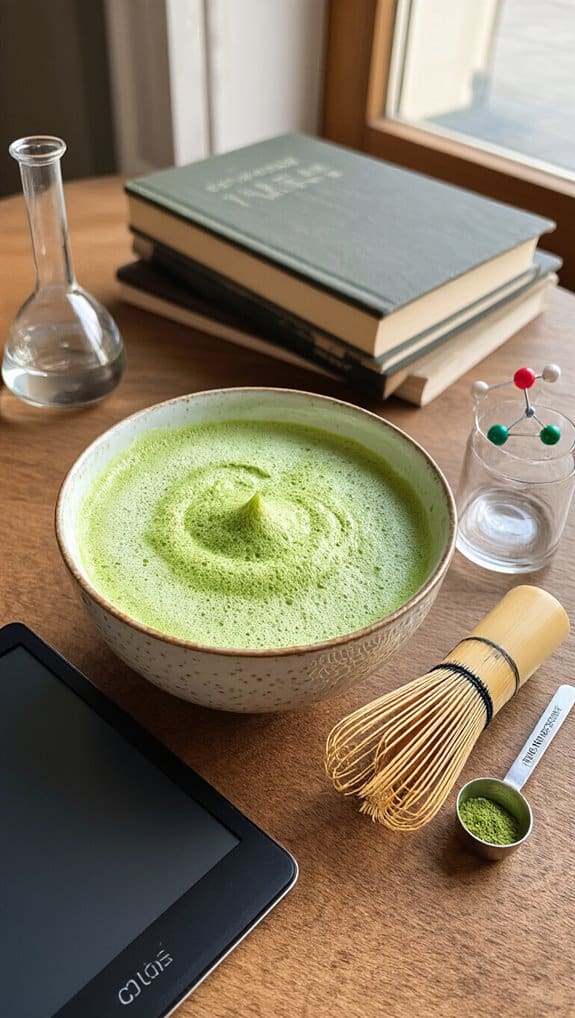
While you sip the warm, slightly astringent green of matcha or the toasty comfort of a black tea, science maps how those flavors translate into biology: concentrated catechins (notably EGCG), L-theanine, and modest caffeine interact to calm your mind, sharpen attention, and nudge metabolism, while polyphenols and flavonoids modulate inflammation and support vascular function.
You can feel the sweet vegetal aroma settle as studies connect ritual with measurable effects: scientific studies link tea to improved alertness, reduced oxidative stress, and modest cardiometabolic gains.
Readings on bioavailability explain why whisked matcha delivers a vivid, immediate hit of health benefits. Let research guide, not dictate, your cup.
- Wakeful calm: L-theanine plus caffeine sharpens focus without jitter.
- Antioxidant armor: EGCG and polyphenols reduce oxidative markers.
- Heartwise sip: flavonoids support endothelial health in trials.
- Metabolic nudge: modest increases in fat oxidation and glucose control in studies.
You taste data in every sip.
Memoirs From Tea Masters and Travellers

You can taste the quiet authority in a tea master’s memoir, where steamed leaves and precise whisk strokes become a lifetime of craft.
As you follow journeys through tea, mountain mists, roadside stalls, and the scent of fresh-picked sencha map out histories and friendships.
These travel reflections make you feel the soil, the ritual, and the conversations that turn a cup into a story.
Tea Master’s Memoirs
Steam from a small bowl brings the scent of misty hills and the faint smoke of a kiln, and these memoirs let masters unspool the tactile memory of tea: plucked leaves, callused fingers, and decisions made over kettles at dawn.
You read their rooms of ritual, their tea philosophy traced in steam, and you feel the weight of a ladle between practiced palms. They record failures, ceremonies, and the slow refinement of attention, offering precise mindfulness practices you can adopt.
Read to taste technique, posture, and silence.
- Notes on seasonal whisking and bowl etiquette
- Kitchen experiments that teach extraction
- Aphorisms about simplicity and craft
- Exercises to deepen attention
You’ll carry these lessons into each quiet cup, practicing presence with every measured pour and breath.
Journeys Through Tea
When you follow a master along mountain tracks and into low-lit teahouses, the terrain of tea reveals itself in scent and sound—damp leaf, chalky clay, the soft clack of porcelain—so each cup becomes a map of place and practice. You trace stories where tea traditions translate into gestures: a whisk’s rhythm, a hand-fanned aroma, a narrow pot shared. Memoirs from masters and travellers ground the sensory—shade, smoke, silence—while explaining technique and history, showing how global practices bend to soil and season. Read to feel texture and technique; you’ll learn to listen to steam, distinguish terroir, and respect lineage without romanticizing it.
| Region | Flavor | Ritual |
|---|---|---|
| Japan | umami & steamed | chanoyu |
| China | floral & roasted | gongfu |
| India | brisk & spiced | chai |
These pages sharpen the palate and practice daily.
Tea Travel Reflections
Though routes and languages change, these memoirs guide you by taste and terrain: damp Yunnan mornings, the metallic clink of a samovar, the powder-sweet lift from a Japanese bowl.
You follow bruised mountains and river routes, learning rituals from elders and novice hosts, tasting soil in a puerh and history in a pot.
These tea-inspired adventures pair travelogue with precise observation; cultural tea exchanges reveal craft, commerce, and consolation.
You’ll feel steam on your wrist, smell smoke and jasmine, and remember that a cup maps a place.
Read these memoirs to move through landscapes and lineages, to trace hands that pick, process, and pour.
- Garden lessons in picking craft.
- Samovar nights reveal old routes.
- Market mornings of scent bargaining.
- Simple ceremonies hold shared memory.
Tea in Fiction: Stories Best Paired With a Cup
As you lift a warm cup to your lips, notice how the first sip alters the rhythm of the page—slower breaths, sharpened focus, the tannic heat cutting through quiet sentences—because certain stories were written to be read with tea in hand. You choose books where character tea drinking becomes scene and symbol: porcelain clinks, steam veils, confessions spilled between cups. These tea-themed novels teach you to slow down, to savor language the way you steep leaves. Let a small table mark pace:
| Mood | Setting | Reading Moment |
|---|---|---|
| Quiet | Kitchen nook | Morning page-turning |
| Nostalgic | Railway carriage | Late-night chapter |
| Cozy | Garden bench | Rain and memoir |
You move through pages like a kettle humming, noticing aroma in description, texture in dialogue, and how tea shapes plot without stealing center stage. You linger over metaphors as if they were leaves, noting warmth, bitterness, and solace in phrasing that pairs naturally with your cup.
Flavor Explorations: Blends, Pairings, and Recipes
You can experiment with creative matcha blends—smoked hojicha with bright ceremonial matcha or citrus zest whisked into creamy milk for a sparkling aroma.
Pairings that pop include almond financiers, yuzu tart, and bittersweet chocolate to play off the tea’s umami and sweetness.
Try a simple matcha latte with coconut milk and a pinch of cardamom, then sip it alongside buttery shortbread to highlight the vegetal finish.
Creative Matcha Blends
When you imagine matcha beyond a simple whisk and bowl, its verdant powder opens up a world of bright, vegetal energy that pairs beautifully with citrus, floral, and savory notes; try blending it with yuzu for a zesty lift, rose or lavender for a perfumed latte, or toasted sesame for a nutty, umami-rich twist.
You’ll explore creative infusions and matcha cocktails that layer citrus, floral, and toasty umami. Stir cold yuzu and honey over ice, or froth milk with lavender for a scented latte. Use toasted sesame oil sparingly to deepen umami.
Focus on texture: crushed ice, silky foam, glossy syrup.
- Yuzu honey sparkling matcha
- Lavender vanilla matcha latte
- Toasted sesame matcha cream
- Matcha cocktail
You’ll taste contrasts sharpening matcha.
Food Pairing Ideas
Matcha’s grassy, slightly astringent edge begs for contrasts that brighten and balance its sweetness—citrus for lift, floral for perfume, toasted nuts and miso for savory depth.
You’ll play with contrasts: a lemon financier to sharpen grassy notes, yuzu curd to illuminate green clarity, or a honeyed panna cotta to echo umami.
For savory matches, think sesame-crusted tuna, miso-glazed eggplant, or a soft cheese board with shiso and pickled ginger; their fat and salt deepen matcha’s texture.
Try baking matcha into shortbread to bridge dessert pairings and tea, or whisk matcha into a vinaigrette for roasted beets to reveal earthy echoes.
Taste deliberately, note balance, and let contrast guide each complementary bite.
Rotate textures and temperatures to keep your palate curious and engaged in daily rituals.
Visual Companions: Photography and Art Books on Tea
Light spills across matte pages and glossy spreads, turning steam, porcelain, and leaves into images that smell almost real. You turn pages that frame rituals and glaze, where tea photography captures steam’s motion and the tiny veins on a tea leaf with near-scientific clarity.
Artistic representations here aren’t just pretty; they teach you to see texture, color temperature, and gesture. These books pair close-up studies with essays that guide your eye—composition, light, negative space—so your own cups look composed, intentional. They make tasting a visual act.
You learn how lens choice shapes mood, how paper finish alters perceived warmth, and how sequencing images constructs a narrative in a silent, tactile album that invites repeated, slow looking.
- Studio series showcasing macro shots of leaves and teaware.
- Photo-essays exploring ceremony through light and shadow.
- Illustrated guides blending sketches with technical notes.
- Coffee-table books that double as contemplative objects.
every sip.
Cultural Crossings: Tea’s Global Journey and Influence
You’ve learned to read tea by sight; now follow its scent and sound across oceans and streets, where leaves narrate histories of trade, migration, and adaptation.
You can taste salt breezes of port cities, hear clinking cups in caravanserais, and feel the hush of temples where rituals slowed time; each cup maps pathways of cultural exchange, colonial markets, and diasporic kitchens.
Books that trace tea’s migrations show how a Chinese leaf became British ceremony, South Asian chai, and East African rust-tea, yet they also reveal everyday creativity: recipes reinvented, ceremonies hybridized, vocabularies borrowed.
You’ll learn how global traditions evolve without losing local roots, how labor, commerce, and intimacy intertwine in porcelain and clay.
Read authors who ground history in texture—scalding steam, powdered brightness, bitter aftertaste—and who explain contexts with humane insight.
These accounts don’t romanticize; they give you tools to sip critically and savor tea’s layered story.
Small-Press Gems and Independent Tea Writers
When you open a small-press pamphlet or a self-published essay on tea, you feel the paper’s tooth, smell fresh ink, and encounter a voice that didn’t have to fit a market brief.
You hold intimate histories, tasting notes, and rituals from independent authors who write with tactile precision. Their small press publications distill terroir into sentences, map steam onto memory, and teach you to listen to a leaf.
You’ll discover experimental blends, local harvest narratives, and instruction that respects slowness. These works ask you to cup tea with curiosity, to trace aroma like a compass.
- Micro-essays that read like a single perfect steep
- Field reports from obscure gardens and artisan producers
- Memoirs weaving family ritual with brewing technique
- Practical guides that are also lyrical, precise, and spare
Support these creators: buy direct, share reviews, and let their quiet expertise reshape your cup.
Savor each page like a tea.
Frequently Asked Questions
Are Audiobook Versions Available for These Matcha Books on Kindle?
Yes, you’ll find audiobook availability varies by title; some have full narrated editions while others don’t.
You’ll hear warm, leafy descriptions in tea-themed audiobooks that unfurl like steam, with skilled narrators coaxing aroma and history into your ears.
Always check each Kindle listing or Audible for format options and sample clips.
If voice, pacing, and sensory detail matter to you, prioritize editions noted for rich narration and immersive production.
Do Kindle Editions Include High-Quality Color Photos for Photography Books?
Yes — Kindle editions can include high-quality color photos, but you’re limited by screen size, resolution, and device color gamut, so expect variable color photo quality.
You’ll still see vivid hues and fine detail on higher-end tablets, yet photography book limitations like contrast, print texture, and large-format layout can’t be fully replicated.
Hold the device, swipe images, and appreciate the images, knowing digital warmth differs from printed paper and depth.
Can I Sample Kindle Matcha Books Before Purchasing?
Yes, you can sample Kindle matcha books before buying; use sample options and preview features to taste pages, smell imagined steam, and feel texture through vivid descriptions.
Flip through recipes, rituals, and photography previews to judge color and composition. You’ll rely on preview features to sense tone, pacing, and visuals before committing.
Those sample options let you sip the book’s essence and decide if it matches your craving right now.
Will Kindle Format Support Complex Recipes and Special Layouts Properly?
Yes, Kindle can handle many complex recipes, though you’ll face recipe formatting and layout challenges; you’ll notice line breaks, ingredient lists and photos restructure across devices.
You’ll want to simplify columns, use numbered steps, and embed high‑res images sparingly so aromas and textures read clearly.
Test on Kindle Previewer and sample devices; adjusting margins, fonts, and image placement keeps your tea rituals vivid and usable for readers every sensory step.
Do These Kindle Books Allow Lending or Have DRM Restrictions?
Yes—you can often lend Kindle books, but it depends on each publisher’s lending policies and DRM limitations; some titles allow lending for a set period while others block sharing.
You’ll smell paperless pages and taste taught instructions as you browse options, and you’ll feel the tug between convenience and control.
Check each product page for borrowing rules, loan duration, and whether a title’s DRM prevents transfer or limits reading devices.
Conclusion
You’ll carry these books like warm bowls, their pages exhaling powdered sweetness and steamed steam, guiding your fingers to whisk, sift, and bow. You’ll taste histories, feel bamboo whisks whisper, and learn health notes that hum beneath every cup. Memoirs will scent your memory; recipes will stain your apron. Whether you’re beginning or deepening a ceremony, these readings steep curiosity into ritual—turning ordinary afternoons into layered, luminous ceremonies you can touch, taste, and share, and remember.


No Comments