
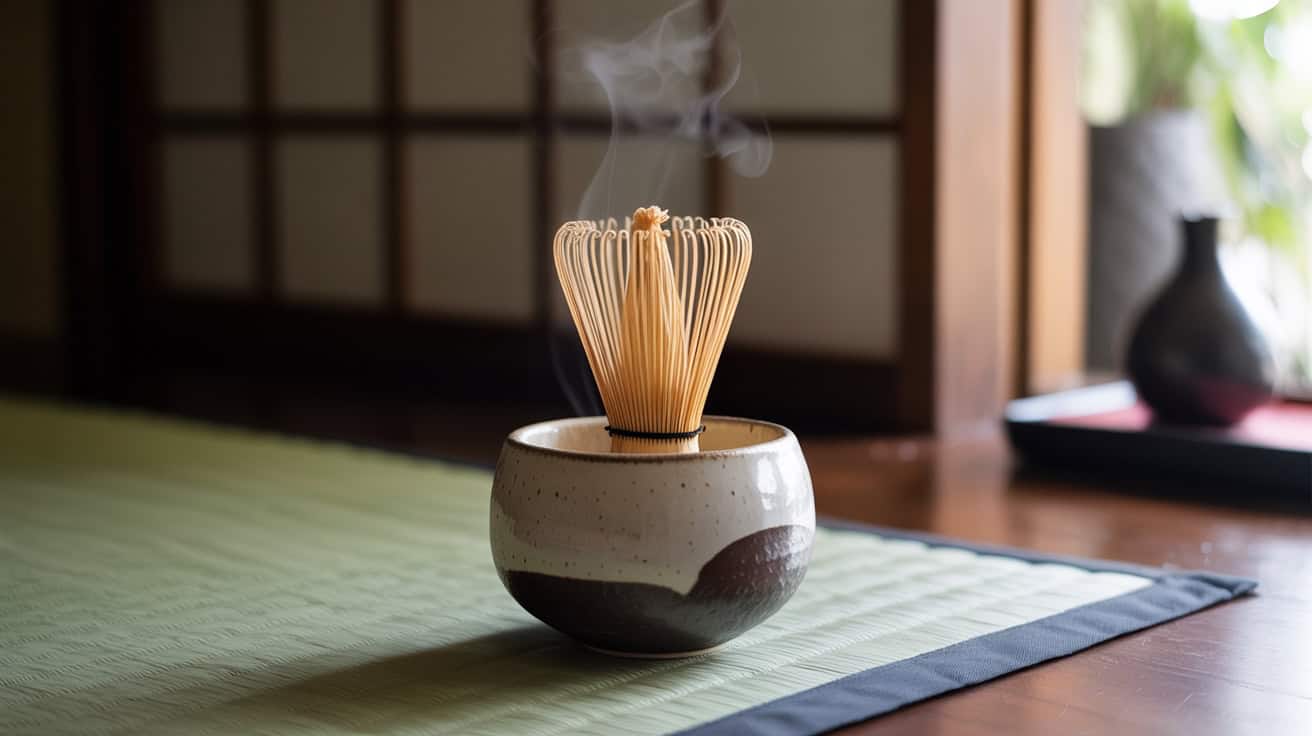
You’ll protect your chasen’s fine bamboo curve, fresh grassy scent, and lively spring by cradling it on a kusenaoshi after each rinse. The rounded crown lets air circulate so tines dry evenly, preventing mildew, warping, and splits while preserving tactile bounce and frothy performance. Wooden, ceramic, or bamboo holders add warmth and ritual to your tea corner, encouraging careful handling and a quiet, wabi‑sabi moment. Keep going to discover care tips and choosing guidance soon.
Table of Contents
Key Takeaways
- Preserves chasen shape by supporting tines, preventing warping and splitting of bamboo for longer whisk life.
- Promotes even air circulation after rinsing, reducing mildew and moisture damage.
- Encourages mindful ritual and organization, making matcha preparation smoother and more intentional.
- Enhances whisk performance and froth consistency by maintaining tine alignment and springiness.
- Serves as an elegant display piece, adding wabi-sabi aesthetics and sensory calm to the tea setup.
What Is a Kusenaoshi (Matcha Whisk Holder)?
A kusenaoshi is a delicate wooden stand that reshapes and preserves your chasen—the bamboo whisk used for matcha—so its fine tines dry evenly and keep their graceful curve; when you lift one, you’ll notice the warm scent of bamboo, a subtle smoothness under your fingers, and the whisk’s tips fan out like a chrysanthemum cradle, ready to create a velvety froth.
You handle it with intention: resting the damp whisk on the stand after rinsing keeps the silhouette, and you feel the grain against your palm as you settle the tines.
In Japan, the history of kusenaoshi traces artisan practices tied to tea ceremony aesthetics, where tools are revered and maintained. Observing how the stand supports each filament, you understand tradition informing function.
During matcha preparation, you move deliberately—measuring, sifting, whisking—and the kusenaoshi quietly returns the chasen to its form, linking your ritual to generations that treated utensils as extensions of practice.
Benefits of Using a Whisk Holder for Your Chasen
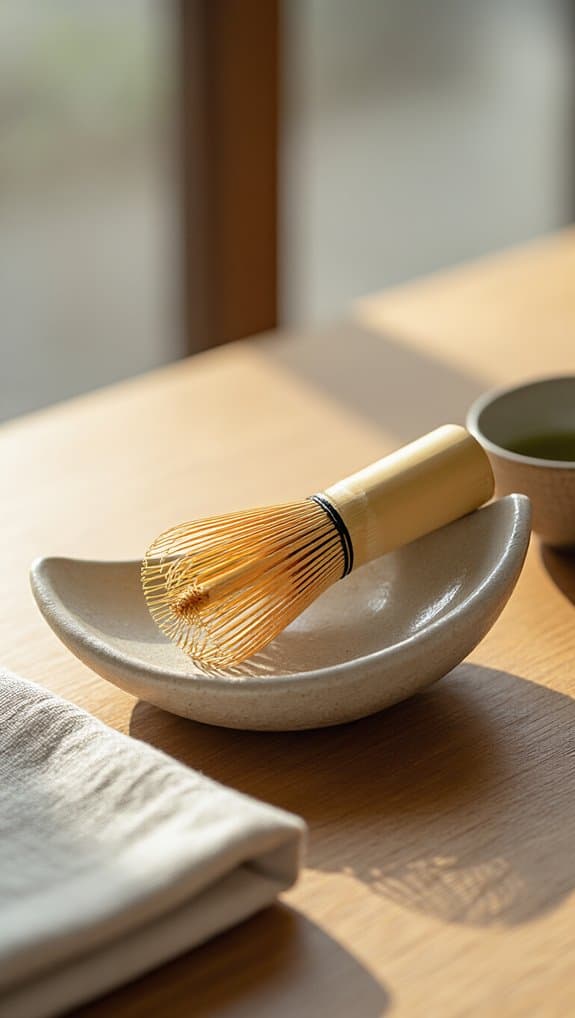
Having felt the kusenaoshi cradle the chasen’s tines, you’ll notice how a dedicated whisk holder amplifies those benefits: it lets air circulate around damp bamboo so the tips dry evenly, prevents mildewing and warping, and keeps each filament poised to create a velvety froth.
You’ll admire the subtle scent of bamboo as it exhales moisture, the cool curve supporting the handle like a hand at rest. When you return your chasen between sessions, the holder organizes it upright, reminding you of disciplined tea rituals and encouraging consistent whisk techniques.
Visually, the rounded silhouette frames the delicate prongs, inspecting for stray breaks or uneven tines effortlessly. Tactilely, you’ll note how removing and replacing the whisk becomes a ritualized motion, grounding your practice.
Culturally, using a kusenaoshi honors artisanship and the ceremony’s quiet care; practically, it streamlines preparation and preserves the chasen’s ready state for precise, repeatable frothing daily.
How a Whisk Holder Extends Your Chasen’s Lifespan
You can hear steam settle as you set your chasen on its holder, feeling the cool curve beneath the tines.
You let the holder cradle the whisk so air circulates evenly, preventing the bamboo from warping.
You encourage gentle drying instead of letting it sit damp, keeping the fibers resilient and honoring the ritual care of Japanese tea tradition.
Prevents Bamboo Warping
One simple accessory—the curved kusenaoshi—keeps the chasen’s fine bamboo tines from curling and splitting, so you’ll notice the whisk stays springy and true to its original shape. You feel the smooth grain against your fingertips as you press the chasen into the holder; the gentle arc supports the crown, preventing uneven stress that leads to warping. This attentive bamboo maintenance preserves form and aroma, and it directly contributes to whisk longevity. In tea rooms where respect for tools is ritual, the holder becomes part of care—quiet, unobtrusive, essential. Small visual cues—aligned tines, balanced silhouette, absence of kinks—tell you the tool will perform. Handle gently for sustained frothy performance.
| Cue | Effect | Action |
|---|---|---|
| Aligned tines | Even whisking | Keep on kusenaoshi |
| No splits | Longer use | Inspect regularly |
Promotes Proper Drying
Pressing the chasen into the kusenaoshi and setting it upright lets air circulate through the tines, so moisture wicks away instead of pooling at the crown.
You’ll notice the faint scent of steamed bamboo as residual dampness evaporates, and the thin prongs relax into their measured curve. Proper airflow prevents the softening and fraying that comes from trapped humidity, and you actively practice moisture control without chemical cleaners.
In tea rituals, this quiet care honors the chasen’s craftsmanship and the seasons that shaped its bamboo. Place the holder in a location where cool room air circulates gently; avoid direct sunlight.
Common Materials and Styles of Whisk Holders
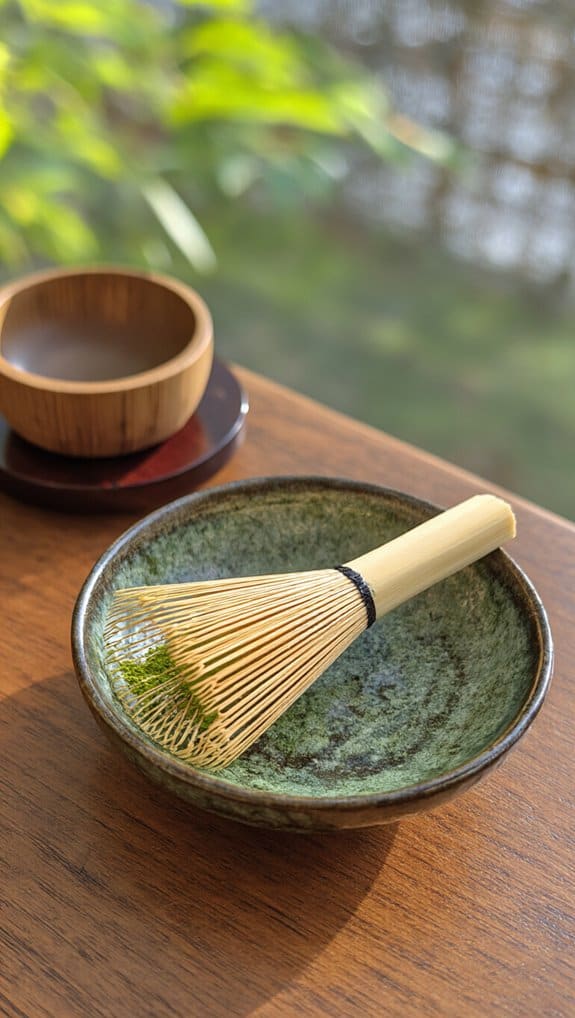
A chasen-oki (whisk stand) can feel like a small sculpture on your counter—smooth ceramic cool to the touch, warm lacquered wood with a faint scent of oil, or matte bamboo with fine grain and slight springiness under your fingers.
You’ll notice how glazed ceramics catch light, their glazed rim sometimes echoing the kiln’s heat; they’re sturdy, easy to clean, and anchor traditional tea corners.
Lacquered wood offers a whisper of human craft—layers of urushi sheen, slightly fragrant, resisting moisture while aging beautifully.
Bamboo, light and resilient, breathes with your kitchen’s humidity and honors Chasen’s origins.
For a clear materials comparison, weigh tactile warmth, porosity, and maintenance.
Contemporary makers blend minimalism and wabi-sabi, so you’ll see style trends from rustic hand-thrown pieces to sleek, modern silhouettes.
Choose what resonates: a holder that complements your ritual, respects cultural roots, and invites touch each morning.
Let it become part of your practice daily.
Choosing the Right Size and Shape for Your Whisk
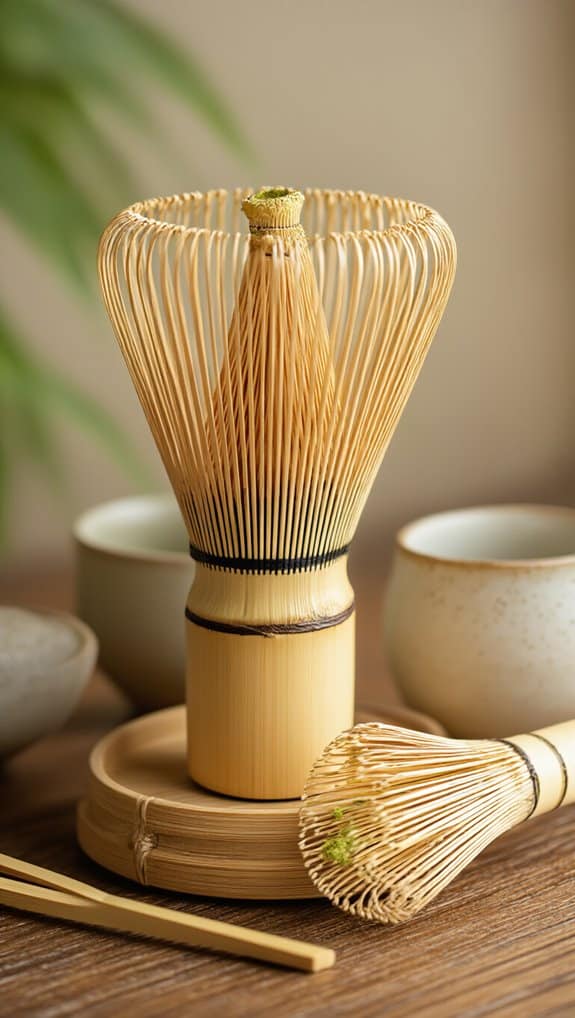
How will the whisk fit into your ritual and bowl? You’ll feel the bamboo’s warmth and hear a soft rasp as tines kiss porcelain; those sensations guide choice.
Consider whisk dimensions: length, tine density, curvature, and crown width—each alters foam, wrist motion, and the matcha’s scent release. Match whisk shapes to vessel size and ceremony style; slender chasen suit narrow bowls, wider crowns bloom in ochawan.
- Measure bowl diameter and choose a compatible handle length.
- Note tine count: more tines = silkier foam, fewer = brisk froth.
- Match curvature to your wrist angle for effortless rhythm.
- Respect tradition: regional shapes reflect tea culture and preparation.
You’ll choose with eyes, touch, and sound, selecting a chasen that balances proportion and purpose. The right size and shape make preparing matcha feel inevitable, intimate, and exquisitely controlled.
It honors lineage and your daily calm with mindful strokes always.
How to Use a Kusenaoshi Properly
After rinsing your chasen, slip it gently onto the kusenaoshi so the tines spread over the rounded crown and the handle points downward; you’ll feel the bamboo settle and hear a faint rasp as each tine finds its groove.
Hold the holder upright on a tatami or lacquered tray, tilt slightly to check symmetry, and appreciate the quiet geometry—fine tines fanning like a chrysanthemum.
You’ll notice kusenaoshi benefits immediately: restored shape, eased drying tension, and prolonged whisk life that honors tea ceremony traditions.
In proper usage, position the crown to support the curve, avoid forcing tines apart, and keep movements deliberate and respectful.
Let your touch be light, your gaze attentive; the ritual of placement connects you to centuries of tea craft.
When stored, allow the kusenaoshi to breathe in a cool, shaded alcove, preserving aroma and bamboo resilience without aggressive handling, and quiet domestic reverence, always gently.
Caring for and Cleaning Your Whisk Holder
When you care for the kusenaoshi, treat its bamboo like a living tool—gentle, deliberate motions preserve its grain and joinery. You’ll notice the warm, faintly sweet scent of bamboo after light rinsing; that aroma signals health.
For whisk maintenance, avoid soaking or harsh detergents; you’ll instead use quick, careful cleaning techniques to remove matcha dust and moisture. After use, pat the holder dry with a soft cloth, then air it upright in a shaded spot to prevent warping. Inspect joints and bristles for residue and mildew.
Follow these concise steps:
- Rinse briefly with lukewarm water; avoid soap.
- Wipe with a soft, lint-free cloth along the grain.
- Air dry away from direct sun, upright.
- Occasionally, refresh with a barely damp cloth and let fully dry.
Respecting tradition, you’ll prolong the kusenaoshi’s life and preserve its tactile warmth. Handle it as craftsmen do, with mindful hands.
Aesthetic Ways to Display Your Whisk Holder in a Tea Corner
You can highlight the bamboo whisk holder with soft, warm light—paper lanterns or low LED strips—to bring out its grain and cast gentle shadows that recall a Japanese tearoom’s calm.
Place it on a shallow wooden tray alongside a small ceramic bowl and a silk cloth, arranging heights to create a quiet asymmetry that nods to wabi-sabi.
Mix open shelving with a single tucked drawer so your tea corner feels curated, tactile, and ready for ritual.
Lighting and Ambiance
Although tea ceremony traditions favor soft, indirect light, you can shape a tea corner’s mood with a warm, directional glow that highlights the whisk holder’s curve and the fine prongs of the chasen.
Use subtle lighting techniques and focus on ambiance creation: choose a single warm bulb, position it to cast gentle shadows, and let steam and aroma catch the light. You’ll notice texture, lacquer sheen, and bamboo grain sing.
Try these simple approaches to display:
- Spot LED with dimmer for adjustable warmth.
- Upward wash to silhouette the chasen.
- Candle cluster for flicker and scent.
- Paper lantern for diffused, traditional radiance.
You’ll handle contrasts thoughtfully, honoring wabi-sabi balance and sensory calm.
Let light guide presence, not overpower quiet ritual, gently.
Shelf and Tray Arrangements
Let the warm glow you’ve chosen guide how you place the whisk holder on a shelf or tray: set it where light will kiss the bamboo prongs and reveal the subtle grain and lacquer sheen.
Position it near a small ceramic teacup to enhance shelf aesthetics; the contrast of matte porcelain and glossy wood invites touch. You’ll want negative space; avoid clutter that masks the whisk’s silhouette.
Consider height variation with books or a folded furoshiki to anchor the composition and honor Japanese sensibility.
On a tray, keep tray organization minimal—tea scoop, cloth, small bowl—arranged with purpose. Choose natural materials and muted tones to enhance aroma cues and calm the eye.
When you arrange, test perspectives: sit, stand, and serve; functionality and beauty coexist in mindful rhythm.
Traditional Versus Modern Designs: Which to Choose
How do you choose between the warm grain and faint lacquer scent of a hand-carved bamboo or wooden chasen holder and the cool, glassy weight of a modern ceramic or metal stand? You’ll weigh traditional aesthetics against modern functionality, and your senses will guide you.
A wooden holder absorbs steam and softens with use; its tactile ridges and amber patina recall tearoom rituals. A ceramic or steel stand gleams, resists staining, and centers a minimalist setup.
Consider use, care, and atmosphere:
- Texture: bamboo warmth vs. smooth glaze.
- Sound: muted clack of wood vs. crisp metal ring.
- Maintenance: oiling and gentle drying vs. quick wipes.
- Visual: handcrafted imperfection vs. engineered symmetry.
Trust cultural cues—wabi-sabi’s embrace of imperfection or contemporary clean lines—to match your practice.
Choose what complements your ritual, space, and the way you touch, see, and hear tea-making. Let sensory preference shape your choice.
Where to Buy Authentic and High-Quality Whisk Holders
Where will you find a whisk holder that smells faintly of bamboo and fits your ritual as naturally as a chasen in your hand? Seek specialist tea vendors in Kyoto-inspired neighborhoods or reputable online marketplaces that list provenance, materials, and maker photos.
You’ll feel the curve of lacquer, the grain of wood, and the cool ceramic glaze in product images and customer reviews. Prioritize pieces described with workshop details and kiln notes.
Visit artisan shops when you can: you’ll hear the steady hum of tools, see hands stained with lacquer, and often get a short history of technique.
If buying remotely, ask sellers for close-up shots of joints and base, and check return policies.
Respect cultural context—look for craftsmen who honor Japanese tea aesthetics rather than mass-produced replicas.
Whether you choose a handmade yokode or a sleek modern stand, verify authenticity, materials, and the story behind the piece so it complements your ritual.
Frequently Asked Questions
Can I Use a Whisk Holder for Non-Matcha Kitchen Utensils?
Yes, you can repurpose a whisk holder for non-matcha utensils; you’ll enjoy whisk holder benefits like airy drying, gentle cradling, and tidy storage.
You’ll feel the smooth bamboo or ceramic under your fingers, smell warm wood or clean glaze, and see neat kitchen organization that honors diverse culinary traditions.
Use it for spatulas, wooden spoons, or delicate pasta forks, and let textures and aromas guide your mindful cooking rituals daily.
Are Kusenaoshi Safe Around Pets or Children?
Yes, you can use kusenaoshi around pets and children if you supervise, as they’re generally stable and smooth, but you should avoid placing them low.
Your hands will feel warm bamboo grain and cool lacquer while soft brush hairs glint; for pet safety and child safety, keep them out of reach to prevent curious mouths or tipping.
Respecting Japanese craft, store them upright and monitor small parts for added safety.
How Do I Repair a Damaged Bamboo Whisk Holder?
You’ll repair a damaged bamboo whisk holder by gently gluing split pieces with food-safe wood glue, carefully clamping until set.
Slowly sanding with fine grit for a smooth, warm finish, then oiling with light camellia or mineral oil.
For hairline cracks, use clear lacquer or Japanese urushi touch-up sparingly.
These whisk maintenance tips and bamboo repair techniques preserve aroma, tactile grain, and respect traditional craft—let the holder dry before use.
Can I Commission or Customize a Handcrafted Kusenaoshi?
Yes, you can commission a handcrafted kusenaoshi; you’ll work with an artisan to choose custom designs and unique materials that honor Japanese craft traditions.
You’ll feel smooth wood grain, see delicate lacquer or natural fiber textures, and smell warm timber and rice glue.
You’ll discuss dimensions, finish, and symbolic motifs, and you’ll receive a piece that’s both functional and culturally resonant, made to cradle your chasen with reverence and longevity.
Is Using a Whisk Holder Acceptable in Professional Tea Ceremonies?
Yes, you can use a whisk holder in professional tea ceremonies when it aligns with professional etiquette and local whisk holder traditions.
You’ll sense the cool wood cradle the damp bamboo, hear the soft clack as you place the chasen, and see respectful placement on the alcove.
You’ll follow the host’s cues, honoring rituals and seasonal aesthetics, letting the holder support both tool care and graceful, culturally aware presentation practices.
Conclusion
You’ll feel the delicate curve of the kusenaoshi cradle your warm, bamboo chasen, its smooth lacquer or porous ceramic cool beneath your fingertips. Using it, you’ll preserve each hair’s spring and the whisk’s vegetal aroma, honoring centuries of Japanese tea craft. Place it beside your tea bowl where steam and light catch the grain; you’ll protect beauty and function, and keep ritual alive in a way both practical and reverent, and quietly shared across generations.


No Comments