
How Many Calories Does 10000 Steps Burn?
You’ll burn between 300 and 550 calories walking 10,000 steps, depending on your weight and walking conditions. If you weigh 120 pounds, you’ll burn about 300-350 calories, while at 200 pounds you’ll burn 500-550 calories. Your walking speed makes a big difference too – power-walking at 4 mph burns 20-30% more than strolling at 2 mph. Hills, stairs, and uneven terrain can boost your burn by 50% or more compared to flat surfaces.
Table of Contents
Key Takeaways
- A 150-pound person burns approximately 375-425 calories walking 10,000 steps at a moderate pace on flat ground.
- Body weight is the primary factor: heavier individuals burn more calories per step than lighter people.
- Walking speed significantly impacts burn rate: 4 mph burns 20-30% more calories than 2 mph for the same distance.
- Terrain dramatically affects calorie expenditure: hills increase burn by 50%, while sand requires 2.5× more energy than pavement.
- Calculate your personal burn using: 0.04 calories × your weight in pounds × 10,000 steps.
The Basic Science Behind Calorie Burn During Walking

When you take a step forward, your body transforms stored energy into movement through a complex metabolic process. Your muscles contract using ATP, which they produce by burning calories from carbohydrates and fats. The harder you work, the more calories you’ll burn.
Your walking economy determines how efficiently you use energy while walking. It’s influenced by factors like your stride length, cadence, and biomechanics. People with better walking economy burn fewer calories covering the same distance because they’ve developed more efficient movement patterns.
Over time, your body undergoes metabolic adaptations that affect calorie burn. Regular walkers often develop improved mitochondrial function and enhanced fat oxidation, making their bodies more efficient at using energy. While this efficiency benefits your cardiovascular health, it means you’ll burn slightly fewer calories for the same 10,000 steps compared to when you first started walking regularly.
Your weight, walking speed, and terrain also significantly impact total calorie expenditure.
Key Factors That Influence Your 10,000-Step Calorie Burn
Understanding the science of calorie burn helps, but you’ll need to consider several personal variables to estimate your actual 10,000-step calorie expenditure.
Your body weight plays the biggest role—if you weigh 180 pounds, you’ll burn about 100 more calories than someone weighing 120 pounds covering the same distance.
Walking speed significantly impacts your burn rate. You’ll torch 20-30% more calories power-walking at 4 mph versus strolling at 2 mph.
Terrain matters too; hiking uphill or walking on sand can double your calorie expenditure compared to flat pavement.
Your footwear choice affects efficiency—heavier boots require more energy than lightweight sneakers.
Age and fitness level influence your metabolic rate, while meal timing can boost your burn through the thermic effect of food.
Walking within two hours after eating increases calorie expenditure by 10-15%.
Even weather conditions matter; you’ll burn extra calories maintaining body temperature in cold or hot environments.
Average Calorie Burn Estimates Based on Body Weight
While individual factors create variation, you can use these weight-based estimates as a reliable starting point for calculating your 10,000-step calorie burn. If you weigh 120 pounds, you’ll burn approximately 300-350 calories. At 150 pounds, expect 375-425 calories. Those weighing 180 pounds burn 450-500 calories, while 200-pound individuals expend 500-550 calories.
Your body’s metabolic adaptation plays a crucial role in these numbers. As you become more efficient at walking, you’ll burn slightly fewer calories for the same distance. This efficiency develops through regular activity and improved cardiovascular fitness.
Fat oxidation increases during moderate-intensity walking, making your 10,000 steps particularly effective for weight management. You’ll maximize this benefit by maintaining a brisk but comfortable pace.
How Walking Speed and Intensity Affect Energy Expenditure
Pick up your pace from a leisurely 2 mph stroll to a brisk 4 mph walk, and you’ll nearly double your calorie burn per minute. Your walking speed directly impacts how hard your body works to complete those 10,000 steps. When you increase intensity, you’re pushing into higher heart rate zones, forcing your muscles to consume more oxygen and burn additional calories.
Pace variability throughout your walk can maximize energy expenditure. You’ll torch more calories alternating between moderate and vigorous speeds than maintaining one steady pace. Here’s how different speeds affect your burn:
| Walking Speed | Intensity Level | Calories/Minute* |
|---|---|---|
| 2-2.5 mph | Light | 3-4 |
| 3-3.5 mph | Moderate | 4-5 |
| 4+ mph | Vigorous | 6-8 |
*Based on 150-pound person
Adding inclines amplifies this effect. You’ll burn 30-50% more calories walking uphill compared to flat terrain. Monitor your heart rate zones to ensure you’re working at the right intensity for your fitness goals.
Terrain and Incline Impact on Calorie Burning
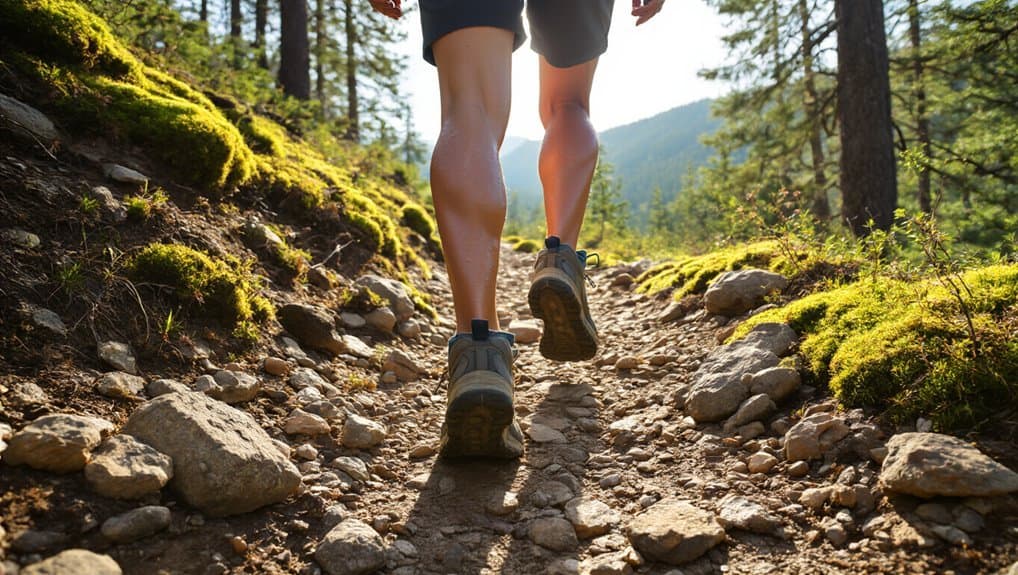
When you switch from walking on flat pavement to tackling hills or uneven surfaces, your body recruits additional muscle fibers and works against gravity, dramatically increasing your calorie burn.
Walking uphill at just a 5% incline can boost your energy expenditure by 50% compared to level ground. At a 10% grade, you’ll burn nearly double the calories.
Uneven surfaces like trails, sand, or grass force your stabilizer muscles to engage constantly, adding 20-30% more calories burned per step. Your ankles, knees, and core work overtime to maintain balance on these challenging terrains.
Using hiking poles on steep inclines distributes the workload to your upper body, increasing total calorie burn by 15-20% while reducing joint stress. They’re particularly effective when descending, where you’d normally burn fewer calories.
Beach walking demands 2.5 times more energy than pavement due to sand’s instability.
These terrain variations transform your 10,000 steps into a significantly more effective calorie-burning workout.
Calculating Your Personal 10,000-Step Calorie Burn
You’ll need to consider three key factors to calculate your personal calorie burn from 10,000 steps.
Your body weight serves as the foundation since heavier individuals burn more calories covering the same distance, while your walking speed determines the intensity and energy expenditure of each step.
The terrain you’re walking on and any inclines you encounter will significantly adjust your final calorie count, as hills and uneven surfaces demand more effort than flat pavement.
Body Weight Impact
While fitness trackers might show the same 10,000-step count for everyone, the calories you’ll burn during that walk depend heavily on your body weight. You’ll burn approximately 0.04 calories per step for every pound you weigh.
If you’re 150 pounds, you’ll torch about 400 calories, while someone weighing 200 pounds burns roughly 540 calories.
Your muscle composition plays a crucial role too. You’ll burn more calories if you’ve got higher muscle mass since muscle tissue requires more energy to move than fat tissue.
Don’t forget about metabolic adaptation either—if you’ve recently lost weight, your body might’ve become more efficient, burning fewer calories for the same activity. That’s why two people at identical weights can still burn different amounts during their 10,000-step journey.
Walking Speed Matters
The pace at which you tackle those 10,000 steps dramatically affects your calorie expenditure. When you increase your walking speed, you’ll burn significantly more calories than strolling at a leisurely pace. Your stride cadence directly influences the intensity of your workout and determines how efficiently you’re torching calories.
Consider these pace variation effects on calorie burn:
- Slow pace (2 mph): You’ll burn approximately 30-40% fewer calories than moderate walking
- Moderate pace (3-4 mph): This sweet spot maximizes calorie burn without excessive fatigue
- Brisk pace (4.5+ mph): You can increase calorie expenditure by 50% or more
You don’t need to maintain the same speed throughout. Mixing slow and fast intervals keeps your body guessing and boosts your metabolic rate. Track your stride cadence to optimize your walking efficiency.
Terrain and Incline
When you’re walking uphill or on uneven surfaces, your body works harder and burns considerably more calories than walking on flat pavement. A 5% incline can increase your calorie burn by 50%, while steeper grades double or triple your energy expenditure. You’ll notice your heart rate climbing and muscles engaging differently as you tackle hills.
Surface variability also affects your calorie burn. Walking on sand, grass, or trails requires more stabilization from your core and leg muscles compared to smooth sidewalks. Adding uphill intervals to your 10,000-step routine maximizes calorie burn without extending workout time. You can incorporate stairs, hiking paths, or treadmill inclines to boost intensity.
Even small elevation changes throughout your walk create significant metabolic differences, making terrain selection a powerful tool for increasing your daily calorie expenditure.
Tools and Methods for Tracking Walking Calories Accurately
You’ll find several reliable options for tracking your walking calories, from high-tech fitness trackers to simple manual calculations.
Popular devices like Fitbit, Apple Watch, and Garmin offer automatic calorie counting based on your personal metrics, while smartphone apps provide free alternatives with varying accuracy levels.
If you prefer the manual approach, you can multiply your body weight by distance walked and a standard MET value to estimate your calorie burn without any technology.
Fitness Trackers Comparison
Fitness-tracking technology has revolutionized how we monitor walking calories, but accuracy varies significantly between devices and methods. You’ll find basic pedometers offer simple step counting, while advanced smartwatches provide comprehensive health metrics.
When selecting a tracker, consider these essential features:
- Battery life determines tracking consistency—choose devices lasting 5-7 days minimum
- GPS accuracy affects distance calculations and calorie estimates for outdoor walks
- Heart rate monitoring improves calorie burn precision during varied walking intensities
Premium trackers like Garmin and Apple Watch excel in GPS accuracy but require frequent charging. Budget-friendly options from Fitbit balance features with extended battery life.
You’ll get the most accurate results by combining wrist-based trackers with chest straps for heart rate data, though this isn’t necessary for casual walkers monitoring basic step goals.
Manual Calculation Methods
Calculate your walking calories without technology using proven formulas that deliver reliable estimates. You’ll need three basic measurements: your weight, walking speed, and duration.
First, determine your step cadence by counting steps for one minute during your typical walking pace. Most adults average 100-120 steps per minute.
Next, apply metabolic equivalents (METs) to estimate energy expenditure. Walking at 3 mph equals 3.5 METs, while 4 mph equals 5 METs. Use this formula: Calories = METs × weight (kg) × time (hours).
For example, if you’re 70kg and walk 10,000 steps in 90 minutes at 3 mph, you’d burn approximately 368 calories.
Track your steps manually using a simple tally counter or smartphone’s basic pedometer function. Record daily totals in a notebook to monitor progress accurately.
Maximizing Calorie Burn During Your Daily 10,000 Steps
Transform your daily 10,000 steps into a more effective calorie-burning workout by making strategic adjustments to your walking routine.
You’ll burn significantly more calories by incorporating these proven techniques that elevate your heart rate and engage more muscle groups.
Here’s how you can maximize your calorie burn:
- Add inclines and stairs – Walking uphill or climbing stairs burns 50% more calories than flat surfaces
- Vary your pace – Alternate between brisk walking and moderate speeds every few minutes
- Carry light weights – Hold 1-2 pound weights or wear a weighted vest for extra resistance
Join step challenges with friends or coworkers to stay motivated and push yourself harder.
You’ll naturally increase your walking intensity when competing against others.
Don’t forget about recovery nutrition after intense walking sessions – protein and complex carbs within 30 minutes help maintain your metabolism and prepare your muscles for tomorrow’s steps.
Frequently Asked Questions
How Long Does It Typically Take to Walk 10,000 Steps?
You’ll typically need 1.5 to 2 hours to walk 10,000 steps.
Your pace variations directly impact this timing – if you’re strolling leisurely at 3 mph, you’ll take closer to 2 hours, while brisk walking at 4 mph cuts it down to about 90 minutes.
Terrain effects also matter significantly; you’ll move slower on hills or rough surfaces compared to flat sidewalks, adding 15-30 minutes to your total walking time.
Can I Split My 10,000 Steps Throughout the Day?
Yes, you can absolutely split your 10,000 steps throughout the day!
You’ll burn the same calories whether you walk continuously or take multiple short walks. Your activity timing doesn’t affect the total calorie burn – it’s the step count that matters.
You can take three 15-minute walks, climb stairs during breaks, or pace while on calls. Breaking it up often makes reaching 10,000 steps more manageable and sustainable.
Do 10,000 Steps Burn the Same Calories as Running Equivalent Distance?
No, you won’t burn the same calories. Running 10,000 steps‘ equivalent distance burns significantly more calories than walking those steps. Your pace differences create distinct energy demands – running requires more explosive force and oxygen consumption.
The gait mechanics differ too; you’re propelling your body off the ground when running versus maintaining ground contact while walking. Running typically burns 30-50% more calories covering the same distance as walking.
Should I Eat More Calories on Days I Walk 10,000 Steps?
You don’t necessarily need to eat more calories on 10,000-step days unless you’re trying to maintain weight or build muscle. If you’re walking for weight loss, you’ll want to maintain your regular calorie intake.
However, adjust your meal timing to fuel your walks – eat a light snack beforehand if needed. Your hydration strategy should increase though – you’ll need extra water before, during, and after your walks.
Is 10,000 Steps Enough for Weight Loss Without Diet Changes?
You’ll likely struggle to lose weight with 10,000 steps alone without diet changes.
While you’re burning 300-500 calories daily, metabolic adaptation slows your metabolism as your body adjusts to the activity level. You’ll also experience behavioral compensation – unconsciously eating more or moving less during other parts of your day.
For effective weight loss, you need to combine your walking routine with mindful eating habits and calorie awareness.
Conclusion
You’ve learned that burning calories through 10,000 steps isn’t one-size-fits-all. Your weight, walking speed, and terrain all play crucial roles in determining your actual calorie burn, which typically ranges from 250-500 calories. Now you’re equipped to calculate your personal burn rate and maximize results. Whether you’re walking for weight loss or general fitness, you can confidently track your progress and adjust your intensity to meet your goals. Every step you take counts toward better health.


No Comments