

How Many Calories Should I Eat?
Your daily calorie needs start with your basal metabolic rate—the calories you’d burn at complete rest—which accounts for 60-75% of your total burn. You’ll multiply this by an activity factor ranging from 1.2 for sedentary to 1.9 for very active lifestyles to get your maintenance calories. For weight loss, subtract 500-750 calories daily to lose 1-2 pounds weekly. The exact formula depends on your age, weight, height, and specific fitness goals.
Table of Contents
Key Takeaways
- Calculate your BMR using the Mifflin-St Jeor equation, then multiply by your activity factor (1.2-1.9) to determine your TDEE.
- For weight loss, reduce your TDEE by 15-20% or create a 500-750 calorie deficit for 1-2 pounds weekly loss.
- To gain muscle, add 200-500 calories above your TDEE while consuming 0.8-1g protein per pound of bodyweight.
- Track intake accurately using a food scale and account for cooking oils, condiments, and liquid calories often missed.
- Adjust calories every 3-4 weeks based on progress, decreasing by 10% if stalled or implementing refeed days if exhausted.
Understanding Your Basal Metabolic Rate (BMR) and Total Daily Energy Expenditure (TDEE)

When you’re trying to figure out how many calories to eat, you’ll need to understand two key numbers that drive your body’s energy needs. Your Basal Metabolic Rate (BMR) represents your resting metabolism—the calories you’d burn lying in bed all day. It covers essential functions like breathing, circulation, and cell production. This baseline typically accounts for 60-75% of your daily calorie burn.
Your Total Daily Energy Expenditure (TDEE) builds on your BMR by adding calories burned through movement, exercise, and digestion. You’ll calculate TDEE by multiplying your BMR by an activity factor ranging from 1.2 for sedentary to 1.9 for very active lifestyles.
These numbers aren’t static. Metabolic adaptation occurs when you drastically cut calories or lose significant weight—your body becomes more efficient, lowering your BMR to conserve energy. That’s why crash diets often backfire. Understanding these metrics helps you set realistic calorie targets for your goals.
Calculating Your Personal Calorie Needs Based on Activity Level
Now that you’ve determined your BMR and TDEE, you’ll need to adjust these numbers based on how active you’re throughout the week.
Your activity level falls into one of five categories—sedentary, lightly active, moderately active, very active, or extremely active—and each requires a different multiplier to calculate your true calorie needs.
You can use simple calculation methods like the Harris-Benedict equation or Mifflin-St Jeor formula, which multiply your BMR by factors ranging from 1.2 for sedentary lifestyles to 1.9 for extremely active ones.
Activity Level Categories
Most people underestimate how much their daily activities affect their calorie needs, which can lead to eating too much or too little for their goals. You’ll typically fall into one of five activity categories that determine your caloric requirements.
The sedentary classification applies if you’re mostly sitting throughout the day with minimal movement. Lightly active means you’re walking or doing nonexercise activity like housework for 30-60 minutes daily. Moderately active describes you if you’re exercising 3-5 days weekly or walking 1.5-3 miles daily. Very active fits when you’re training hard 6-7 days weekly or have a physically demanding job. Extra active means you’re doing intense workouts twice daily or working an extremely physical job. Understanding your category helps you calculate accurate calorie targets.
Calculation Methods
Once you’ve identified your activity category, you’ll need to calculate your specific calorie requirements using proven formulas that factor in your age, gender, weight, and height. The Mifflin-St Jeor equation provides your basal metabolic rate (BMR), which you’ll multiply by your activity factor. For men: BMR = (10 × weight in kg) + (6.25 × height in cm) – (5 × age) + 5. For women: subtract 161 instead of adding 5.
After determining your daily calories, you’ll optimize results through strategic macro timing and meal frequency. Spreading protein intake across 3-5 meals supports muscle synthesis. Pre-workout carbohydrates fuel performance, while post-workout nutrition aids recovery. Your meal frequency should match your schedule and preferences—whether that’s three larger meals or six smaller ones.
Adjusting Calories for Weight Loss Goals
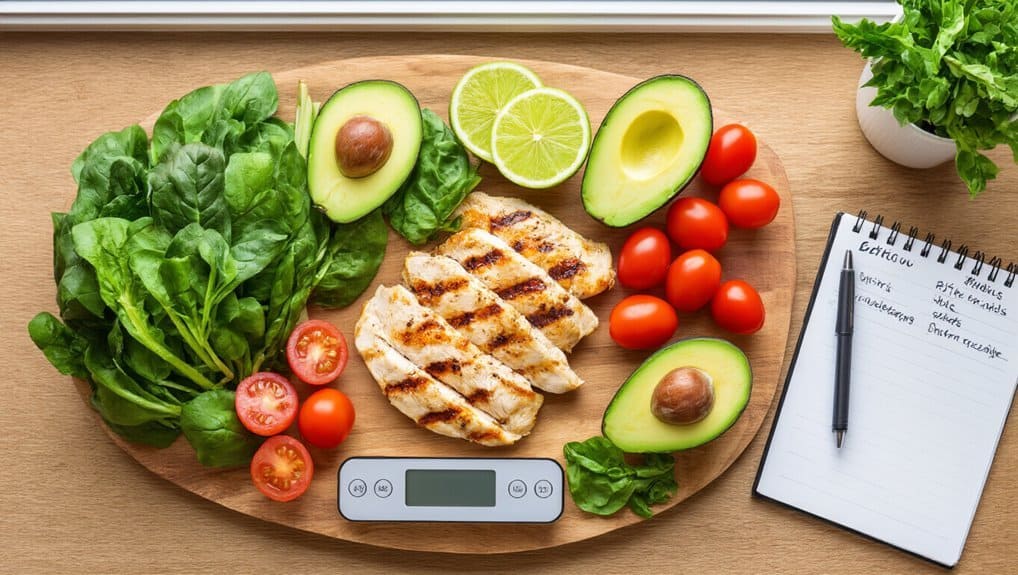
After establishing your baseline calorie needs, you’ll need to create a caloric deficit to lose weight effectively. A deficit of 500-750 calories per day typically results in 1-2 pounds of weight loss weekly. Don’t cut more than 1,000 calories daily, as extreme restrictions can slow your metabolism and trigger muscle loss.
Start by reducing your maintenance calories by 15-20%. If you maintain at 2,000 calories, aim for 1,600-1,700. Track your progress weekly and adjust accordingly. When weight loss stalls, implement plateau strategies like recalculating your needs based on your new weight or incorporating refeed days.
Consider meal timing to optimize your deficit. You might try intermittent fasting or eating larger meals earlier when metabolism is higher. Remember, you’re playing the long game. Sustainable deficits beat crash diets every time. If you’re losing more than 2 pounds weekly, you’re likely sacrificing muscle mass along with fat.
Determining Caloric Requirements for Muscle Gain and Body Recomposition
While cutting calories helps with fat loss, building muscle requires a different approach—you’ll need to eat at or above maintenance levels. For muscle gain, you’ll typically need a 200-500 calorie surplus above your TDEE. This surplus fuels progressive overload training and muscle protein synthesis.
Body recomposition—simultaneously losing fat while gaining muscle—works best at maintenance calories or a slight deficit (100-200 calories). You’ll progress slower than with dedicated bulking or cutting phases, but you’ll avoid excessive fat gain.
| Goal | Caloric Target | Daily Protein |
|---|---|---|
| Muscle Gain | TDEE + 200-500 | 0.8-1g/lb bodyweight |
| Recomposition | TDEE ± 100 | 1g/lb bodyweight |
Protein timing matters for maximizing results. Distribute your protein across 3-4 meals, consuming 20-40g per serving. Post-workout protein within 2-3 hours supports recovery, though the “anabolic window” isn’t as narrow as once believed. Track your weight weekly and adjust calories based on progress—aim for 0.5-1 pound gain monthly during muscle-building phases.
Common Mistakes When Estimating Calorie Needs
Even with the best calculators and formulas, you’ll likely make errors that sabotage your progress. You’re not alone—most people underestimate their intake by 20-40% and overestimate their activity levels.
Overreliance on labels leads to miscalculations since manufacturers can legally be off by 20%. That “100-calorie” snack might contain 120 calories. You’ll also fall into the trap of ignoring meal timing, assuming calories work the same regardless of when you eat them. Your body processes nutrients differently throughout the day.
Common pitfalls include:
- Not tracking cooking oils, condiments, and “taste tests” while preparing meals
- Using generic database entries instead of weighing your specific portions
- Forgetting liquid calories from alcohol, smoothies, and coffee additives
You’ll often trust outdated metabolic formulas that don’t account for your current muscle mass or hormonal changes. Weekend binges get conveniently forgotten, while you meticulously log weekday meals. These mistakes compound quickly, turning a planned 500-calorie deficit into maintenance or surplus.
Tracking Progress and Fine-Tuning Your Caloric Intake Over Time
| Time Frame | No Progress Signal | Action Required |
|---|---|---|
| Week 1-2 | Weight fluctuates wildly | Stay patient, trust the process |
| Week 3-4 | Scale hasn’t budged | Decrease calories by 10% |
| Week 5-6 | Feeling exhausted, moody | Implement adaptive refeeds |
When fat loss stalls despite adherence, incorporate adaptive refeeds by eating at maintenance calories for 2-3 days. This’ll reset hormones and restore energy. Remember, your metabolism adapts to prolonged deficits, so you’ll need periodic adjustments. Document everything—photos, measurements, and how you feel—to identify patterns and make informed decisions about your caloric needs.
Frequently Asked Questions
Should I Eat the Same Number of Calories on Rest Days?
You don’t need to eat the same calories on rest days. Many people cycle calories by eating less on rest days and more on training days to match their energy expenditure. This approach can support your goals while maintaining consistent protein distribution throughout the week.
You’ll typically reduce calories by 10-20% on rest days, primarily from carbs and fats, while keeping your protein intake steady for recovery.
How Do Medications Affect My Daily Calorie Requirements?
Medications can significantly alter your daily calorie needs through various mechanisms. Some drugs cause metabolic suppression, slowing your body’s calorie-burning rate and requiring you to eat less to maintain weight. Others increase appetite or cause water retention.
You’ll need to monitor drug interactions with your metabolism, as antidepressants, steroids, and diabetes medications commonly affect caloric requirements. Track your weight changes and adjust your intake accordingly when starting new medications.
Does Meal Timing Impact How Many Calories I Should Consume?
Meal timing doesn’t change your total daily calorie needs, but it affects how your body processes them. Your circadian nutrition patterns influence metabolic adaptation throughout the day, making morning calories more efficiently burned than late-night ones.
Strategic meal timing improves appetite regulation, helping you naturally stick to your calorie goals. You’ll find eating earlier supports better metabolism, while late eating can disrupt hormonal balance and increase fat storage tendencies.
Should Pregnant or Breastfeeding Women Adjust Their Calorie Intake Differently?
Yes, you’ll need to increase your calorie intake during pregnancy and breastfeeding.
Your pregnancy nutrition requirements add about 340 calories daily in the second trimester and 450 in the third.
When you’re breastfeeding, you’ll burn extra breastfeeding energy – approximately 500 additional calories per day.
You should focus on nutrient-dense foods rather than empty calories.
Always consult your healthcare provider to determine your specific needs based on your individual circumstances.
How Do Food Allergies or Intolerances Affect Calorie Planning?
Food allergies and intolerances complicate your calorie planning by limiting food choices, which can create masked nutrient deficiencies when you’re avoiding entire food groups. You’ll need to find alternative calorie sources that provide similar nutrients without triggering reactions.
Watch for cross reactivity risks between similar proteins that might further restrict options. You’re often replacing calorie-dense foods with alternatives that may be higher or lower in calories, requiring careful meal planning adjustments.
Conclusion
You’ve learned how to calculate your BMR and TDEE, adjust calories for your specific goals, and avoid common estimation mistakes. Now it’s time to put this knowledge into practice. Start with your calculated baseline, track your progress consistently, and adjust as needed. Remember, you’re not locked into one number forever—your caloric needs will change as your body and activity levels evolve. Stay flexible, monitor your results, and fine-tune your approach for long-term success.


No Comments