
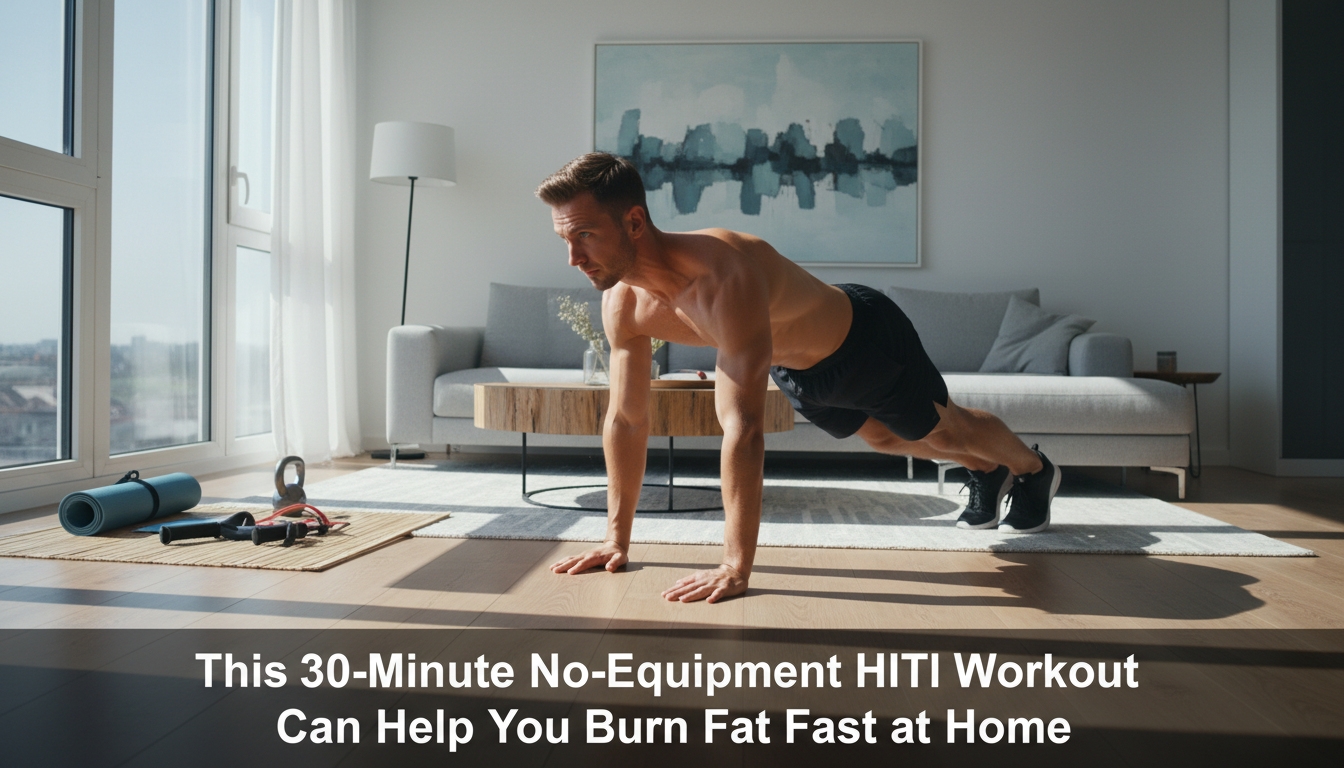
This 30 Minute No Equipment HIIT Workout Can Help You Burn Fat Fast at Home
You’ll torch fat fast at home with a 30‑minute, no‑equipment HIIT that spikes your heart rate to 80‑90% of max, burns 200‑300 kcal per session, and keeps metabolism elevated 6‑15% for up to 24 hours. The routine cycles through nine 90‑second full‑body circuits—30 seconds of intense work followed by 15 seconds of rest—targeting glutes, quads, chest, shoulders, back, and core. Scale the work/rest intervals as you progress and track heart‑rate zones, RPE, and body measurements for optimal results, and you’ll discover even more tips and tricks ahead.
Table of Contents
Why a 30‑Minute No‑Equipment HIIT Beats Steady‑State Cardio for Fat Loss
Why settle for a slow‑burn jog when a 30‑minute, no‑equipment HIIT session can torch 200–300 kcal in the same time? You’ll burn more calories per minute because the intense bursts spike your heart rate to 80‑90 % of max, while steady‑state cardio lingers at a modest 50‑60 %.
After the workout, EPOC keeps your metabolism elevated by 6‑15 % for up to 24 hours, meaning you continue to burn fat long after you finish. HIIT also improves VO₂max by 5‑15 % after just a few weeks, boosting overall aerobic efficiency and fat oxidation. The interval format forces your body to recruit fast‑twitch muscle fibers, which are more metabolically active than the slow‑twitch fibers used in long‑duration jogs. Consequently, you experience a greater reduction in body‑fat percentage—2‑4 % after 12 weeks—while spending less time exercising and needing no equipment at all.
9‑Round Full‑Body HIIT Circuit Overview: Exercises & Muscle Targets
Ever wonder how a 30‑minute, no‑equipment HIIT session can hit every major muscle group? You’ll rotate through nine circuits, each lasting 90 seconds (30 seconds work, 15 seconds rest). Every circuit bundles three moves that target lower‑body, upper‑body, and core zones, so you never pause long enough to let your heart rate drop.
Circuit 1 starts with squat jacks (glutes, quads, calves), moves to push‑ups (chest, shoulders, triceps), then finishes with bicycle crunches (obliques, rectus). Circuit 2 swaps squat jacks for lunges, push‑ups for superman swimmers, and adds a side‑plank variation for lateral core stability. Subsequent rounds replace jumps with skaters or lateral shuffles, and swap push‑ups for plank shoulder taps or mountain climbers, ensuring balanced activation of glutes, hamstrings, back, and hip stabilizers. By the end of the 20‑minute HIIT block you’ve engaged all major muscle groups while keeping the cardio intensity high.
How the 30‑Second Work / 15‑Second Rest Structure Boosts EPOC in No‑Equipment HIIT
How does a 30‑second sprint followed by a 15‑second pause supercharge your metabolism? The brief, intense burst forces your heart rate to 80‑90 % of max, depleting ATP and phosphocreatine stores. When the 15‑second rest arrives, your body scrambles to restore oxygen, pulling in extra blood flow and accelerating mitochondrial activity. This rapid shift fuels excess post‑exercise oxygen consumption (EPOC), keeping calories burned for up to 24 hours.
Because the work interval is short, you can sustain near‑maximal effort across nine circuits, amplifying the hormonal surge of catecholamines and growth hormone that further elevate metabolic rate. The rest period is long enough to prevent complete fatigue, yet short enough that the anaerobic system stays engaged, preserving the high‑intensity stimulus. In practice, you’ll see a 6‑15 % increase in resting metabolism after each session, turning a 30‑minute routine into a powerful fat‑loss engine.
How to Scale the No‑Equipment HIIT Workout for Beginners and Advanced Users
You can start by easing the work/rest ratio to 20 seconds on and 40 seconds off, then tighten it to the classic 30/15 as you get stronger. Swap basic moves for progressive variations—like jumping lunges for regular lunges or plank shoulder taps for plank rows—to keep the stimulus challenging. Finally, track your heart‑rate zones or RPE each interval and adjust the intensity until you consistently hit 80‑85 % of max HR or an RPE of 8‑9.
Adjust Adjust Work/Rest Ratios
Why not start with a gentler work/rest split and build up to the classic 30‑second work/15‑second rest as your fitness improves? Begin with 20 seconds of effort followed by 40 seconds of recovery; this lets you master form while keeping heart‑rate spikes modest. As you feel stronger, shrink the rest to 30 seconds and keep the 20‑second work, then progress to 25 seconds work/25 seconds rest. When you can sustain the intensity, switch to the standard 30 seconds work/15 seconds rest. Advanced users can flip the ratio, doing 35 seconds work with only 10 seconds rest for a metabolic surge. Track each session, note perceived exertion, and adjust the timing until you consistently hit an RPE of 8–9 during work phases.
Progressive Exercise Variations
When you’re just starting out, swapping high‑impact moves for low‑impact alternatives—like stepping instead of jumping—lets you build the without overwhelming your joints, while advanced users can crank up the challenge by adding plyometric twists or extending work intervals to keep the intensity high.
For beginners, replace squat jumps with regular squats, use knee‑push‑ups instead of full push‑ups, and keep plank holds to 20 seconds.
As you progress, transition to jump squats, full push‑ups, and 45‑second planks, then add single‑leg variations or mountain‑climber bursts.
Advanced users can insert explosive skaters, one‑leg burpees, or staggered push‑up rotations, and push work phases to 45 seconds while trimming rest to 10 seconds.
Track reps and form, and increase complexity only when you feel stable and strong.
Tailored Intensity Tracking
Swapping low‑impact moves for higher‑intensity ones sets the stage for fine‑tuning your HIIT session, so you can match the workout to your current fitness level. Start by adjusting work‑to‑rest ratios: beginners might use 20 seconds work/40 seconds rest, while advanced users push 30 seconds work/15 seconds rest. Next, monitor heart‑rate zones or RPE scores; aim for 80‑85 % of max HR or an RPE of 8‑9. Finally, log each circuit’s total work time and perceived fatigue, then tweak duration or add a second circuit after four weeks to keep progressing without overtraining.
- Modify interval lengths (20/40 → 30/15).
- Track heart‑rate or RPE (80‑85 % HR, RPE 8‑9).
- Record work time and fatigue, adjust circuits after 4 weeks.
How to Track Fat‑Loss Progress in Your No‑Equipment HIIT Program
You can start by measuring key body areas each week to spot subtle changes.
Next, use a reliable body‑fat percentage test—like skinfold calipers or a bio‑impedance scale—to quantify actual fat loss.
Finally, track performance metrics such as interval reps, RPE, and heart‑rate zones; improvements there often signal that your body is getting leaner even before the scale moves.
Scale Body Measurements
How can you know if that 30‑minute HIIT routine is truly shrinking your waistline? Grab a flexible tape measure and record your waist, hips, and thighs every two weeks. Consistency beats occasional snapshots; use the same time of day, preferably after waking, and stand relaxed. Compare the numbers, and a 1‑2 cm drop signals real change, even if the scale stays flat.
- Waist circumference – measure at the narrowest point or just above the belly button.
- Hip circumference – wrap the tape around the fullest part of the hips.
- Thigh circumference – measure mid‑thigh, halfway between the hip and knee.
Track these three metrics in a simple spreadsheet, noting the date and any workout notes. Small, steady reductions confirm your HIIT sessions are trimming excess fat.
Body Fat Percentage Tests
Wondering how to gauge true fat loss without a scale? You can estimate body‑fat percentage with a few simple tools. A skinfold caliper measures sub‑cutaneous fat at sites like the triceps, abdomen, and thigh; plug the readings into the Jackson‑Pollock equation for a reliable %‑fat estimate. Bioelectrical impedance scales (or handheld devices) send a low‑level current through your body and calculate %‑fat based on resistance—use them first thing in the morning, hydrated but not after a workout. If you prefer a tech‑free method, take a circumference measurement of your waist, hips, and neck, then apply the US Navy formula. Record these numbers every four weeks to spot trends and confirm your HIIT program’s effectiveness.
Performance‑Based Metrics
Ever wondered which numbers truly reflect fat‑loss progress when you’re doing a no‑equipment HIIT routine? You can gauge results with three concrete metrics that stay in sync with your body’s response.
- Heart‑rate zones – Aim for 80‑85 % of your max HR during work intervals. Track it with a wearable or pulse check; a rising average suggests improved cardiovascular efficiency and higher calorie burn.
- Rate of Perceived Exertion (RPE) – Rate each interval 8‑9 on a 10‑point scale. If you notice the same effort feels easier over weeks, you’re likely shedding fat while preserving muscle.
- Repetition count per interval – Record reps completed in each 30‑second burst. Incremental increases, even a couple of extra reps, signal strength gains and reduced body‑fat resistance.
Quick FAQ: Common Questions About No‑Equipment HIIT and Fat Burning?
Curious about whether a 30‑minute, no‑equipment HIIT routine really accelerates fat loss? You’ll burn 200‑300 kcal per session, outpacing moderate cardio, and EPOC can keep your metabolism 6‑15 % higher for up to 24 hours.
How often should I train? Aim for two to three 30‑minute workouts weekly, with at least 48 hours of recovery between sessions.
Can beginners start right away? Begin with 20‑second work/40‑second rest intervals; progress to the standard 30/15 as fitness improves.
Do I need any equipment? No—just bodyweight and an optional mat.
Will HIIT replace strength training? It builds muscular endurance and boosts VO₂max, but add dedicated strength work for maximal muscle growth.
Is HIIT safe for joints? Choose low‑impact alternatives (step‑outs, marching) if you have joint concerns.
How do I track progress? Log work time, heart‑rate zones (80‑85 % of max), and RPE (8‑9/10).
Will I see fat loss? Consistent 12‑week HIIT can cut body‑fat percentage by 2‑4 % and improve cardiovascular markers.
Frequently Asked Questions
Can I Lose Belly Fat Without Changing My Diet?
You can shrink belly fat by exercising, but without adjusting your diet the results will be modest and slower; combine regular HIIT, strength work, and consistent calorie control for noticeable loss.
How Many Calories Does a 30‑Minute HIIT Session Actually Burn?
You’ll burn roughly 200‑300 kcal in a 30‑minute HIIT session, depending on intensity and your fitness level, and the after‑burn effect (EPOC) can keep metabolism elevated for hours.
Do I Need a Heart‑Rate Monitor to Gauge Intensity?
You don’t need a monitor; just check your pulse, aim for 80‑90% max, and use perceived exertion. If you can’t talk comfortably, you’re hitting the right intensity.
Can I Combine This HIIT Routine With Yoga on Rest Days?
Yes, you can pair yoga with HIIT rest days; it aids recovery, improves flexibility, and reduces soreness, while keeping your metabolism active and preventing burnout, so schedule gentle flow sessions between intense workouts.
Is HIIT Safe for People With Joint Arthritis?
Yes, HIIT can be safe for arthritis if you modify intensity, choose low‑impact moves, keep joints aligned, and listen to pain signals; start with shorter work periods, longer rests, and progress gradually.
Conclusion
You’ve got a powerful, equipment‑free HIIT routine that torches calories, spikes EPOC, and builds strength in just 30 minutes. Stick with the 15‑second rest, 30‑second work pattern, tweak intensity as you progress, and track your results. Consistency will melt fat faster than steady‑state cardio—so fire up, push hard, and watch the transformation happen.


Sorry, the comment form is closed at this time.