
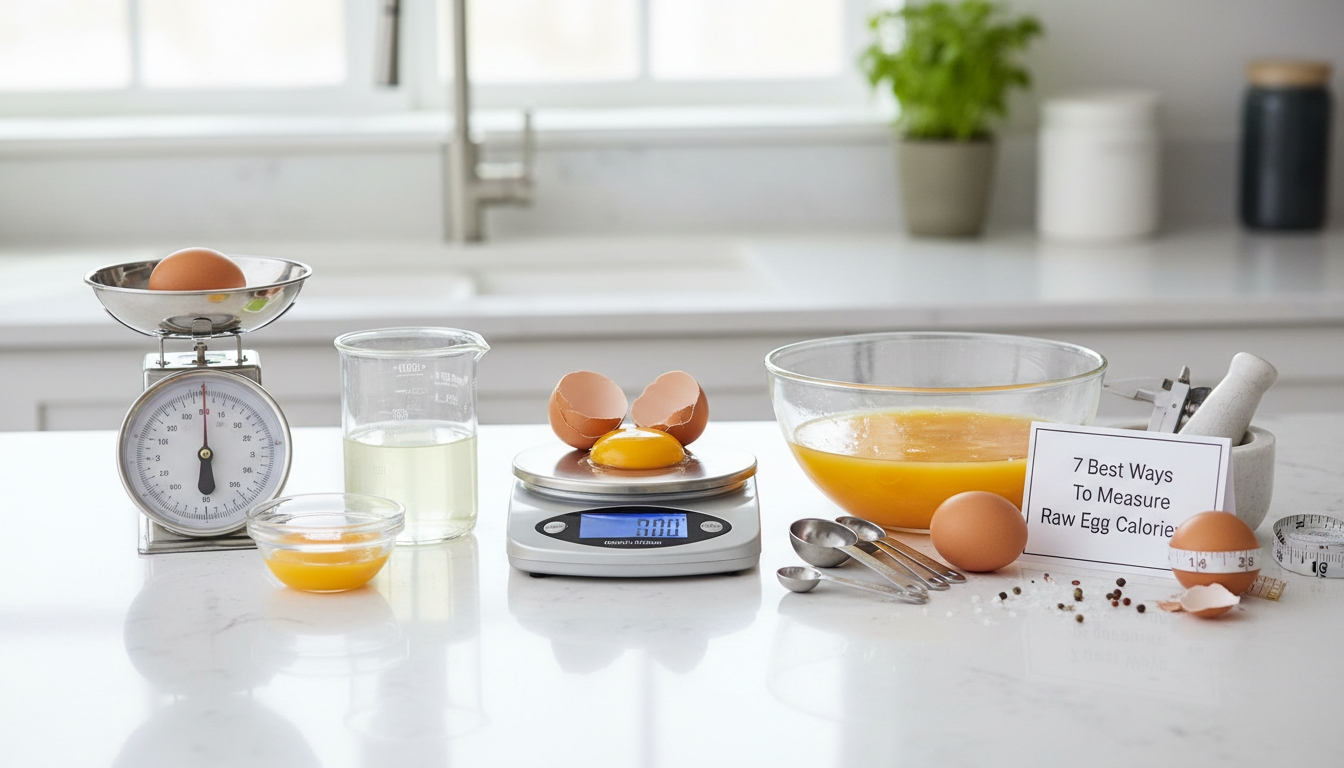
You can get raw egg calories fast by weighing each egg and multiplying its grams by 0.71 kcal/g, using size‑based averages (e.g., small ≈ 45 g ≈ 32 kcal, large ≈ 57 g ≈ 40 kcal), checking USDA weight‑based tables (≈ 1.55 kcal per gram), logging the weight in a phone nutrition app, cross‑checking carton labels, or estimating from protein and fat grams. These quick methods give reliable numbers, and the next steps will show you how to apply them accurately.
Quick Answer: Raw Egg Calories and the 0.71 kcal/g Formula
Curious how many calories sit inside a raw egg? You can estimate it quickly by using the 0.71 kcal/g formula. First, weigh the egg on a kitchen scale; most large eggs weigh about 57 g. Multiply the weight by 0.71, and you’ll get roughly 40 kcal.
This method works for any size—small (≈45 g) yields about 32 kcal, medium (≈50 g) about 36 kcal, and extra‑large (≈63 g) about 45 kcal. The formula assumes the egg is raw, un‑cooked, and includes both white and yolk. It’s handy when you’re logging meals or comparing recipes, because you don’t need a nutrition label.
Just remember that cooking changes water content, so the calorie count shifts slightly after frying or boiling. For most tracking purposes, the 0.71 kcal/g estimate is accurate enough.
How to Use the 0.71 kcal/g Formula for Raw Eggs
You can calculate an egg’s calories by multiplying its weight in grams by 0.71 kcal/g, then adjust the result for the egg’s size category.
If you have a large egg (about 57 g), the formula gives roughly 40 kcal, while a medium egg (≈50 g) yields about 35 kcal.
Just plug in the actual weight you measure and you’ll have an accurate calorie count every time.
Applying the Formula
Wonder how you turn a raw egg’s weight into calories? First, weigh the egg on a kitchen scale and note the grams. Then multiply that number by 0.71 kcal/g—the energy density of raw egg protein and fat. For example, a 55‑gram egg yields 55 × 0.71 ≈ 39 kcal. If you have multiple eggs, add their weights before applying the factor, or calculate each individually and sum the results. Use a calculator or spreadsheet to avoid arithmetic errors, especially when dealing with large batches. Remember to record the weight and calculated calories for consistency, and keep the process simple: weight → multiply → record. This method gives you a quick, reliable calorie estimate for any raw egg.
Adjusting for Egg Size
How do you adjust the 0.71 kcal/g formula for different egg sizes? First, weigh the raw egg on a kitchen scale. Then, multiply its mass in grams by 0.71 kcal/g to get an estimate. If you don’t have a scale, use standard size averages: a small egg (≈45 g) yields ~32 kcal, medium (≈50 g) ~36 kcal, large (≈57 g) ~40 kcal, extra‑large (≈63 g) ~45 kcal, and jumbo (≈70 g) ~50 kcal. Adjust the formula by substituting the specific weight for your egg. Remember that shell weight is negligible, so you can treat the whole egg as edible mass. This method keeps your calorie count accurate across all sizes.
USDA’s Raw Egg Calorie Estimate (Weight‑Based)
Although the USDA lists raw egg calories by weight, the calculation is straightforward: each gram of egg contains about 1.55 kcal, so a typical 50‑gram large egg provides roughly 78 kcal. You can use this factor to estimate calories for any egg you weigh. First, weigh the egg on a kitchen scale, noting the total grams. Multiply that number by 1.55 to get the calorie count. For example, a 60‑gram egg yields 93 kcal, while a 45‑gram egg gives about 70 kcal.
This method bypasses size categories and accounts for natural variations in shell thickness and yolk‑white ratio. If you’re tracking intake precisely, record each egg’s weight before cooking, because cooking can alter water content but not the baseline caloric density. The weight‑based estimate remains reliable across breeds and farming practices, delivering a consistent, science‑backed metric for your nutrition plan.
Determining Raw Egg Calories by Size (Small‑Medium‑Large‑XL)
You’ll notice that a small egg typically contains about 55–65 calories, while a large egg ranges from roughly 70–80 calories.
These ranges let you estimate intake quickly without weighing each egg.
Adjust your portion goals accordingly, whether you’re counting a medium or an extra‑large.
Small Egg Calorie Range
Curious about how many calories a small egg actually packs? You’ll find that a typical U.S. small egg (about 38 g) contains roughly 54 kcal. The calorie count stems mainly from protein (≈5 g) and a modest fat portion (≈4 g).
If you’re tracking macros, note that the egg’s yolk contributes most of the fat, while the white supplies the bulk of the protein. Variations arise with breed and feed, but the range stays tight—generally 52–56 kcal per egg.
To stay accurate, weigh your egg and apply the standard conversion of 1 g protein ≈ 4 kcal and 1 g fat ≈ 9 kcal. This method lets you pinpoint the exact calorie load, even when eggs differ slightly in size.
Large Egg Calorie Range
How many calories does a large egg actually contain? You’ll find that a typical large egg (about 50 g) supplies roughly 70–80 kcal, but the exact number shifts with shell thickness, breed, and freshness. When you’re tracking macros, treat the range as a flexible band rather than a fixed point. This mindset helps you stay on track without obsessing over minute variations.
Below are the key factors that shape the large‑egg calorie spectrum:
- Shell weight – heavier shells shave a few calories.
- Yolk‑to‑white ratio – more yolk means more fat and calories.
- Breed genetics – some breeds lay richer yolks.
- Freshness – fresher eggs retain slightly more water, lowering calorie density.
Use these cues to estimate your intake confidently.
How to Measure Egg Weight With a Kitchen Scale
A kitchen scale gives you an instant, accurate readout of an egg’s weight, letting you track calories with pinpoint precision. First, place a small bowl or plate on the scale and zero it out (tare) so only the egg’s mass registers. Gently crack the egg into the container, being careful not to spill. The display will show the weight in grams or ounces; record that number. If you’re measuring multiple eggs, weigh each one separately, then add the values for a total. Use the weight to consult a nutrition table: roughly 50 g of a large egg equals about 70 kcal, while a medium egg at 44 g provides around 60 kcal. For consistency, always use the same container and tare the scale before each measurement. This method eliminates guesswork and ensures your calorie count matches the actual egg you consume.
Can Your Phone Quickly Log Egg Calories?
Ever wondered if your phone can instantly log egg calories? You can, and it feels surprisingly empowering. Modern nutrition apps let you snap a photo of an egg, scan a barcode, or type “large egg” and instantly see the calorie count. The speed eliminates guesswork, so you stay on track without pausing your day. Plus, the data syncs across devices, giving you a clear picture of daily intake. When you rely on your phone, you also gain confidence that each entry is accurate and timely.
- Instant gratification – see calories the moment you capture the egg.
- Seamless tracking – no manual calculations, just a tap.
- Motivation boost – visual progress fuels healthier choices.
- Peace of mind – trust that your log matches real nutrition facts.
How to Verify Egg Carton Calorie Claims
Ever wondered whether the calorie count on an egg carton is trustworthy? First, check the nutrition label’s serving size. If it lists “1 large egg (≈50 g)” as a serving, compare that weight to the actual egg you have using a kitchen scale. Next, look up the USDA FoodData Central value for a large egg—about 72 kcal. If the carton claims a significantly higher or lower number, note the discrepancy. You can also verify the claim by calculating calories yourself: multiply the protein (6 g) by 4 kcal/g, fat (5 g) by 9 kcal/g, and carbs (0.4 g) by 4 kcal/g, then sum the results. Finally, research the brand’s testing methods. Reputable producers often reference lab analysis or third‑party audits. If none are provided, treat the label with caution and rely on standard database values for accuracy.
Frequently Asked Questions
Do Raw Egg Calories Differ Between Cage‑Free and Conventional Eggs?
Yes, you’ll find only tiny differences—cage‑free eggs might have a few extra calories, but the variance is usually less than 5 % per egg, so it’s practically negligible.
How Does Cooking Method Affect the Calorie Count of a Raw Egg?
Cooking doesn’t add calories, but heat can evaporate water, concentrating nutrients, so a boiled egg may feel slightly richer than raw. Frying adds oil, which boosts calories dramatically, while poaching keeps them unchanged.
Can the 0.71 Kcal/G Formula Be Applied to Egg Whites Only?
You can apply the 0.71 kcal/g rule to egg whites alone, but remember it assumes pure protein water; any added liquids or yolk remnants will slightly skew the calculation.
Do Egg Yolk Color Variations Indicate Different Calorie Values?
You won’t see a meaningful calorie difference from yolk color; pigments don’t add energy. Focus on size and weight instead—those factors drive the calorie count, not shade.
Are There Seasonal Changes in Raw Egg Calorie Content?
You won’t notice any seasonal shift; raw egg calories stay roughly constant year‑round, because the bird’s diet and metabolism are regulated, so the energy content of the egg doesn’t fluctuate with the seasons.
Conclusion
You now have every tool you need to gauge raw egg calories accurately. Use the 0.71 kcal/g rule, weigh the egg, or rely on size‑based USDA tables—whichever suits your routine. A kitchen scale gives the most precise count, while a phone app can log it instantly. Double‑check carton claims, and you’ll always know exactly how many calories you’re adding to your meals.


No Comments