
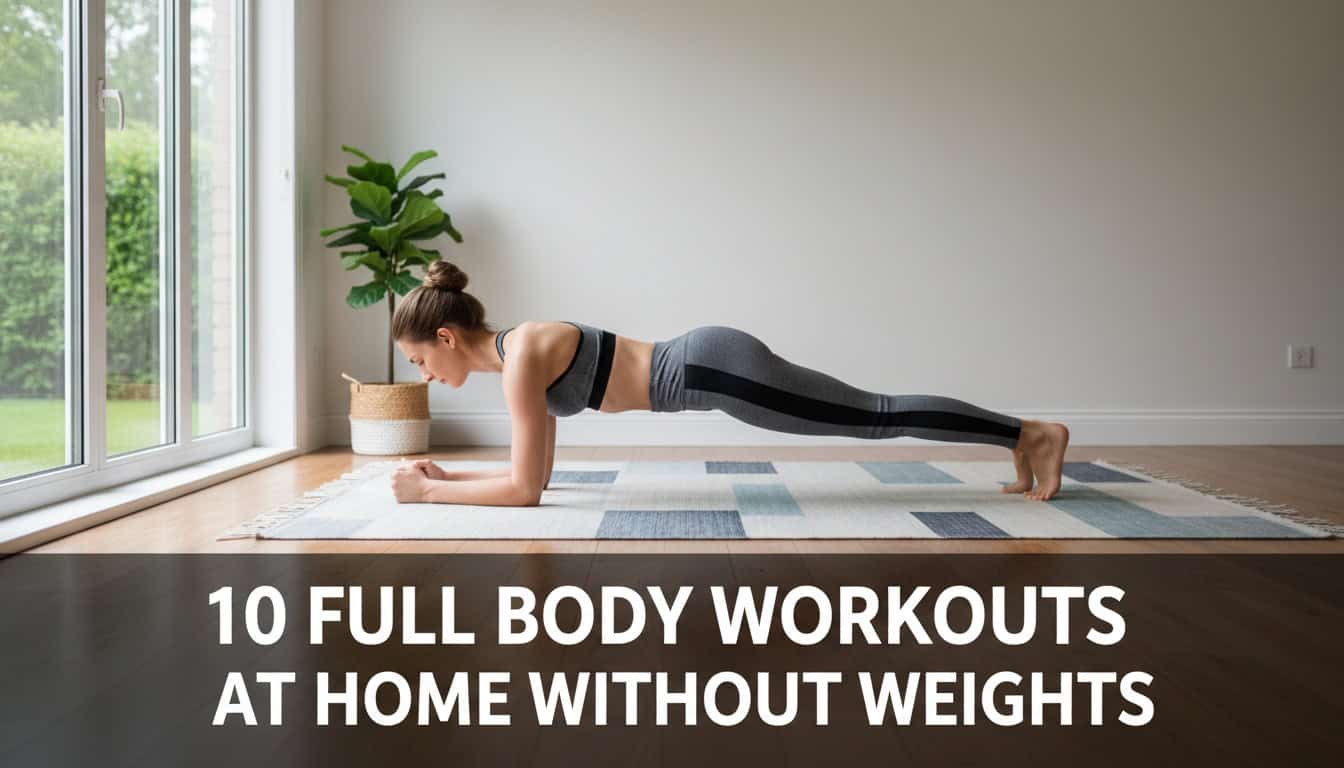
Kick off with a 30‑second marching warm‑up, arm circles, hip and ankle rolls, then flow into dynamic lunges and torso twists to fire up your core. Follow a plank circuit—forearm, side, reverse, and plank‑to‑push‑up—holding tension throughout. Sculpt legs with basic, pulse, sumo, single‑leg, and jump squats, then boost upper body using classic, elevated, pike, and close‑grip push‑ups with slow eccentrics. Add pulling strength via table or door rows, spike heart rate with a burpee combo, and finish with mobility stretches, hamstring holds, chest openers, child’s pose, and spinal twists. Keep rests short, track rounds, and you’ll see progress fast.
Table of Contents
Warm‑up Every Muscle Group
Before you dive into the workout, warm up every muscle group to boost blood flow and prevent injury. Start with marching in place for 30 seconds, then transition to arm circles—10 forward, 10 backward—to loosen shoulders. Follow with hip circles, rotating each side five times, and ankle rolls, five per direction.
Next, perform dynamic lunges: step forward, lower your torso, and push back, alternating legs for a minute. Add torso twists, swinging arms gently, to engage the core. Finish with a brief set of high knees, aiming for 30 seconds, to elevate heart rate.
This routine activates the major joints and muscles, priming them for the upcoming bodyweight exercises. By moving through each region—neck, shoulders, chest, back, hips, knees, and ankles—you reduce stiffness, improve range of motion, and lower the risk of strains. Stay mindful of form, breathe steadily, and keep the pace steady to maximize the warm‑up’s effectiveness.
Activate Core With a Plank Circuit
Looking to fire up your core quickly and efficiently? Grab a mat, assume a forearm plank, and hold for 30 seconds. Then transition to a side plank on each side for 20 seconds, keeping hips stacked and shoulders over elbows. Next, drop into a reverse plank, lifting hips toward the ceiling for 25 seconds to engage the lower abdominals and glutes. Finish the circuit with a plank‑to‑push‑up: lower onto hands, push back up, and repeat for 10 reps. Rest 30 seconds, then repeat the whole sequence three times. Focus on a tight core, neutral spine, and steady breathing throughout. If you feel sagging hips, pull your belly button toward your spine to maintain tension. This circuit hits the rectus abdominis, obliques, and transverse abdominis while also strengthening shoulders and hips. Consistency will improve stability, posture, and overall functional strength.
Sculpt Legs & Glutes With Squat Variations
Ready to ignite your lower body? Start with a basic squat: feet shoulder‑width apart, chest up, push hips back, and descend until thighs are parallel to the floor. Drive through your heels to stand, squeezing glutes at the top. For extra burn, try pulse squats—hold the low position and pulse up and down for 15 reps. Switch to sumo squats: widen your stance, point toes outward, and drop low, targeting inner thighs and glutes. Add a single‑leg twist with pistol‑style squats; balance on one foot, extend the other forward, and lower slowly, then switch sides. Incorporate jump squats for power: explode upward, land softly, and repeat for 12 explosive reps. Finish with a wall‑sit: slide down until thighs are parallel, hold for 45 seconds, and feel the burn. These variations hit quads, hamstrings, and glutes, giving you a sculpted lower half without a single weight.
Build Chest, Shoulders & Triceps With Push‑Up Styles
Ever wondered how to sculpt a powerful upper body without any equipment? Push‑up variations let you hit the chest, shoulders, and triceps with just your body weight. Start with a classic push‑up: hands shoulder‑width apart, core tight, lower until your chest kisses the floor, then press up. To shift focus to the upper chest, place your hands slightly lower than shoulder width and angle your elbows outward. For shoulder dominance, try the pike push‑up: hips lifted high, forming an inverted V, and lower your head toward the floor. Triceps get a serious burn with close‑grip push‑ups—hands tucked under your chest, elbows hugging your sides. Elevate your feet on a sturdy chair for an incline push‑up, increasing chest activation. Mix slow eccentric phases (3‑4 seconds down) with explosive concentric pushes to build power. Aim for three sets of 8‑12 reps per style, resting 60 seconds between sets. Adjust hand placement, tempo, and elevation to keep the muscles guessing and growing.
Add Pull Strength Using Inverted‑Row Alternatives (Table or Door)
If you have a sturdy table or a strong door, you can turn them into makeshift pull‑up stations and work your back, biceps, and rear shoulders without any weights. For a table row, slide a towel or a sturdy sheet under the edge, lie underneath, and grip the edge with both hands. Keep your body straight, pull your chest toward the tabletop, then lower slowly. Aim for three sets of eight to twelve reps, pausing at the top to squeeze the shoulder blades together.
For a door row, use a thick towel or a door‑jammed strap; place the strap over the top of the door, close it, and lean back while gripping the ends. Pull your torso toward the door, keeping elbows close to your sides. Adjust the angle by moving your feet farther from the door to increase difficulty. Both options engage the latissimus dorsi, rhomboids, and biceps, delivering a solid pulling stimulus without any equipment.
Boost Balance With a Lunge Flow
After building pulling strength with table and door rows, shift your focus to lower‑body stability by incorporating a dynamic lunge flow. Start in a tall stance, step your right foot forward, and lower into a forward lunge while keeping your torso upright. As you rise, bring your left knee up to hip height, then lower it back down. Switch sides and repeat, moving fluidly from one leg to the other. This pattern challenges proprioception, engages the glutes, hamstrings, and quads, and forces your core to stay engaged for balance. Keep your knees aligned with your ankles, and avoid letting the front knee drift past the toe. Perform three sets of twelve to fifteen repetitions per side, pausing briefly at the bottom of each lunge to feel the stretch. Over time, the flow improves coordination, steadies your gait, and builds a solid foundation for more advanced body‑weight moves.
Spike Heart Rate With a Full‑Body Burpee Combo
Ready to torch calories and push your cardio to the max? You’ll feel the burn the you dive into a full‑body burpee combo that spikes your heart rate in seconds. The sequence blends a squat, plank, push‑up, and jump, forcing every muscle group to work while your lungs gasp for air. Keep the tempo brisk, land softly, and reset instantly for the next rep. This high‑intensity burst shreds fat, boosts endurance, and leaves you exhilarated.
- Drop into a deep squat, hands on the floor.
- Kick your feet back into a tight plank, shoulders over wrists.
- Perform a chest‑level push‑up, elbows tucked.
- Jump feet forward to the squat position, hips low.
- Explode upward, arms overhead, landing quietly.
Repeat for 30‑second intervals, rest briefly, then go again. The rapid transition between moves maximizes oxygen demand, keeping your heart rate soaring. Adjust reps to match your fitness level, and watch your cardio improve dramatically.
Recover With Mobility Stretches for Post‑Workout Flexibility
Why let tight muscles linger after a hard session? You’ve just crushed a body‑weight circuit, and now you need to restore range of motion before stiffness sets in.
Begin with a cat‑cow flow: on all fours, inhale to arch your back, exhale to round it. Move slowly for 30 seconds, letting each vertebra articulate.
Next, swing each leg forward and backward like a pendulum, keeping hips stable; 10 swings per side loosen hip flexors and hamstrings.
Transition to a deep lunge with a twist: step right foot forward, drop hips, then rotate torso left, reaching arm overhead. Hold 20 seconds, then switch sides.
Finish with a seated forward fold, reaching for your toes while keeping the spine long; breathe into any tightness for 25 seconds.
These mobility stretches re‑engage muscles, improve joint fluidity, and prime your body for the next workout.
Cool‑down Stretches to Reduce Soreness
Wondering how to keep post‑workout soreness at bay? A solid cool‑down routine eases muscle tension, improves blood flow, and speeds recovery. Move slowly, breathe deeply, and hold each stretch for 20‑30 seconds. Focus on the muscles you just taxed, and you’ll feel less stiffness tomorrow.
- Standing hamstring stretch – hinge at the hips, keep the back straight, and gently reach toward your toes.
- Chest opener – clasp hands behind your back, lift the arms slightly, and squeeze the shoulder blades together.
- Child’s pose – sit back on your heels, extend arms forward, and let your torso settle between your thighs.
- Figure‑four glute stretch – lie on your back, cross one ankle over the opposite knee, and pull the uncrossed leg toward your chest.
- Seated spinal twist – sit cross‑legged, place one hand on the opposite knee, and rotate gently, looking over your shoulder.
Finish with a few deep breaths, and you’ll reduce soreness while maintaining flexibility.
Progress This Full‑Body Home Workout Without Extra Weights
You’ll notice your core getting steadier as you keep pushing through each circuit, and that steadier core lets you maintain better form on every move.
The repeated, weight‑free reps also train your muscles to sustain effort longer, boosting endurance across the whole body.
Keep tracking how many rounds you can complete before fatigue sets in, and use that data to gradually raise the intensity.
Boosts Core Stability
Ever wondered how a weight‑free routine can still tighten your core? You’ll feel steadier during daily tasks and workouts when your midsection can lock in every move. By engaging deep abdominal muscles, you protect your spine, improve posture, and create a solid platform for upper‑ and lower‑body actions. The key is to hold tension throughout each rep, not just at the peak.
- Plank variations that challenge shoulder and hip alignment
- Bird‑dog extensions that demand balance and spinal control
- Hollow‑body holds that activate the transverse abdominis
- Side‑plank twists that engage obliques while stabilizing hips
- Dead‑bug progressions that keep the core tight as limbs move
These drills build a resilient core without any equipment.
Enhances Muscular Endurance
A solid muscular‑endurance base lets you power through longer sets and recover faster between moves, keeping the whole body humming without any weights.
When you train endurance, you boost the capacity of each muscle fiber to sustain repeated contractions, so circuits feel less taxing.
Incorporate high‑rep bodyweight moves—like 20‑30 squat jumps, 30‑second plank variations, or 15‑20 walking lunges—into timed intervals.
Keep rest periods short, aiming for 15‑30 seconds, to challenge oxidative systems.
As you progress, increase reps or extend the work interval by five seconds each week.
This gradual overload trains slow‑twitch fibers, improves lactic‑acid tolerance, and lets you maintain form longer, turning everyday activities into effortless, stamina‑driven motions.
Frequently Asked Questions
Can I Use Resistance Bands Instead of Body Weight for These Exercises?
Yes, you can swap in resistance bands for body‑weight moves. They add tension, target muscles differently, and let you adjust difficulty. Just keep form tight, control the stretch, and progress gradually.
How Often Should I Change My Workout Routine to Avoid Plateaus?
You should switch your routine every six to eight weeks, mixing new exercises, rep ranges, or tempos to keep muscles guessing and prevent plateaus. Small tweaks each session also help maintain progress.
What Is the Ideal Duration for Each Exercise Session?
Aim for 45‑60 minutes per session, mixing 10‑15 minutes of warm‑up, 30‑40 minutes of core exercises, and 5‑10 minutes of cool‑down. Keep rest intervals short to maintain intensity and efficiency.
Do I Need Any Special Equipment for the Mobility Stretches?
You don’t need any special gear for mobility stretches; a mat or towel for comfort, plus enough space, is enough. Just focus on smooth, controlled movements and breathing.
How Can I Track Progress Without a Gym Log?
You can track progress by noting reps, sets, and time in a simple notebook or phone app, taking weekly photos, timing how long each circuit takes, and rating perceived effort after each workout.
Conclusion
You’ve just built a complete, equipment‑free routine that hits every major muscle group, boosts cardio, and improves flexibility—all in the comfort of your home. By mixing core planks, squat variations, push‑up styles, inverted‑row alternatives, and a burpee combo, you keep your body guessing and progress steady. Stick with the warm‑up, mobility work, and cool‑down to stay injury‑free, and you’ll keep getting stronger, leaner, and more resilient without ever needing weights.


Sorry, the comment form is closed at this time.