
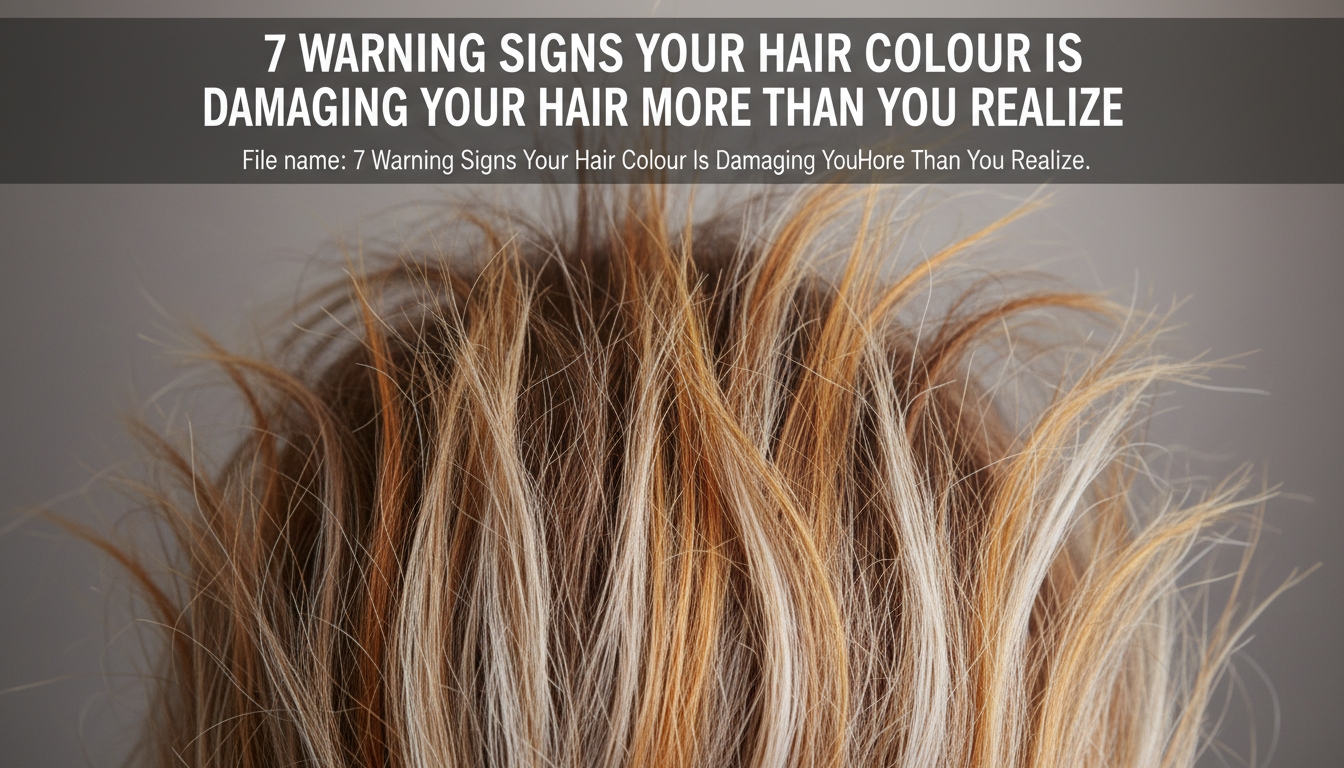
7 Warning Signs Your Hair Colour Is Damaging Your Hair More Than You Realize
If you’re seeing more brittleness, persistent frizz, uneven fading, dullness, scalp irritation, split ends, or a sudden loss of elasticity after coloring, those are the seven warning signs that your hair color is damaging your strands. The alkaline lift, peroxide oxidation, and lipid loss all compromise cuticle integrity, increase porosity, and strip moisture, leading to those symptoms. Keep an eye on them, and the next section will explain how to protect and repair your hair.
Table of Contents
Why Does Hair‑Color Damage Cause Cuticle Lift and Porosity?
When you apply a hair‑color formula, alkaline agents like ammonia lift the cuticle scales to let the pigment penetrate, and this lift doesn’t fully reseal afterward. The raised cuticles create a rough, uneven surface that lets water slip in quickly but also rush out, increasing porosity.
Because the cuticle can’t close tightly, moisture evaporates faster, leaving the shaft brittle and prone to breakage. You’ll notice that your hair feels spongy and loses its natural elasticity; it may also appear dull as light scatters off the uneven scales.
In the first 48 hours after coloring, the lift can persist, meaning the hair continues to absorb chemicals and environmental stressors. This heightened porosity not only weakens the shaft but also makes future color applications uneven, as pigment settles into the gaps rather than staying uniformly locked.
How Does Peroxide Break Keratin’s Disulfide Bonds in Hair‑Color Damage?
How does peroxide actually break down the disulfide bonds that give hair its strength? When you mix hydrogen peroxide with the dye, it generates free radicals that target the sulfur atoms in keratin’s disulfide bridges. These radicals pull the sulfur atoms apart, converting the strong –S–S– link into two –SH groups. The result is a weakened protein matrix that can’t hold its shape, leaving hair more prone to snapping and losing elasticity.
- The radicals attack the sulfur atoms, cleaving the –S–S– bond and forming thiol groups.
- This chemical change reduces tensile strength, making strands easier to break.
- Each peroxide exposure adds more broken bonds, compounding weakness over multiple colorings.
- The disrupted network allows water and pigment to infiltrate unevenly, amplifying damage.
What Hair‑Color Damage Does to Moisture Retention and Lipid Loss?
When you color your hair, the oxidatives strip away the natural lipids that help the shaft hold water, cutting its water‑holding capacity by up to 20 %.
This lipid loss leaves the cuticle rough and porous, so moisture evaporates faster, especially under UV exposure.
As a result, your hair feels drier and looks duller after each coloring session.
Reduced Water‑Holding Capacity
Ever notice your hair feels drier after coloring? The chemicals lift cuticles and strip natural lipids, so the shaft can’t cling to water like it used to. You’ll notice less bounce, more static, and a dull sheen because the hair’s water‑holding capacity drops dramatically. Without that moisture buffer, the hair becomes fragile and breaks more easily, especially when you style or wash it.
- Cuticle lift creates micro‑gaps that let water escape quickly.
- Lipid loss reduces the inner seal that normally traps moisture.
- Porous hair absorbs water fast but releases it just as fast.
- The combined effect is a 15‑20 % drop in overall hydration, leaving hair feeling rough and lifeless.
Lipid Stripping by Oxidatives
Because the oxidative developers in hair dye break down the natural lipids that coat each strand, they strip away the protective barrier that locks moisture inside. When those lipids disappear, the cuticle can’t seal properly, so water evaporates faster and the shaft becomes porous. You’ll notice a dull, flat look because light scatters on the rough surface, and your hair feels rough rather than silky. The loss of lipids also reduces elasticity, making each strand more prone to snapping during brushing or styling. Even a single coloring session can cut water‑holding capacity by 15‑20 %, and repeated applications compound the effect. To counteract this, use lipid‑rich conditioners and avoid excessive heat, which further depletes the already‑thin barrier.
Accelerated Dryness Under UV
Why does your color‑treated hair feel extra dry after a day in the sun? UV rays break down the remaining lipids that your dye already stripped, and the lifted cuticles can’t seal moisture back in. The result is a rapid loss of water‑holding capacity, making each strand feel brittle and straw‑like. You’ll notice a dull sheen, increased frizz, and a tighter, less flexible texture that wasn’t there before the coloring.
- UV accelerates lipid oxidation, shaving 15‑20 % of your hair’s natural moisture barrier.
- Porous, lifted cuticles let water evaporate twice as fast under sunlight.
- Color‑induced protein loss reduces elasticity, so UV‑induced dryness feels harsher.
- Without deep conditioning, only about 40 % of lost lipids are reclaimed, leaving hair chronically dehydrated.
Why Does Hair‑Color Damage Irritate the Scalp and Trigger Sensitization?
When you apply hair dye, the chemicals—especially ammonia, peroxide, and PPD—penetrate the scalp’s outer layer, irritating nerve endings and breaking down the skin’s natural barrier. This breach lets allergens seep deeper, prompting an immune response that releases histamine and cytokines. You’ll feel itching, redness, and a tingling sensation within hours, and repeated exposure can shift a mild reaction into chronic contact dermatitis.
PPD, a common aromatic amine, binds to skin proteins and forms hapten‑protein complexes that the body recognizes as foreign, leading to sensitization after just a handful of applications. Once sensitized, even a tiny amount of the same dye can trigger a flare‑up, causing swelling, flaking, and sometimes blistering. The inflammation also weakens follicular walls, making hair shafts more prone to breakage at the root.
Patch testing before each new color can cut the risk of sensitization dramatically.
How Does Cuticle Damage From Hair‑Color Damage Lead to Uneven Fade and Brassy Tones?
Scalp irritation from repeated dye exposure often coincides with cuticle damage, and that compromised cuticle layer directly drives uneven fade and brassy tones. When the cuticle lifts, pigment can’t lock in evenly, so color bleeds out faster in some strands while clinging to others. The rough surface also scatters light, turning cool shades into unwanted brassy hues. Porous hair absorbs excess pigment, creating dark patches that fade unevenly, while the exposed cortex oxidizes quicker, shifting tones toward yellow or orange. You’ll notice the color looking dull at the roots, vibrant mid‑length, and brassy at the ends—classic signs of cuticle‑related fade.
- Raised cuticles leave gaps for pigment to escape.
- Porosity spikes, causing uneven pigment absorption.
- Light scattering on rough cuticles creates brassy reflections.
- Oxidation of the cortex accelerates yellowing in exposed areas.
What Hair‑Color Damage Does to Split Ends and Thinning Over Time?
If you keep coloring your hair, the repeated lift and oxidation of the cuticle gradually weaken the shaft, so split ends and thinning appear faster. Each coloring session raises cuticle porosity, preventing the scales from resealing and letting moisture escape. The loss of water‑holding capacity makes the fiber brittle; when you brush or style, the weakened ends snap off, creating more split ends. Hydrogen peroxide also attacks keratin bonds, cutting tensile strength by up to 25 % after a single dye and adding roughly 10 % loss with every repeat. As the protein matrix degrades, elasticity drops and the hair shaft thins, especially near the scalp where follicle irritation may already be present. Over months, you’ll notice a higher density of frayed tips and a gradual reduction in overall thickness, even if the color still looks vibrant. Regular deep‑conditioning can only partially restore lost lipids and proteins, so the underlying damage continues to accumulate.
Why Short Recoloring Intervals Increase Hair‑Color Damage and What Can You Do About It?
Repeated coloring every few weeks doesn’t give your hair enough time to rebuild the cuticle and protein matrix that were stripped in the previous session. The cuticle stays lifted, porosity spikes, and the keratin bonds you just repaired are broken again, leaving your strands brittle and prone to breakage. Each new color also adds fresh oxidative stress, depleting natural lipids and increasing scalp irritation. The result is faster fade, uneven pigment, and a noticeable loss of elasticity. To protect your hair while still enjoying fresh shades, you need to give it a proper recovery window and reinforce it with targeted care.
- Extend intervals to at least 6‑8 weeks between color jobs.
- Use low‑ammonia or ammonia‑free dyes to lessen cuticle lift.
- Incorporate protein‑rich masks and deep‑conditioners weekly.
- Apply a UV‑protective spray to shield color and cuticle from sun damage.
Frequently Asked Questions
Can I Use a Color‑Safe Shampoo to Reverse Cuticle Lift?
You can’t fully reverse cuticle lift with a color‑safe shampoo, but it’ll smooth the surface, reduce porosity, and protect against further damage, especially when paired with deep‑conditioning treatments.
Does Bleaching Affect My Hair’s Natural Pigment Production?
You’ll find bleaching doesn’t restore pigment natural pigment; it actually strips melanin, so your hair can’t produce its original color. The process damages the cuticle and keratin, leaving you with a lighter, less vibrant shade.
Will Low‑Ammonia Dyes Prevent Protein Bond Loss?
You’ll still lose some protein bonds, but low‑ammonia dyes cut the damage roughly in half, so you retain more strength and elasticity compared to traditional high‑ammonia formulas.
How Does Frequent Heat Styling Compound Chemical Damage?
Frequent heat styling opens cuticles, letting chemicals penetrate deeper, accelerates protein bond breakage, and dries out lipids, so each dye session compounds brittleness, breakage, and split‑ends, making your hair far more fragile.
Can Regular Scalp Massages Reduce Sensitization Risk?
Yes, regular scalp massages boost circulation, help clear allergens, and keep the skin barrier strong, which can lower sensitization risk. Just keep pressure gentle and avoid massaging right after coloring.
Conclusion
If you keep coloring without caring for the damage, you’ll notice weaker strands, flaky scalp, and uneven tones. The peroxide lifts cuticles, breaks disulfide bonds, and strips moisture, leaving hair porous and prone to split ends. Shortening the time between dyes only worsens the problem. To protect your locks, space out treatments, use gentle, low‑peroxide formulas, and follow up with deep‑conditioning, protein‑rich care. Your hair will stay healthier, shinier, and more vibrant.


Sorry, the comment form is closed at this time.