
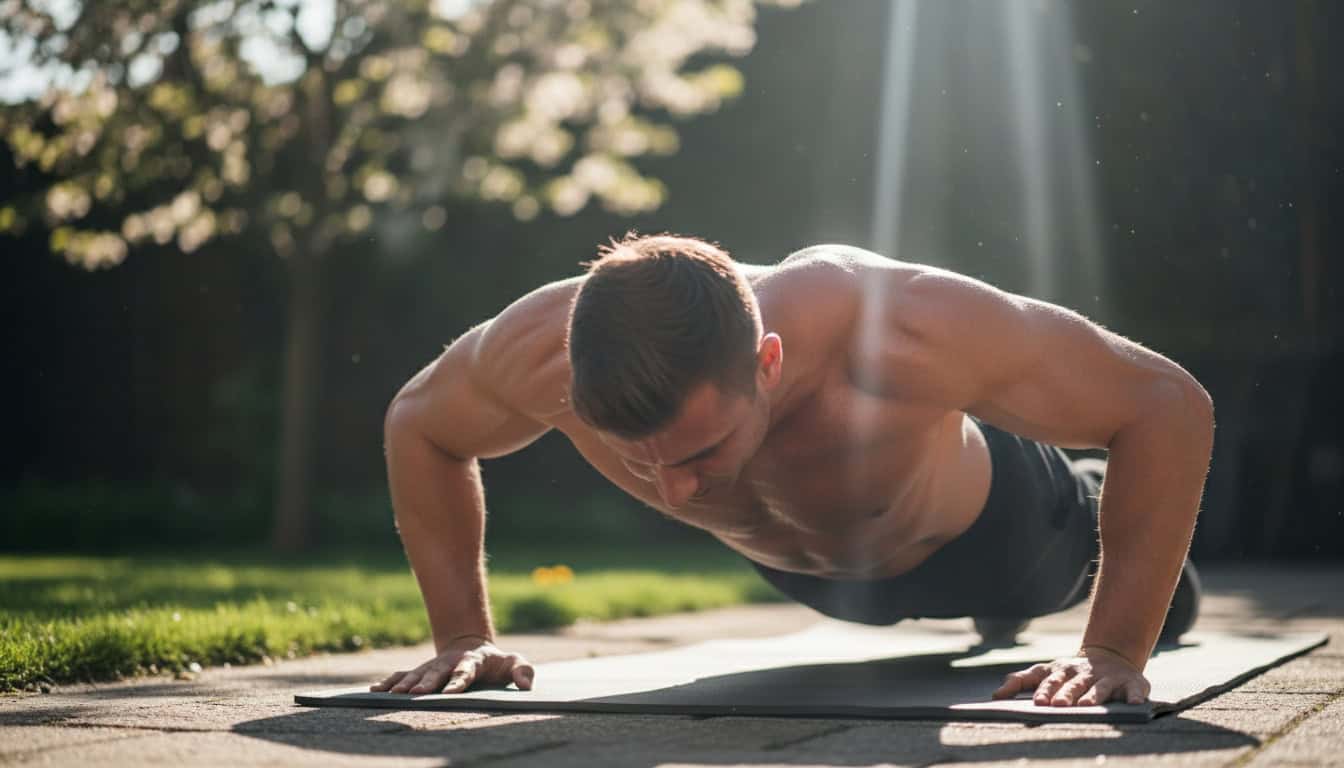
Start with a 5‑minute dynamic stretch to wake up your muscles, then hit standard push‑ups and progress to archer variations for chest and shoulder growth. Use an inverted row on a sturdy surface as a pull‑up alternative, and power up with Bulgarian split squats for quad and glute strength. Advance to pistol squats for single‑leg power, then do plank‑to‑push‑ups to lock in core stability. Add glute bridge marches for hamstrings, hand‑supported push‑ups for shoulders, and finish with a quick mobility cool‑down—keep going to discover the full routine.
Table of Contents
Warm‑Up: 5‑Minute Dynamic Stretch Routine for Muscle Activation
Five minutes of dynamic stretching primes your muscles and joints, boosting blood flow and neural activation before you dive into the workout. You’ll start with arm circles—30 seconds forward, 30 seconds backward—to lubricate shoulder girdles. Then move into leg swings, front‑to‑back and side‑to‑side, 45 seconds each, opening hips and hamstrings.
Next, perform inchworms: walk hands forward, hold a plank, then walk feet to hands, repeating for a minute to engage core and posterior chain. Follow with hip openers—standing figure‑four circles, 30 seconds per side—to mobilize glutes and piriformis. Finish with a quick spinal twist, rotating torso while keeping hips square, 45 seconds each direction, to awaken thoracic mobility.
This routine raises core temperature, improves range of motion, and primes neural pathways, ensuring you’re ready to execute bodyweight movements efficiently and safely.
Bodyweight Push‑Up Variations: Progress From Standard to Archer
You start with a solid standard push‑up form, keeping your core tight and elbows close to your body.
When you feel ready, shift your weight laterally into an archer push‑up, extending one arm while the other supports most of the load.
Use gradual progression tips—like widening hand placement or adding tempo variations—to bridge the gap between the two moves and keep the muscles challenged.
Standard Push‑Up Form
When you master the standard push‑up, you lay the foundation for every advanced variation, because proper alignment, core tension, and controlled descent keep the movement safe and effective.
Start in a high plank, hands shoulder‑width apart, fingers pointing forward. Keep your body in a straight line from head to heels; avoid sagging hips or a pike.
Engage your core, glutes, and quadriceps throughout.
Lower yourself until your chest is just above the floor, elbows tucked at about a 45‑degree angle to your torso.
Push back up, fully extending the elbows without locking them.
Breathe in on the way down, exhale on the way up.
Maintain a neutral neck, looking a few inches ahead, and keep the shoulder blades retracted to protect the joints.
This form maximizes chest, shoulder, and triceps activation while minimizing injury risk.
Archer Push‑Up Technique
Mastering the standard push‑up gives you the stability and core tension needed to expand your range of motion, and the archer push‑up builds on that foundation by shifting the load laterally. Start in a wide‑hand position, feet hip‑width apart, and lower your chest toward one hand while the opposite arm stays straight, forming a “bow” shape. Keep your spine neutral, engage your glutes, and breathe in as you descend. Push through the bent arm to return to the top, then repeat on the other side. Alternate sides for each rep, maintaining controlled tempo and full range of motion. This unilateral load forces the chest, shoulders, and triceps to work harder, improving strength, stability, and muscular balance. Practice consistently, and you’ll notice a clear jump in upper‑body power.
Progression Tips and Variations
Even if you’ve nailed the standard push‑up, moving toward the archer version requires deliberate steps: start by widening your hand placement and adding a shallow incline, then progress to a deeper incline, a staggered‑hand push‑up, and finally a full‑range archer.
- Widen your grip to feel a stronger chest stretch and engage your core.
- Add a shallow incline (a low bench or step) to reduce load while mastering the wider hand stance.
- Deepen the incline gradually, increasing the angle as your strength improves.
- Try staggered‑hand push‑ups, placing one hand forward to mimic the archer’s asymmetry.
- Execute the full archer by fully extending one arm while the other bends, maintaining a controlled, powerful motion.
These progressions build confidence, power, and stability, turning a simple push‑up into a dynamic, muscle‑building movement.
Pull‑Up Alternative: Inverted Row Using a Sturdy Surface
Pick a sturdy table or low bar that can support your weight, then set your hands at a width that feels comfortable for your shoulders. Pull yourself up with a controlled tempo, pausing briefly at the top before lowering slowly through a full range of motion.
This simple setup lets you target the same muscles as pull‑ups while keeping the movement safe and effective.
Choose Proper Surface
A sturdy, level surface—like a sturdy table, a low bar, or a set of parallel rails—lets you perform inverted rows safely and effectively. Choose a surface that won’t wobble, can support your weight, and offers enough clearance for your feet. Test it first by applying pressure with your hands; if it feels solid, you’re good to go. Keep the area around the surface clear of obstacles, and make sure the surface is clean to avoid slipping. A proper surface boosts confidence, protects joints, and lets you focus on pulling with power.
- You feel grounded, not shaky.
- Your grip stays firm, no slipping.
- You hear a satisfying, steady creak of strength.
- Your muscles engage fully, no distractions.
- You finish each rep with pride and control.
Adjust Grip Width
Ever wondered how a simple change to your hand placement can target different muscle groups during an inverted row? Shifting your grip wider spreads the load across the rear deltoids and upper back, while a narrow grip pulls more from the mid‑trapezius and biceps. To experiment, start with a shoulder‑width grip, then move your hands a few inches outward. Feel the stretch in your lats as you pull, and notice the increased activation in your shoulders when the grip widens. Conversely, bring your hands closer together to emphasize the inner back and arms. Keep your elbows flared slightly on a wide grip and tucked on a narrow grip for optimal joint alignment. Adjusting grip width lets you sculpt a balanced, stronger upper body without extra equipment.
Control Tempo and Range
Changing your grip sets the stage for the next factor that determines how effective an inverted row will be: the tempo and range of motion. Slow, controlled reps force muscle fibers to stay under tension longer, boosting hypertrophy. Full range—from a deep stretch at the bottom to a chin‑over‑bar at the top—recruits every fiber in the back, biceps, and core. If you rush, you lose tension and risk sloppy form; if you cut the range, you miss the stretch‑shortening cycle that drives growth. Play with eccentric (lowering) speed, pause at the peak, and explosive concentric (pull) phase to keep the stimulus fresh.
- Lower for 3‑4 seconds, feeling the stretch
- Pause 1 second at the top, squeezing shoulder blades
- Pull up explosively, aiming for a quick contraction
- Use a full range: chest to bar, elbows fully extended
- Adjust tempo weekly to avoid adaptation and keep progress steady
Bulgarian Split Squat: Build Quad & Glute Power on One Leg
Even if you’ve never tried it, the Bulgarian split squat lets you isolate each leg while blasting the quads and glutes, giving you powerful, balanced strength in a single movement. Set a sturdy bench or chair behind you, place one foot on it, and keep the other firmly planted forward. Lower your hips until the front thigh is parallel to the floor and the back knee hovers just above the ground. Drive through the front heel to rise, squeezing the glute at the top. Keep your torso upright, core engaged, and knee tracking over the toes to protect the joint. Perform 3–4 sets of 8–12 reps per side, adjusting depth or tempo as you progress. This unilateral load forces the supporting muscles to stabilize, improving symmetry and preventing dominance by the stronger leg. Incorporate it regularly to build quad size, glute power, and overall lower‑body resilience without any equipment beyond a bench.
Pistol Squat Progression: Develop Full‑Leg Strength Without Weights
When you master the pistol squat progression, you’ll develop single‑leg strength that rivals weighted lifts—no equipment required. Begin with a supported version: use a sturdy pole or a wall for balance, hinge at the hips, and lower yourself until the non‑supporting leg lifts forward. Once you can control this, transition to a box pistol, sitting back onto a low platform before standing up. Next, try a negative pistol: jump up with both legs, land on one, and slowly descend. Finally, attempt the full pistol, keeping the torso upright, core engaged, and the free leg extended. Consistent practice builds quad, hamstring, and glute power while enhancing balance and mobility.
- Feel the burn as you conquer each rep.
- Experience the pride of progressing without weights.
- Notice your stability improving daily.
- Celebrate the freedom of training anywhere.
- Embrace the confidence that comes from mastering a demanding move.
Chair Dips: Target Chest, Triceps, and Front Delts
Chair dips let you sculpt your chest, triceps, and front delts using just a sturdy seat, making a powerful upper‑body workout accessible anywhere. Position your hands shoulder‑width apart on the edge, legs extended, feet planted firmly. Lower your body until elbows form a 90‑degree angle, then press up, fully extending the arms. Keep shoulders down and core engaged to protect the shoulders. For added difficulty, elevate your feet on another chair or place a weight on your lap. Aim for three sets of eight to twelve reps, resting 60 seconds between sets. Focus on a controlled descent and an explosive push to maximize muscle tension. Maintain a straight back; avoid letting the elbows flare outward, which shifts stress to the shoulders. Progress by increasing range of motion, adding tempo variations, or integrating pause‑at‑bottom holds. Consistent practice will build strength, improve endurance, and shape the upper body without any equipment beyond a reliable chair.
Plank‑To‑Push‑Ups: Boost Core Stability and Upper‑Body Strength
You’ll feel your core fire up as you hold the plank, then transition smoothly into a push‑up, engaging both stabilizers and movers.
This flow lets you maintain tension across the entire body, building upper‑body strength without breaking form.
Increase the challenge by adding reps, pausing at the top, or elevating your feet for progressive difficulty.
Core Activation Mechanics
If you want a move that simultaneously fires your core and builds upper‑body strength, the plank‑to‑push‑up is the answer. You’ll feel your transverse abdominis tighten, your obliques engage, and your rectus abdominis stabilize as you transition smooth.
Keep momentum to. into the to movement keeps the core alive, preventing sagging and protecting the spine. Focus on breath, exhaling as you push up and inhaling as you lower. Consistency builds neural pathways, turning the exercise into an automatic core‑activation habit.
- You’ll notice a stronger, flatter midsection after each set.
- Your balance improves, letting you move confidently in daily activities.
- You’ll feel a surge of power when your core and upper body work together.
- Your confidence rises as you master a challenging, functional move.
- You’ll experience less lower‑back fatigue during other workouts.
Upper‑Body Transition Flow
Ever wondered how a single movement can fire your core while sculpting your chest, shoulders, and triceps? The plank‑to‑push‑up transition does exactly that. Begin in a forearm plank, shoulders stacked over elbows, body in a straight line. Engage your abs, glutes, and quads. Push up onto your hands, one arm at a time, keeping hips level. Lower back down to the forearms, maintaining control. Each rep challenges the transverse abdominis and obliques while loading the pectorals, deltoids, and triceps. Aim for three sets of eight to twelve reps, pausing briefly at the top to squeeze the chest. Keep breathing steady, and avoid sagging hips or flared elbows. This fluid shift builds functional upper‑body strength and core stability in one efficient motion.
Progressive Difficulty Scaling
When you master the basic plank‑to‑push‑up, you can quickly amplify its challenge by adding tempo changes, weighted vests, or single‑leg variations, each step forcing greater core activation and upper‑body load. Start by slowing the descent to three seconds, then pause at the bottom for a count of two. Add a light vest to increase resistance without sacrificing form. Progress to lifting one leg, alternating sides each rep. Finally, combine tempo and weight for a true strength‑building circuit.
- Feel the burn as your core tightens under slower moves.
- Experience the surge of power when the vest adds extra load.
- Notice the balance boost from single‑leg work.
- Celebrate each rep that feels tougher yet more rewarding.
- Embrace the confidence that comes with mastering each progression.
Glute Bridge March: Activate Posterior Chain for Bigger Hamstrings
Ever wondered how a simple movement can fire up your entire posterior chain while sculpting stronger hamstrings? The glute bridge march does exactly that. Start lying on your back, knees bent, feet flat. Lift hips into a bridge, squeeze glutes, then alternately lift each heel toward your glutes, keeping hips level. This marching action isolates the hamstrings, glutes, and lower back, forcing them to work together for stability and power.
Perform three sets of 12‑15 marches per leg, pausing briefly at the top of each lift. Keep your core engaged to avoid arching the lower back, and drive through your heels to maximize hamstring activation. As you progress, add a pause of two seconds at the apex or place a light weight on your hips for extra resistance. Consistent marching builds endurance, improves hip extension, and creates a solid foundation for bigger, stronger hamstrings without any equipment.
Handstand‑Supported Push‑Ups for Shoulder Strength and Body Control
Looking to boost shoulder strength while mastering body control? Handstand‑supported push‑ups let you defy gravity and forge rock‑solid deltoids. You’ll engage the entire shoulder girdle, core, and wrist stabilizers, turning a simple press into a full‑body challenge. Start against a wall for safety, then progress to free‑standing as confidence builds. Keep your body tight, elbows close, and breathe steadily—each rep feels like a triumph over gravity.
- Feel the surge of power as you push your feet higher, shoulders burning with purpose.
- Experience the rush of balance when your core tightens, turning instability into strength.
- Enjoy the confidence boost when you hold the pose longer than before.
- Relish the satisfaction of mastering a skill that looks impressive and feels empowering.
- Celebrate the progressive overload you achieve without any equipment, just your own body.
Integrate three sets of five to eight reps into your routine, and you’ll notice stronger shoulders, better posture, and heightened body awareness.
Cool‑Down: 5‑Minute Mobility Stretch for Faster Recovery
Even after an intense session, a brief, focused cool‑down can dramatically speed up recovery and preserve mobility.
Start by standing tall, inhale, then exhale as you hinge forward, reaching for your toes. Hold the hamstring stretch for 30 seconds, feeling a gentle pull along the back of your legs.
Next, place one hand on a wall, step the opposite foot back, and lower your hips into a hip‑flexor stretch; switch sides after 20 seconds.
Move into a cat‑cow flow on all fours, arching and rounding your spine for 45 seconds to mobilize the thoracic region.
Transition to a seated spinal twist: sit, cross one leg over the other, and turn toward the crossed knee, holding for 30 seconds each side.
Finish with a deep chest opener—clasp your hands behind your back, lift gently, and breathe for 45 seconds. This routine flushes metabolites, reduces stiffness, and primes you for the next workout.
Frequently Asked Questions
Can I Train Daily Without Overtraining?
Yes, you can train daily if you vary intensity, target different muscle groups, and include active recovery. Keep sessions short, listen to soreness, and prioritize sleep and nutrition to avoid overtraining.
How Many Reps Should I Aim for Each Exercise?
Aim for 8‑12 reps per set, adjusting the weight or difficulty so the last rep feels challenging but doable. If you’re hitting failure early, lower the rep range or add assistance. Keep rest short, then repeat.
Do I Need Equipment for the Pull‑Up Alternative?
No, you don’t need equipment for the pull‑up alternative; just find a sturdy horizontal bar, a tree branch, or a playground set. Use your body weight, focus on controlled motion, and increase volume gradually.
What’s the Best Rest Time Between Sets?
You should rest 60‑90 seconds between sets for most bodyweight moves; if you’re lifting heavy or doing plyometrics, push it to 2‑3 minutes. Shorter rests boost endurance, longer rests increase strength gains.
Can Beginners Skip the Pistol Squat Progression?
You shouldn’t skip the pistol‑squat progression; the steps build balance, strength, and joint stability. Jumping straight into full pistols risks injury and limits the muscle gains you could achieve safely.
Conclusion
You’ve just equipped yourself with a compact, full‑body routine you can hit anytime, anywhere. By mixing push, pull, leg, and core moves, you hit every major muscle group without any equipment. Stick with the progression, keep the tempo steady, and listen to your body. Consistency will turn these daily sessions into real strength gains, better mobility, and a healthier, more resilient you.


Sorry, the comment form is closed at this time.