
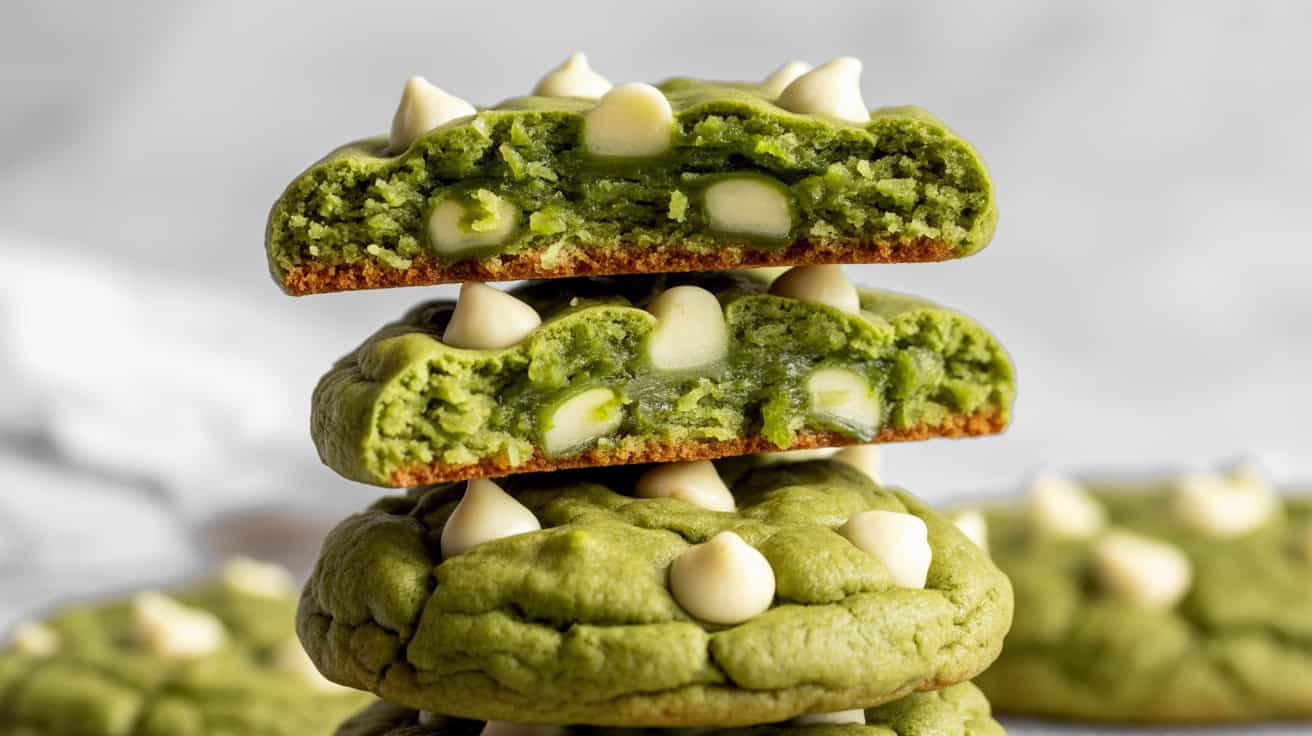
You’ll make 24 soft cookies with 1¾ cups flour, 2 tsp ceremonial matcha, ½ tsp baking soda, ¼ tsp salt, ¾ cup butter, 2/3 cup brown sugar, 1/3 cup sugar, 1 egg, 1 tsp vanilla and 1 cup chopped white chocolate. Cream butter and sugars until pale, fold in dry mix, chill 30–45 minutes, scoop 1½‑inch portions and bake at 350°F 9–11 minutes for tender, chewy centers and light edges. See technique, storage and pairing tips.
Table of Contents
Key Takeaways
- Use 1 3/4 cups flour, 2 tsp culinary matcha, 3/4 cup butter, 2/3 cup brown sugar, 1 egg, and 1 cup white chocolate.
- Prefer ceremonial-grade matcha for vivid flavor, or culinary-grade for stable color when baking.
- Cream butter and sugars until pale, add egg and vanilla, then fold in sifted dry ingredients gently.
- Chill the scooped dough for 30–60 minutes, bake at 325°F (163°C) for 11–13 minutes until edges set and centers glossy.
- Cool on a rack, store airtight up to 3 days at room temperature, and pair with a matcha latte or jasmine tea.
Why You’ll Love These Cookies
Because they balance vivid matcha and melting white chocolate with a tender, chewy crumb, use one tablespoon of finely sifted ceremonial matcha and 1 cup (175g) of white chocolate chips for clear green flecks and sweet pockets.
You’ll notice an immediate contrast: a satin green aroma, subtle umami, and a warmth reminiscent of buttered sugar. Measure dough to 1.5 tbsp scoops, chill 30–45 minutes to firm fats, then press slightly before baking for an even spread and optimal cookie texture.
Bake at 175°C (350°F) for 9–11 minutes, until the edges are set and the centers remain soft. Cool for 5 minutes on the sheet to finish the structure. Temper dough handling—don’t overmix once flour’s folded—to preserve lift and tender crumb.
Use light coarse salt on top for flavor lift and quick chill between batches to maintain a consistent spread. The matcha benefits are clear: concentrated antioxidants, vegetal brightness, and stable color that withstands gentle heat, delivering balance in each precise bite.
Ingredients
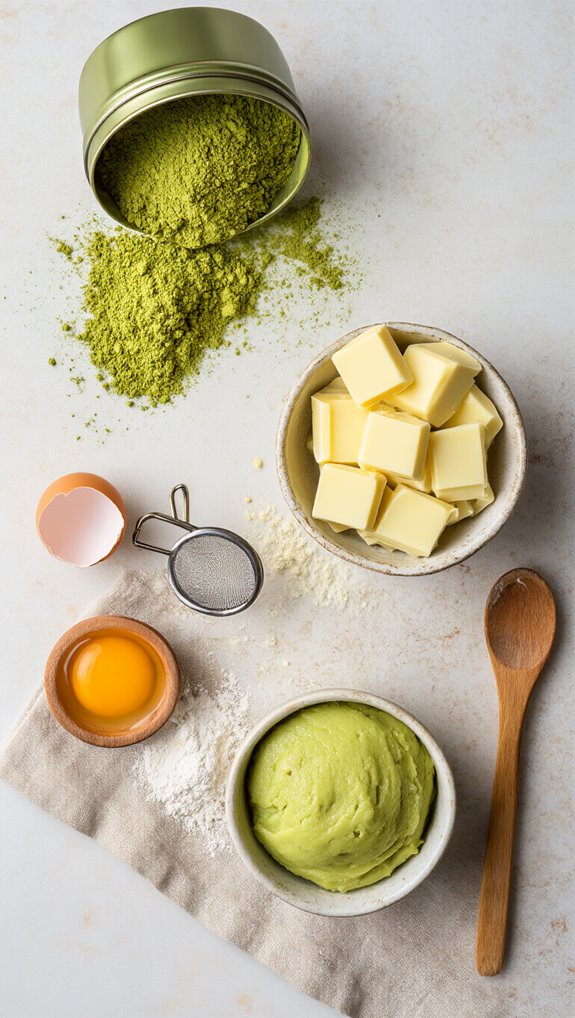
You’ll need 1 3/4 cups all-purpose flour, 2 tsp culinary-grade matcha, 1/2 tsp baking soda, 1/4 tsp salt, 3/4 cup unsalted butter (softened), 2/3 cup packed brown sugar, 1/3 cup granulated sugar, 1 large egg, 1 tsp vanilla, and about 1 cup chopped white chocolate for the base cookie. You can stir in 1/2 cup chopped macadamia nuts, 1/3 cup dried cranberries, or an extra tablespoon of matcha for a greener, earthier bite. If you need swaps, use a 1:1 gluten-free flour blend for flour, coconut oil for butter (chill dough 30–45 minutes), or swap dark chocolate chips for the white for more bitterness.
Core Ingredients List
Foundation: this cookie dough uses 2 cups (250 g) all‑purpose flour, 2 tsp cornstarch, 1 tsp baking powder and ½ tsp fine salt, plus 2 tbsp sifted culinary matcha for bright color and a clean, grassy aroma.
You’ll cream 1/2 cup (113 g) unsalted butter with 3/4 cup (150 g) granulated sugar and 1/4 cup (50 g) light brown sugar until pale, 2–3 minutes. Beat in 1 large egg and 1 tsp vanilla.
Fold dry mix until just combined to preserve tenderness. Use 1 cup (180 g) coarsely chopped white chocolate; choose quality chocolate options to balance sweetness.
Consider matcha types—ceremonial for vivid flavor, culinary for baking stability—and adjust sifted amount if using stronger varieties to keep texture even.
Chill the dough 30–60 minutes first.
Optional Add-ins
A few measured add-ins can sharpen the matcha and balance sweetness: fold in up to 1/2 cup total of mix-ins such as 1/2 cup coarsely toasted pistachios or almonds (toast 6–8 minutes at 350°F until fragrant, then cool), 1/3 cup dried tart cherries or cranberries (finely chopped), 1/3 cup toasted shredded coconut, or an extra 1/2 cup white chocolate chips for pockets of melty sweetness; stir in 1 tsp finely grated lemon zest or 1 tsp orange zest for brightness, or sprinkle 1/2–1 tsp flaky sea salt on tops before baking to enhance contrast.
- Crunch: coarsely chopped pistachios, briefly toasted.
- Brightness: finely grated lemon zest.
- Sweet pockets: extra white chocolate chunks, dried fruit pieces.
Chill dough 20–30 minutes; bake 10–12 minutes until edges set.
Ingredient Substitutions
If you need to swap ingredients, keep ratios and sensory goals in mind: for flour, use a 1:1 gluten-free all‑purpose blend (include 1 tsp xanthan gum per cup if not in the blend) or replace up to 25–30% of the all‑purpose with whole‑wheat pastry flour to add nutty flavor and slight chew without drying (use the same weight, not volume);
for fat, substitute browned butter or unsalted butter 1:1 for richer, toasty notes, or virgin coconut oil 1:1 for subtle coconut aroma but chill dough an extra 15–20 minutes to firm;
for sugar, swap up to 50% granulated sugar with light brown sugar 1:1 to boost moisture and caramel complexity, or use 3/4 cup granulated + 1/4 cup powdered sugar for a finer crumb;
Replace the egg with 3 Tbsp aquafaba or 1/4 cup mashed banana (adds moisture and slight banana flavor) if needed;
For matcha, use ceremonial or high‑grade culinary matcha at the stated 2 Tbsp for bright, grassy notes—if using lower‑grade, increase by 1 tsp and taste the dough;
replace white chocolate chips with 1:1 chopped ruby or milk chocolate for color and creaminess, or 1/2 cup toasted macadamia nuts for crunch;
Finally, adjust leavening only by weight (0.5 tsp baking soda ≈ , 2.5 g) and keep flaky sea salt on top as written to preserve contrast.
Use ingredient alternatives deliberately: weigh flour and leavening, note moisture shifts, and document recipe modifications so texture and flavor stay consistent.
Equipment Needed
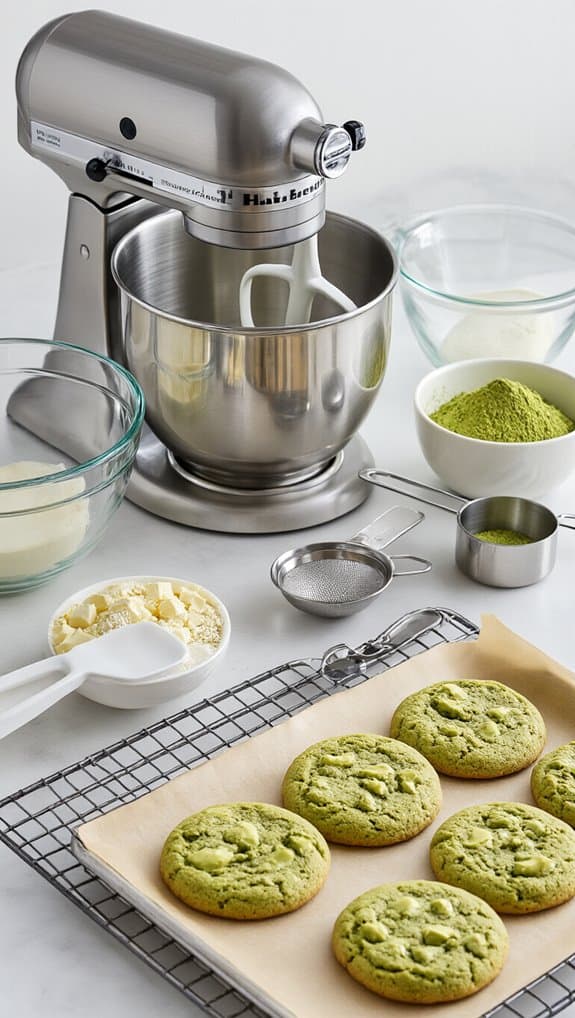
Before you start, lay out the essential tools so you move efficiently: a stand mixer with paddle (or a handheld mixer) for 2–3 minutes of creaming, a digital scale (accurate to ±1 g) for weighing 240 g flour and 170 g butter, a 30 mL (2 Tbsp) cookie scoop for uniform 30–35 g portions, two half-sheet baking pans (13 × 18 in) lined with parchment or silicone mats, a fine-mesh sieve for sifting 8–10 g matcha to remove lumps, a set of measuring spoons for 1.5 tsp baking powder/salt, a 1.5–2 L mixing bowl for combining wet and dry components, a rubber spatula to fold in 150–175 g chopped white chocolate without overworking the dough, an oven thermometer to ensure an accurate 170–175°C (340–350°F) bake, and a wire cooling rack (about 30 × 40 cm) so cookies stop cooking evenly once they come out.
- glossy
- vibrant
- melty
Start.
Choosing and Preparing Matcha
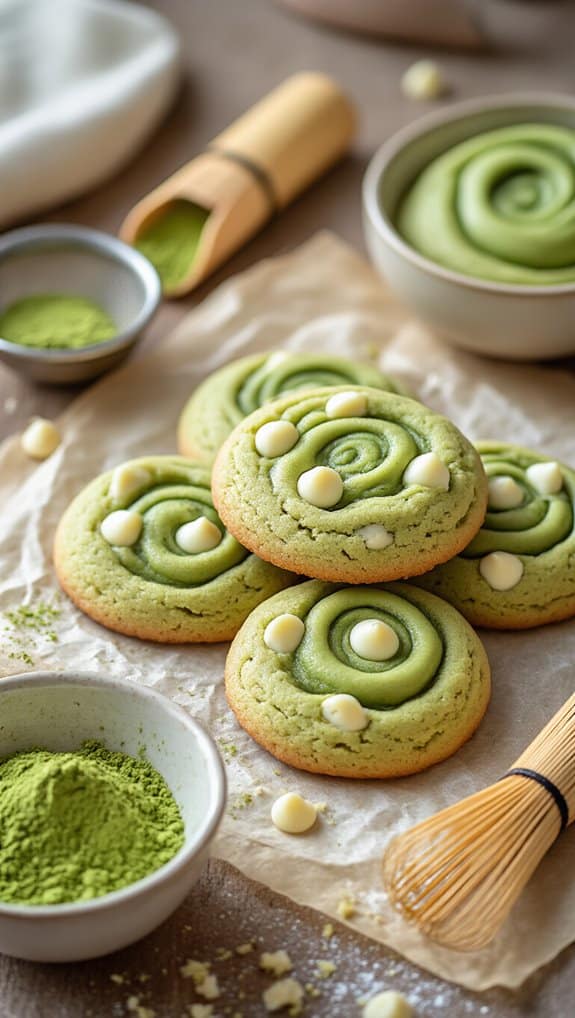
Choose a vibrant, bright-green ceremonial-grade matcha for its clean, grassy-sweet aroma and creamy finish (use 8–10 g per batch), or opt for culinary grade if you want a sturdier, slightly roasted taste; weigh the powder on your digital scale, then push it through your fine-mesh sieve into a bowl to remove lumps.
You’ll measure 9 g for a balanced green hue and subtle umami; larger batches scale linearly (18 g per double batch). Note matcha quality by color, scent, and texture: vivid green, brisk vegetal aroma, and powdered silkiness.
For flavor control, taste a 0.5 g pinch dissolved in 5 ml of warm water. Use a dry spoon and an airtight container; seal immediately after measuring.
For matcha storage, keep powder in a cool, dark place, ideally refrigerated at 2–6°C, and use within 30 days of opening. Handle quickly to avoid moisture or light exposure that dulls aroma and bitterness.
Creaming the Butter and Sugar
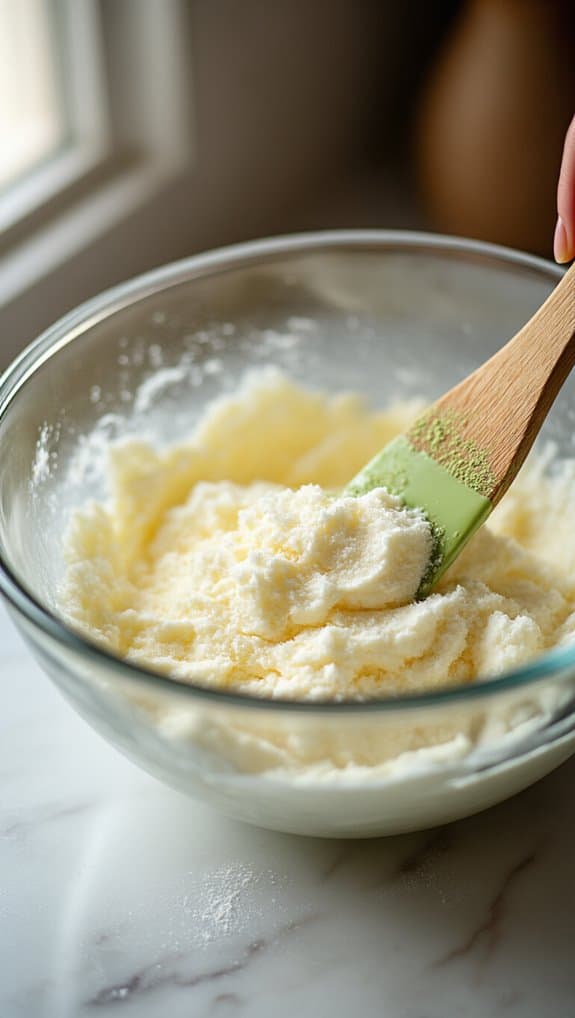
Use 113 g (1/2 cup) unsalted butter at 65–68°F (18–20°C) so it yields to gentle thumb pressure but still holds its shape.
Beat with a paddle or hand mixer on medium speed, adding 150 g (3/4 cup) granulated sugar in two additions over 2–3 minutes to incorporate air without warming the butter.
You’re aiming for a pale, airy, creamy mass that falls in a thick ribbon from the beater and holds briefly — that texture tells you to stop and fold in the dry ingredients.
Room-Temperature Butter
Anyone can get butter to the right softness: 1 cup (226 g) should register about 65–68°F (18–20°C), pliable yet still holding its shape. You’ll test Butter temperature with a fingertip; it should yield slightly, leave a faint impression, and still feel cool.
For Baking techniques, this precise temperature ensures even incorporation with sugar and consistent dough spread. Visualize texture and scent:
- Smooth surface, no glossy melt, slight matte sheen.
- Soft edges, clean knife glide, faint buttery aroma.
- Finger impression recovers slowly, not oily or sticky.
Weigh accurately, room conditions matter: cool kitchens may need 15–20 minutes; warm rooms less. Adjust by short rests, not heat. Aim for predictable consistency before you proceed.
Measure again if unsure; repeat waits in small increments for precision and accuracy.
Creaming Technique Tips
Start by placing 1 cup (226 g) room‑temperature butter and 1 cup (200 g) granulated sugar in the bowl, then beat with a paddle attachment on medium (about speed 4 on a KitchenAid) for 2–4 minutes until the mix is noticeably lighter in color, airy, and increased in volume by roughly 30–50%.
Keep the bowl scraped every 30 seconds so pockets of unworked butter don’t remain; you want uniform aeration. If butter temperature is cooler, let it sit 10–15 minutes or use brief 5–8 second pulses to avoid overworking.
Watch for sugar crystals dissolving against the paddle; stop when you feel resistance drop. These creaming methods ensure even incorporation of air and sugar, improving dough structure without excessive heat or melting, or separation issues.
Desired Creamy Texture
When you cream 1 cup (226 g) room‑temperature butter with 1 cup (200 g) granulated sugar on medium speed (about a KitchenAid 4), beat 2–4 minutes until the mixture lightens in color, feels airy to the touch, and has gained roughly 30–50% in volume; scrape the bowl every 30 seconds to prevent unworked pockets and stop once you feel the resistance drop as sugar crystals begin to dissolve.
You’ll notice pale, ribboned batter that indicates trapped air and a creamy balance between fat and sugar. Fold additions gently to preserve aeration and texture contrast between tender crumb and molten white chocolate.
Visualize:
- pale, velvety ribbons falling slowly
- tiny glossy bubbles on the surface
- a satin sheen indicating dissolved sugar
Measure, observe.
Mixing the Dry and Wet Ingredients
Before combining, whisk 1 1/2 cups (190 g) all‑purpose flour, 2 tbsp (12 g) ceremonial‑grade matcha, 1/2 tsp baking soda, and 1/4 tsp fine salt in a bowl until pale green and free of lumps.
In a separate bowl, you’ll have creamed 1/2 cup (115 g) unsalted butter and 2/3 cup (135 g) light brown sugar until light and aerated, beat in 1 large egg and 1 tsp vanilla until glossy.
Use a silicone spatula to fold one-third of the dry mix into the wet, using gentle vertical strokes; these mixing techniques preserve air and prevent overdevelopment.
Pause between additions, scraping sides, and judging texture: the batter should form a cohesive, slightly tacky mass that yields when pressed.
Maintain the ingredient ratios and avoid vigorous stirring; stop as soon as streaks disappear.
Finish with controlled folds to ensure an even pale‑green dough, smooth with no flour pockets.
Shaping, Scooping, and Chilling the Dough
Once the dough is cohesive and slightly tacky, transfer it to a sheet of plastic wrap and press into a 1‑inch‑thick disk; this keeps the surface cool and makes scooping uniform. Chill the disk 30–60 minutes so the dough consistency firms to a slightly elastic, pliable state; cold dough preserves matcha color and prevents white chocolate from melting into the batter.
Use a 1½‑inch cookie scoop for 24 uniform portions; level each scoop and drop onto an insulated tray. For shaping techniques, handle minimal times to maintain lift: roll gently with floured palms or flatten to ¾‑inch thickness if you prefer wider cookies.
- Smooth, cool surface glows pale green.
- Firm edges yield defined domes.
- Tiny white chocolate pockets peek through.
Wrap any unused dough tightly and chill until firm; when ready, re-scoop quickly to retain texture and even spread. Maintain chilled temperature for best results.
Baking Time and Temperature
Although the dough’s chill helps prevent spreading, set your oven to 325°F (163°C) and bake the 1½‑inch scoops 11–13 minutes on the middle rack—edges should look set and pale green while centers remain slightly glossy, and they’ll finish firming as they cool.
Rotate the sheet once at 7 minutes for even color; use a light-colored baking sheet to avoid overbrowning. For consistent results weigh portions at 18–20 grams each and space them 2 inches apart.
Monitor aroma and texture: you’ll notice a faint sweet, vegetal matcha scent when near-done; edges will lose sheen first.
If your oven runs hot, make temperature adjustments of 5–10°F lower and shorten baking time slightly, checking at the earlier minute. Conversely, if cookies remain too soft after 13 minutes, raise temp 5°F or add 1–2 minutes.
Use visual cues over exact minutes; precise baking time varies by sheet, rack position, and oven calibration.
Cooling, Storing, and Reheating
After baking, let the cookies sit on the sheet 5 minutes to set, then transfer with a thin spatula to a wire rack and cool 30–45 minutes until the centers lose gloss and feel slightly springy to the touch.
Use Cooling techniques: cool in a single layer, avoid stacking for 1 hour, and rotate the rack halfway for even air exposure.
For Storing methods, place completely cooled cookies in an airtight container: layer with parchment, seal, and store at room temperature up to 3 days for optimal Cookie longevity; refrigerate up to 10 days or freeze up to 3 months in a labeled freezer bag.
Reheating tips: microwave 6–8 seconds on medium to soften, or warm in a 300°F oven 4–5 minutes on a tray to restore surface chew and melt white chocolate chips.
Visual cues: crisp edges, matte centers, slight bounce indicate readiness for storage or reheating.
- thin spatula lifts cookies without tearing
- parchment layers prevent sticking and moisture transfer
- wire rack air circulation gives even matte finish
Variations and Serving Ideas
Try folding in 1/2 cup toasted sesame seeds or 3 tbsp finely chopped pistachios to add nutty crunch and amplify the grassy matcha.
For dietary swaps, you’ll replace 1 cup butter with 3/4 cup coconut oil and 3/4 cup almond flour for a gluten-free crumb, or sub 1 egg with 1 tbsp ground flax mixed with 3 tbsp water for vegan binding.
Pair the cookies with 6–8 oz steamed milk, an 8 oz cup of hojicha for toasted aroma, or a 6 oz matcha latte to echo the green-tea notes.
Flavor Variations
When you want a brighter, bolder matcha profile, increase the matcha to 2½ tsp (add 1 tsp), sift it with the 150 g flour to prevent clumps, and expect a more herbal, slightly bitter note against the sweet white chocolate. For subtler change try matcha alternatives like hojicha (1½ tsp roasted powder); measure by teaspoon, adjust to taste. Visualize:
- vibrant green crumb
- glossy white chocolate pockets
- speckled pistachio crunch
Use cookie toppings sparingly: sprinkle 5 g flaky sea salt or press 20 g chopped pistachios into dough before baking. Texture guidance: chill 30 to 45 minutes and you’ll control spread; bake 10 to 12 minutes at 170°C for soft centers. Plate warm, serve with 150 ml milk or green tea. Enjoy for texture.
Dietary Swaps
If you need swaps for diet or allergy reasons, start by matching weights and texture: replace the 150 g all-purpose flour with 150 g 1:1 gluten-free flour plus 1/4 tsp xanthan gum to mimic chew, and keep the 30–45 minute chill to control spread. You swap 100 g butter for 90 g coconut oil or 100 g vegan butter; expect slightly flatter edges and hint of coconut. Use 80 g white chocolate chips or 80 g dairy-free chips; expect less creaminess. For lower sugar, reduce 120 g of granulated sugar to 80 g and add 30 g of applesauce for moisture.
| Swap | Amount | Effect |
|---|---|---|
| Flour | 150 g | Chew |
| Butter | 90 g | Aroma |
| Sugar | 80 g | Moist |
| Chips | 80 g | Less creamy |
Contains healthy alternatives and ingredient swaps.
Beverage Pairings
Because the swaps change fat and sugar notes—coconut oil adds a faint coconut aroma, dairy-free chips cut creaminess—you’ll want beverages that balance sweetness and highlight matcha’s bitter-green lift.
Choose a 6-oz matcha latte prepared 1:1 milk-to-water, 1 tsp matcha whisked to foam; its creamy mouthfeel tames sugar and echoes vegetal notes.
For contrast, brew 8-oz jasmine iced tea, chill to 40°F, add 10 g simple syrup, pour over ice to sharpen citrus and lift.
Serve a 3-oz cold-brewed oolong concentrate, dilute 1:2 with sparkling water for tannin clarity and palate cleanse.
Pairing technique:
- 6-oz creamy matcha latte, froth microfoam, sip slowly.
- 8-oz jasmine iced tea, crystal-clear, ice-clinking.
- 3-oz oolong concentrate, effervescent rinse.
Rotate combinations; adjust sweetness by 2–5 grams per cookie.
Frequently Asked Questions
Is This Recipe Safe for Pregnant or Nursing People?
Yes, you’ll usually enjoy them in moderation.
For pregnancy safety, limit caffeine from matcha to about 200 mg daily (roughly 1–2 teaspoons matcha total), and check pasteurized white chocolate.
For lactation considerations, note flavor transfer; taste is sweet, creamy, vegetal.
Use 1 cup butter, 1/2 cup sugar, gentle 10–12 minute bake for soft centers, cool 10 minutes on rack to set texture before serving, and consult your provider regularly today.
How Should I Adjust Ingredients for High-Altitude Baking?
Reduce baking powder by 1/8 teaspoon and sugar by 1–2 tablespoons, increase flour by 1–2 tablespoons; for moisture, add 1 tablespoon extra butter or 1 tablespoon milk—these Ingredient substitutions keep texture.
Raise oven temperature 15–25°F and shorten Baking time by 1–3 minutes, watching edges for golden, tender centers.
Press dough slightly flatter, chill 15 minutes, and test with a toothpick to ensure soft, chewier, not collapsed cookies with subtle chew.
Can I Sell These Cookies Commercially Without Special Permits?
You can’t sell them without checking local commercial permits and food regulations.
Measure 2 cups flour, 1 tsp baking soda, 1/2 tsp salt; fold 1 cup white chocolate, 2 tbsp matcha for grassy aroma, 1 cup butter, 3/4 cup sugar; chill dough 30 minutes, scoop 1.5 tbsp, bake at 350°F for 10–12 minutes until edges set and centers stay soft.
Follow inspections, labeling, and sanitary techniques and document ingredient sourcing.
What’s the Approximate Calorie Count per Cookie?
About 200 calories per cookie.
For calorie breakdown, estimate 120 kcal from 28 g dough (butter+sugar+egg), 60 kcal from 15 g white chocolate, 20 kcal from 2 g matcha.
Use a 30 g serving size pre-bake, portion with a 1.5 tablespoon scoop.
You’ll feel a tender, chewy crumb, faint grassy matcha, and sweet pockets of chocolate.
Chill the dough 30 minutes to prevent spreading.
Bake 10–12 minutes at 175°C on parchment.
Will Matcha Stain Teeth, Fingers, or Clothing?
Yes, matcha can stain teeth, fingers, and clothing. You’ll need 1 tsp. Precautions: Rinse your mouth with 30–60 ml of water after consuming to reduce matcha staining and support tooth care.
When handling powder, wear a 1-layer apron and use a damp 2×2-inch cloth to blot spills immediately; avoid rubbing.
Sensory notes: vivid green powder, grassy aroma.
Technique tip: dissolve 1 tsp in 15–30 ml hot water to minimize grit and contact elsewhere.
Conclusion
You’ll finish by chilling the dough 30–45 minutes, then baking 10–12 minutes at 350°F until edges set and centers stay soft; remove on a wire rack and cool 5 minutes before transferring. You’ll taste bright, grassy matcha and sweet, creamy white chocolate with a tender, cakey crumb and slightly crisp edge. For best texture, measure 1 cup flour precisely, gently fold rather than overmix, and cool fully on racks; brush lightly with 1 tsp butter.


No Comments