
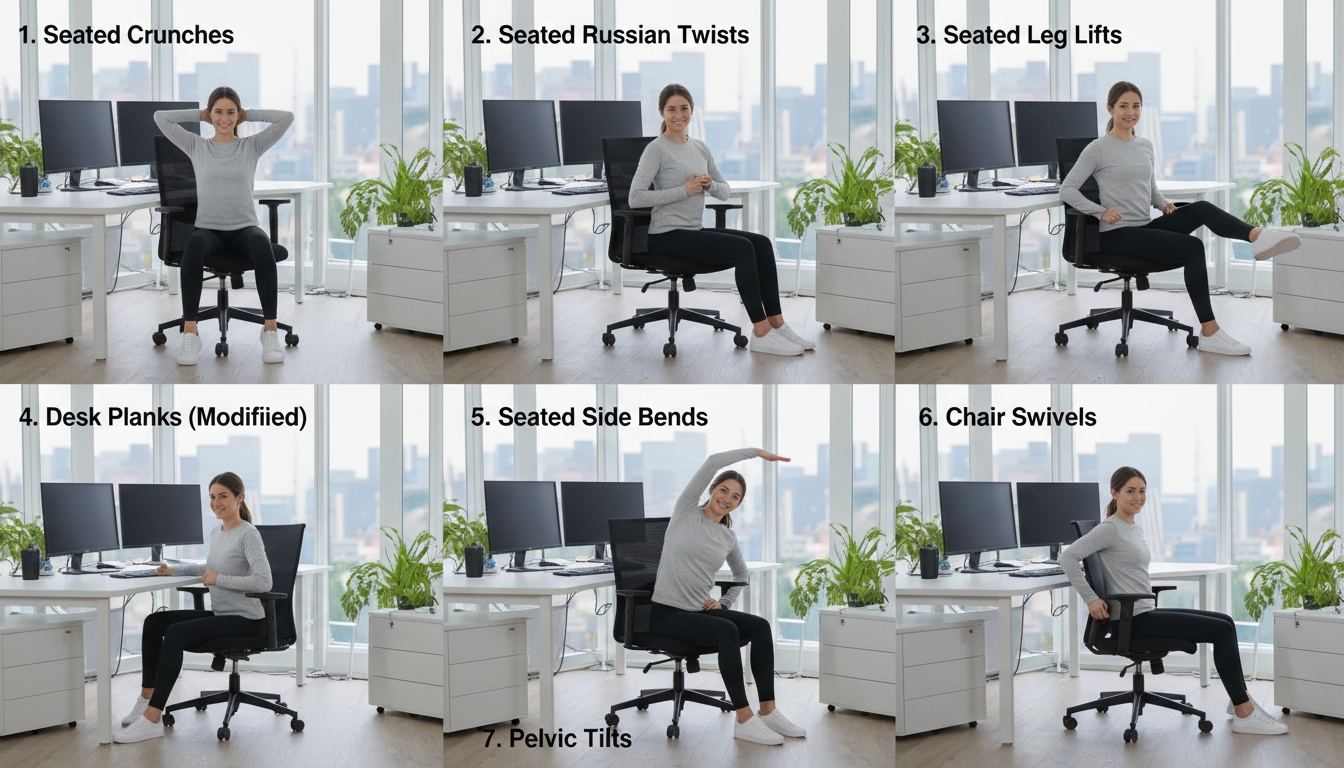
7 Seated Core Exercises To Do At Your Desk
Start with seated Russian twists: sit tall, clasp hands at your chest, and twist your torso right, elbows toward the back of the chair, then left, doing twelve reps per side. Follow with desk‑edge plank holds, side‑bends holding a water bottle, and pelvic tilts synced to your breath. Add desk‑based leg raises, chair‑supported bicycle crunches, and reverse seat crunches to hit lower abs. Cycle these moves every few minutes in meetings, and you’ll keep your core engaged and posture strong.
Table of Contents
Seated Russian Twists: Core Exercises at Work for a Quick Oblique Burn
Ever wondered how to fire up your obliques without leaving your chair? Sit tall, plant your feet flat, and clasp your hands together in front of your chest. Twist your torso to the right, bringing your elbows toward the back of the chair, then return to center.
Repeat on the left, and keep the motion fluid. Do three sets of twelve twists per side, pausing a beat at the peak of each turn.
To increase intensity, lean back slightly, engage your core, and lift your feet a few inches off the floor, maintaining balance. Keep your shoulders relaxed and avoid hunching; the movement should originate from your waist, not your arms.
Breathe steadily—inhale as you center, exhale as you twist. This simple routine isolates the obliques, improves rotational strength, and fits neatly into any workday break. You’ll feel a noticeable burn and a tighter midsection after just a few minutes.
Desk‑Based Leg Raises: Core Exercises at Work to Strengthen Lower Abs
After the twists, keep the momentum going with desk‑based leg raises to target those lower abs. Sit upright, feet flat, and place both hands on the edge of the desk for stability. Engage your core, then lift both knees toward your chest, keeping the spine neutral. Pause briefly at the top, then lower the legs slowly, resisting the pull of gravity. Aim for three sets of ten to twelve reps, adjusting the range of motion if your chair is low. To increase intensity, straighten the legs fully before descending, or hold a light weight between your ankles. Breathe out as you lift, inhale as you lower, and maintain a steady rhythm. This micro‑movement fits into any meeting or email session, burns calories, and reinforces the lower abdominal wall without leaving your workstation. Consistency will tighten the core and improve overall posture.
Chair‑Supported Bicycle Crunches: Core Exercises at Work for Full‑Core Activation
While you’re seated, a chair‑supported bicycle crunch lets you engage the entire core without leaving your desk. Sit tall, grip the edge of the chair, and lift one knee toward your chest while twisting the opposite elbow toward that knee. Extend the other leg straight, then switch sides in a fluid, controlled motion. Keep your spine neutral, avoid hunching, and breathe out on each twist. Perform 12–15 repetitions per side, aiming for two to three sets. The diagonal movement recruits rectus abdominis, obliques, and transverse abdominis, delivering full‑core activation. If space is tight, keep the legs shallow; for a greater challenge, straighten the moving leg fully. Maintain a steady cadence, and pause briefly at the top of each twist to maximize muscle tension. This exercise fits into any workday, boosts stability, and improves posture without disrupting productivity.
Reverse Seat Crunches to Hit the Lower Midsection (Core Exercises at Work)
If you want to target the lower midsection without leaving your chair, reverse seat crunches are a simple, effective move you can do in seconds. Sit upright, feet flat, and place your hands lightly on the seat behind you for balance. Engage your core, then draw your knees toward your chest while keeping your back straight. As you pull, contract the lower abs, and gently press the seat forward with your hands to increase resistance. Hold the contraction for a beat, then slowly extend your legs back to the starting position. Repeat for 12‑15 reps, focusing on controlled motion rather than speed. Breathe out on the pull and inhale on the release to maintain proper intra‑abdominal pressure. This exercise isolates the lower rectus abdominis, improves hip flexor activation, and fits seamlessly into a busy workday. No equipment needed—just your chair and a few minutes of mindful movement.
Desk‑Edge Plank Holds for Core Stability (Core Exercises at Work)
Reverse seat crunches fire up your lower abs, and the next move builds on that activation by challenging your entire core. For a desk‑edge plank, sit near the front of your chair, place your forearms on the edge, and straighten your legs, keeping heels on the floor. Engage your glutes, draw your belly button toward your spine, and lift your hips until your body forms a straight line from shoulders to heels. Hold this position for 20–30 seconds, breathing steadily, then lower gently. Repeat three to four times, extending the hold by five seconds each set as you grow stronger. This exercise recruits the rectus abdominis, obliques, and transverse abdominis while also activating the lower back and hip flexors, delivering a full‑body core workout without leaving your workstation. Keep your neck neutral and avoid sagging hips to maintain proper alignment and maximize stability.
Side‑Bends With a Desk‑Weight (Water Bottle) to Tone the Flanks
Place the water‑bottle on the side of your desk so it rests just above your elbow, giving you a steady counterbalance.
As you bend laterally, keep your spine neutral and move slowly, letting the weight guide a smooth arc.
Inhale as you return to center, exhale as you deepen the bend, syncing breath with each side‑bend.
Proper Desk‑Weight Placement
A few simple side‑bends with a water bottle desk‑weight can effectively tone your flanks while you work. Proper placement of the bottle determines leverage, balance, and safety. Hold the bottle in the hand opposite the bending side, keeping it close to your torso to avoid over‑stretching. Position it at shoulder height, letting the weight hang just above your elbow; this creates a natural pivot point and engages the obliques without straining your shoulder. Keep the bottle’s base stable on a flat surface, and avoid gripping it too tightly, which can fatigue the forearm. By aligning the weight with your spine, you’ll maintain a controlled motion and maximize the flank‑toning effect.
- Hold bottle opposite the bend side
- Keep bottle near torso, at shoulder height
- Ensure flat, stable base for the bottle
- Grip lightly to prevent forearm fatigue
Controlled Lateral Bending Form
With the bottle secured at shoulder height, start the side‑bend by engaging your core and gently leaning toward the weighted hand. Keep your spine neutral; avoid arching or rounding. Your hips should stay square, and your shoulders remain relaxed, allowing the movement to come from the waist. Hold the bend for one to two seconds, then slowly return to upright, feeling the stretch along the opposite side. Perform three sets of eight to twelve repetitions per side, pausing briefly between reps. Maintain steady, controlled motion—no jerking or sudden shifts. Keep your gaze forward to prevent neck strain, and ensure the desk weight stays stable throughout. This precise form isolates the obliques, tones the flanks, and improves lateral core stability.
Breath‑Synchronized Movement Timing
If you sync your breathing with each side‑bend, the movement becomes smoother and the core engages more fully. Inhale deeply, lift the water‑bottle weight, then exhale as you bend toward the opposite side, feeling the stretch along the ribcage and the contraction in the obliques. Keep your spine neutral, shoulders relaxed, and avoid jerking the weight. Repeat the pattern rhythmically, allowing the breath to dictate the tempo; this timing maximizes muscle activation while preventing tension buildup in the neck and lower back. By treating each breath as a cue, you turn a simple desk‑weight side‑bend into an efficient, low‑impact flank‑toner you can do anytime.
- Inhale while preparing, exhale while bending
- Maintain a neutral spine throughout
- Keep shoulders relaxed, avoid hunching
- Perform 8‑12 reps per side, then switch
Pelvic Tilts & Breathing to Keep Core Engaged in Meetings (Core Exercises at Work)
Ever feel your back slumping during long meetings? Try a simple pelvic tilt while you breathe. Sit upright, feet flat, knees at 90 degrees. Inhale deeply, expand your belly, then exhale and gently tuck your pelvis under, flattening the lower back against the chair. Hold the tilt for a count of three, then release as you inhale again. Repeat this cycle every five minutes to keep your core activated without drawing attention.
The tilt engages the transverse abdominis and lumbar stabilizers, while the breath coordinates movement and reduces tension. When you feel a slump, pause, inhale, tilt, and exhale—repeat three to five times. This micro‑exercise counters the forward‑lean that drains posture, improves spinal alignment, and steadies your focus. You can do it while listening, speaking, or taking notes, making it perfect for any meeting length. Consistent practice turns a passive sit into a subtle strength‑building routine.
Frequently Asked Questions
Can I Do These Exercises if I Have a Back Injury?
Yes, you can try them, but modify each move, keep movements gentle, and stop if pain spikes. Consult your therapist first, use proper posture, and avoid any exercise that strains your injured back.
How Many Repetitions Are Safe for Beginners?
You should start with eight to twelve repetitions per set, aiming for two or three sets. Focus on controlled movements, pause if you feel strain, and increase gradually as your core strengthens.
Do I Need a Special Chair for These Movements?
You don’t need a special chair; a stable, upright office chair works fine. Just make sure it supports your back, lets your feet rest flat, and doesn’t wobble while you engage your core.
Will These Desk Exercises Replace a Full Workout?
You won’t replace a full workout, but these desk exercises boost core activation, improve posture, and burn calories, helping you stay healthier between sessions and complementing your regular training routine.
Can I Perform Them While on a Video Call?
Yes, you can do them during a video call; just keep movements subtle, stay upright, and engage your core without disrupting your view. You’ll stay active while appearing professional and focused.
Conclusion
By fitting these seven moves into your workday, you keep your core strong without ever leaving your desk. The twists, raises, crunches, and planks target every muscle group, while the side‑bends and pelvic tilts add stability and flexibility. Consistency is key—do a set every hour, and you’ll notice better posture, reduced back strain, and a tighter midsection, all while staying productive.


Sorry, the comment form is closed at this time.