
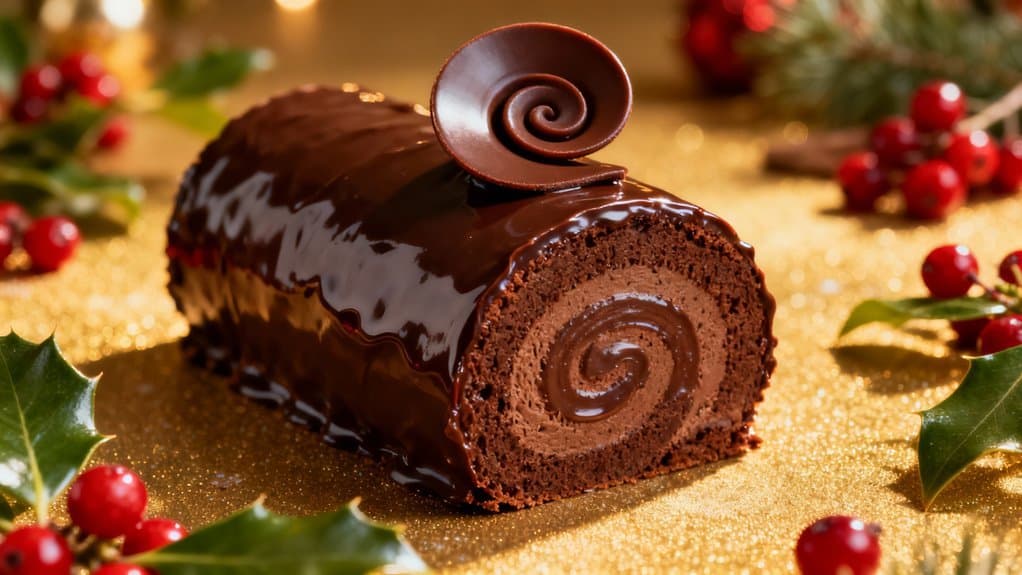
Perfect Chocolate Log That Never Cracks
The secret to a crack-free chocolate log lies in rolling your sponge while it’s still warm and pliable—this leverages the partially denatured proteins that haven’t fully set. You’ll need to whip your eggs thoroughly for maximum air incorporation, use cake flour to minimize gluten development, and add a touch of honey for moisture retention. Roll gently using a damp towel for support, and you’ll discover the professional techniques that guarantee bakery-perfect results every time.
Table of Contents
Key Takeaways
- Roll the chocolate sponge while still warm to leverage pliable proteins before they fully set and become brittle.
- Use cake flour and avoid excess butter to create a lighter, more flexible structure that bends without breaking.
- Whip eggs thoroughly to incorporate maximum air, creating a protein network that provides bendability and prevents cracking.
- Support the rolling process with a damp towel and use gentle pressure, allowing the sponge to guide naturally.
- Add honey or corn syrup to retain moisture and prevent the cake from drying out and becoming prone to cracks.
The Science Behind a Flexible Chocolate Sponge Cake
How does a delicate sponge cake bend and roll without cracking into pieces?
The secret lies in understanding protein denaturation and thermal expansion during baking.
When you whip eggs, you’re creating a protein network that traps air bubbles.
During baking, heat causes protein denaturation – the proteins unfold and set into a flexible structure rather than a rigid one.
This happens because you’re controlling temperature and timing precisely.
Thermal expansion also plays a crucial role.
As your cake bakes, it expands from heat, then contracts as it cools.
Rolling the cake while it’s still warm takes advantage of this thermal state – the proteins remain pliable and the structure hasn’t fully set.
The key is removing your cake from the oven before it’s completely firm.
You’ll achieve optimal flexibility when proteins are partially denatured but still malleable.
This creates the perfect balance between structure and bendability for rolling.
Essential Ingredients and Techniques for Crack-Prevention
What transforms a basic sponge cake into a rollable masterpiece that won’t crack under pressure? It’s all about understanding fat balance and strategic ingredient choices.
You’ll need eggs as your primary fat source, but don’t overdo the butter.
Too much fat creates a dense cake that’s prone to breaking.
Instead, focus on sugar inversion – using both granulated sugar and a touch of honey or corn syrup.
This creates moisture retention and flexibility.
Your flour choice matters tremendously.
Cake flour’s lower protein content prevents tough gluten development that leads to cracks.
Whip your eggs thoroughly to incorporate maximum air, creating a light structure that bends rather than breaks.
Temperature control is crucial.
Roll your cake while it’s still warm and pliable, using a damp towel to maintain moisture.
Cool completely before unrolling to add filling.
This technique prevents the sudden temperature shock that causes most cracking disasters.
Step-by-Step Method for the Perfect Chocolate Log Base
Before you preheat your oven to 375°F, line a 15×10-inch jelly roll pan with parchment paper and lightly grease it. This foundation prevents sticking and ensures smooth removal.
Your Preparation Timeline begins 30 minutes before baking. First, complete your Tool Checklist: electric mixer, large bowl, wire whisk, and rubber spatula. Beat egg yolks with sugar until pale and thick, approximately 3-4 minutes. In a separate bowl, whip egg whites to soft peaks, then gradually add remaining sugar until stiff peaks form.
| Step | Action | Visual Cue |
|---|---|---|
| 1 | Fold cocoa into yolks | Smooth chocolate ribbons |
| 2 | Add 1/3 whites to yolk mixture | Lightened brown color |
| 3 | Fold remaining whites gently | Airy, uniform batter |
Pour batter into prepared pan, spreading evenly to corners. Bake 12-15 minutes until surface springs back when lightly touched. This creates your perfect crack-resistant base.
Master the Art of Rolling Without Breaking
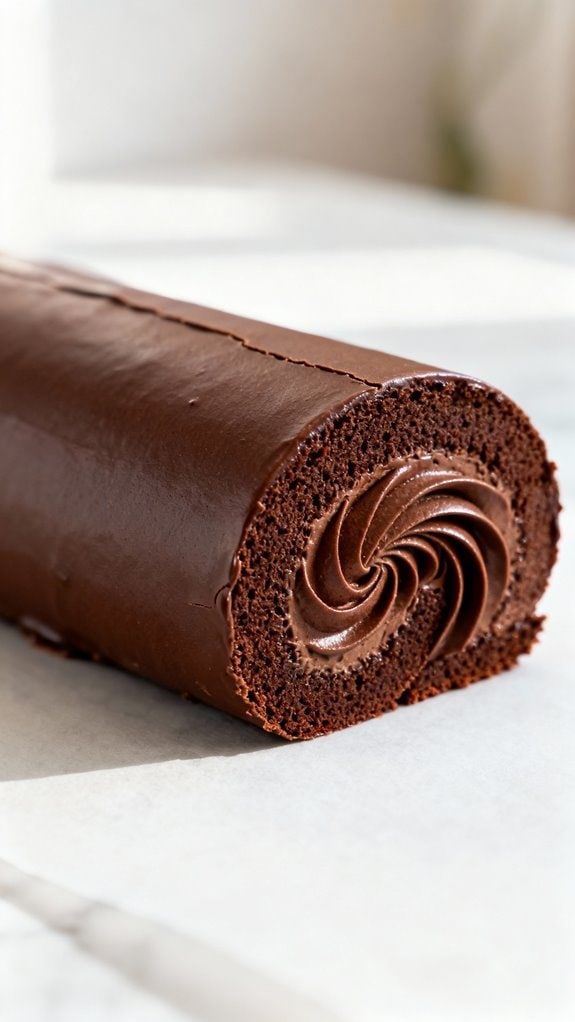
Begin by placing a clean kitchen towel over your cooled sponge. Gently lift one short edge and start rolling slowly, using the towel as support. Don’t press too hard—let the sponge guide itself into shape.
If you hear cracking sounds, stop immediately and allow more cooling time.
Your tool selection matters significantly here. A flexible offset spatula helps release stubborn edges, while parchment paper creates a smooth rolling surface.
Work methodically, checking for resistance as you progress.
Once rolled, consider your transport packaging early. Wrap the finished log in plastic wrap, then place it seam-side down in a rigid container.
This prevents shifting during transport and maintains your perfect spiral shape.
Finishing Touches and Decorating Your Bûche De Noël
Now that your chocolate log holds its perfect form, you’ll transform this simple roll into an authentic-looking yule log that captures the rustic beauty of a forest branch.
Start by texturing the chocolate ganache coating with a fork’s tines, creating bark-like ridges along the entire surface. Drag the fork lengthwise and crosswise to mimic natural wood grain patterns.
Create delicate meringue mushrooms by piping small caps and stems separately, then dusting with cocoa powder before assembling. These whimsical fungi add woodland charm when nestled against your log’s base.
Roll sugared cranberries in granulated sugar while still damp for a frosted appearance that resembles winter berries. Scatter these jewel-toned spheres around the log’s perimeter.
Add finishing touches with powdered sugar dusted through a fine sieve, creating snow-like drifts. Position small rosemary sprigs as evergreen branches, and dust everything lightly again. Your bûche de Noël now resembles an enchanted forest floor centerpiece.
Frequently Asked Questions
How Long Can a Chocolate Log Be Stored Before Serving?
You can store your chocolate log for up to three days in the refrigerator before serving. The refrigeration timeline ensures optimal taste and texture while preventing spoilage.
Watch for freshness indicators like changes in color, texture, or smell that signal it’s past its prime. You’ll want to wrap it tightly in plastic wrap or store it in an airtight container to maintain moisture and prevent it from absorbing other flavors.
Can I Make This Recipe Gluten-Free or Dairy-Free?
You can definitely make ingredient swaps to accommodate dietary restrictions.
For gluten-free, replace regular flour with almond flour or a gluten-free blend.
Dairy alternatives work well too – substitute butter with vegan butter and use coconut cream or cashew cream for the filling.
You’ll need to adjust ratios slightly, but these modifications won’t compromise the log’s texture or prevent cracking when rolled properly.
What’s the Best Way to Transport a Finished Bûche De Noël?
You’ll need secure packaging and temperature control to transport your bûche de noël successfully.
Place it on a sturdy cake board, then carefully slide it into a long cake box or improvised cardboard container.
Keep it refrigerated until the last moment, then transport in a cooler with ice packs.
Don’t let it sit in warm temperatures, as the frosting will soften and decorations may shift during transit.
Can I Freeze the Chocolate Log for Later Use?
Yes, you can freeze your chocolate log for up to three months.
Use flash freezing by placing it unwrapped on a baking sheet for two hours, then wrap tightly in plastic wrap and foil. Consider your portioning strategy before freezing – slice into individual portions or freeze whole.
Thaw overnight in the refrigerator before serving to maintain the log’s texture and prevent condensation from forming.
What Traditional Flavors Work Well Instead of Plain Chocolate Filling?
You’ll love hazelnut praline filling – it’s a classic French combination that adds rich, nutty sweetness.
Coffee mascarpone creates an elegant tiramisu-inspired flavor that’s incredibly smooth.
Chestnut cream offers traditional holiday taste, while orange buttercream brings bright citrus notes.
Vanilla bean pastry cream works beautifully too.
Each filling complements the chocolate sponge perfectly and maintains the log’s authentic European character.
Conclusion
You’ve mastered the secrets to creating a flawless chocolate log that won’t crack or break. By understanding the science behind flexible sponge cake, using proper ingredients and techniques, following the step-by-step method, and rolling with confidence, you’ll create a stunning bûche de noël every time. Your guests won’t believe you made this professional-looking dessert at home. Now you can confidently tackle this classic French holiday treat without fear of failure.


No Comments