
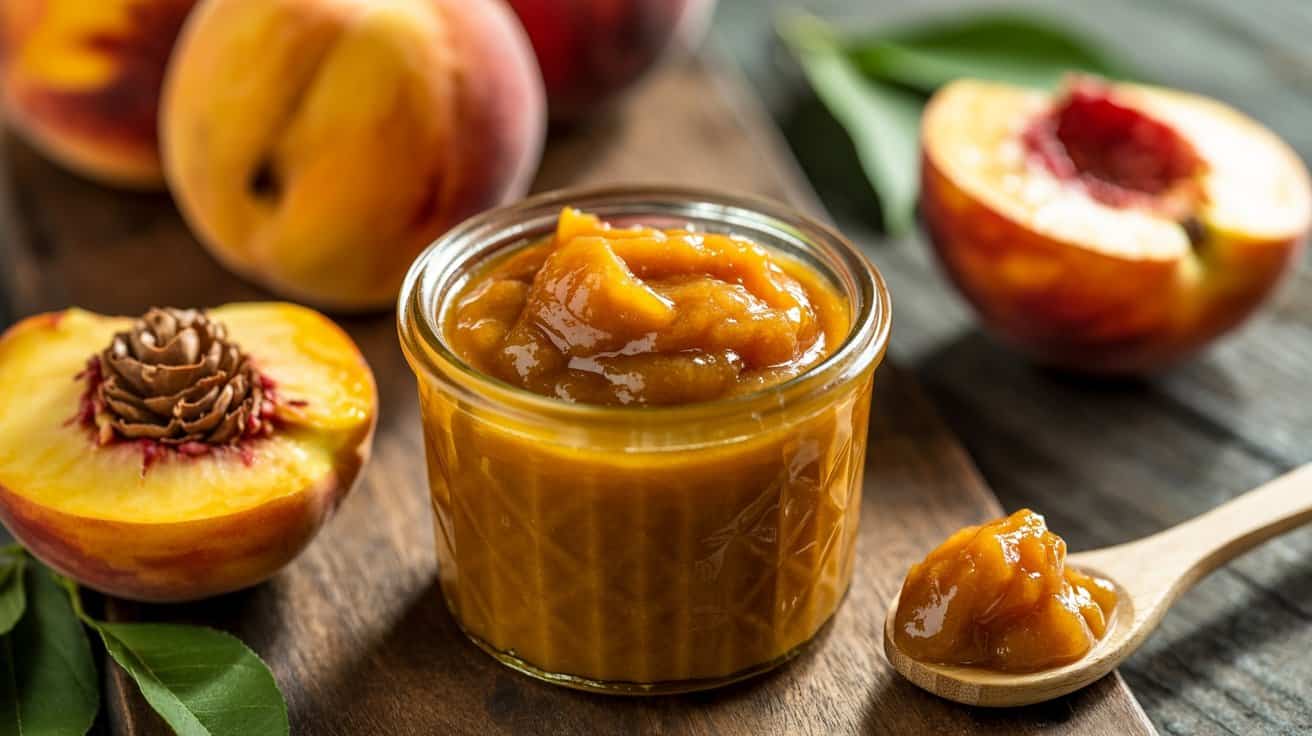
Yummy Homemade Peach Butter Recipe Everyone will Love
You’ll make perfect peach butter by simmering 3 pounds of ripe, peeled peaches with ¾ cup sugar, cinnamon, and lemon juice for 45-60 minutes until thick and amber-colored. Start by blanching and chopping your peaches, then cook them down while stirring every 10 minutes. The butter’s ready when it mounds on a spoon and doesn’t run on a chilled plate. Master the exact timing, spice combinations, and canning techniques that transform ordinary fruit into this versatile spread.
Table of Contents
Key Takeaways
- Combine 3 pounds peeled, chopped peaches with ¾-1 cup sugar, ½ teaspoon cinnamon, and 2 tablespoons lemon juice in a heavy pot.
- Simmer mixture 45-60 minutes over medium-low heat, stirring every 10 minutes until thickened and amber-colored.
- Test doneness when mixture mounds on a spoon and holds its shape on a chilled plate without running.
- Blend smooth with immersion blender, add vanilla extract, and adjust sweetness or spices to taste before jarring.
- Process filled jars in boiling water bath for 10 minutes (half-pints) or 15 minutes (pints) for shelf-stable storage.
What Makes Peach Butter Different From Jam and Preserves
Understanding the key differences between peach butter and its cousins—jam and preserves—will help you appreciate why this smooth spread deserves a spot in your pantry.
While jam contains fruit pieces suspended in gel and preserves feature large chunks, peach butter’s completely smooth texture comes from slow cooking and pureeing. You won’t find added pectin here—the fruit reduction process naturally concentrates the peaches’ sugars and flavors.
Peach butter’s consistency resembles a thick peach compote that’s been cooked down even further.
You’ll achieve this by simmering peaches for hours until they’re spreadable and deeply caramelized. The extended cooking time creates complex flavors you can’t get from quick-cooked jams.
Unlike preserves that maintain fruit integrity, you’ll puree everything until it’s silky smooth. The result? A concentrated spread that’s less sweet than traditional jam but packed with intense peach flavor.
You’ll use less sugar since the fruit reduction intensifies natural sweetness through evaporation.
Essential Ingredients for Perfect Peach Butter
You’ll need just a handful of ingredients to create rich, velvety peach butter that’s far superior to store-bought versions. Start with perfectly ripe peaches that give slightly when pressed, then choose your sweeteners—whether traditional sugar, honey, or maple syrup—along with warming spices like cinnamon and nutmeg.
Don’t forget the critical addition of lemon juice or apple cider vinegar, which brightens the flavor and ensures safe preservation.
Fresh Peach Selection
Ripe peaches transform into luxurious butter when you choose the right fruit from the start. You’ll want peaches that yield slightly to gentle pressure, indicating they’re perfectly ripe for cooking. Check the fruit’s background color—it should be golden-yellow, not green, even beneath the red blush.
Your aroma evaluation tells you everything about ripeness. Sweet, fragrant peaches at the stem end promise exceptional flavor in your finished butter. Skip hard, odorless fruits that won’t develop proper sweetness.
During stone selection, choose freestone varieties when possible. They’ll release from the pit easily, saving you prep time. Clingstone peaches work too, but you’ll spend extra minutes cutting around stubborn pits. Select unblemished fruits without soft spots or wrinkled skin. You’ll need about three pounds of peaches per pint of butter.
Sweeteners and Spices
Sugar always forms the foundation of peach butter’s sweetness, but you’ve got options beyond plain white granulated. Brown sugar adds caramel notes that complement peaches beautifully, while natural sweeteners like honey or maple syrup introduce complex flavors. You’ll typically need ¾ to 1 cup per 4 pounds of peaches, adjusting based on fruit ripeness.
Spices transform basic peach butter into something extraordinary. Cinnamon’s warmth pairs naturally with stone fruit, while nutmeg adds depth without overpowering. For sophisticated variations, try floral spices like cardamom or star anise—they’ll enhance the peaches’ inherent aromatics. Vanilla extract brings everything together, and a pinch of salt amplifies all flavors. Start with ½ teaspoon of primary spices, then adjust to taste during cooking.
Acidity Balance Essentials
While sweetness defines peach butter’s appeal, acidity determines whether it’s safe for canning and storage. You’ll need to add lemon juice or citric acid to achieve the proper pH level below 4.6, preventing harmful bacteria growth. This acidity pairing isn’t just about safety—it’s crucial for flavor chemistry too.
Add two tablespoons of bottled lemon juice per quart of peach butter. Don’t use fresh lemons since their acidity varies. If you prefer citric acid, use half a teaspoon per quart. These acids brighten the peaches’ natural flavors while cutting through the concentrated sweetness.
Test your mixture’s pH with strips if you’re unsure. The acid won’t make your butter taste sour—instead, it’ll enhance the fruit’s complexity and ensure you’ve created a shelf-stable product that’s safe to enjoy year-round.
Choosing and Preparing Your Peaches
Before you begin making peach butter, you’ll need to select the right fruit for optimal flavor and texture. Choose peaches that yield slightly to gentle pressure and emit a sweet fragrance at the stem end. Stone ripening occurs naturally as peaches mature, softening the flesh around the pit and developing deeper flavors. You’ll want fruit that’s ripe but not mushy.
To prepare your peaches, wash them thoroughly under cool water. You can remove the skins by blanching—submerge peaches in boiling water for 30-60 seconds, then transfer to ice water. The skins will slip off easily. However, some cooks prefer peel preservation, keeping the skins on for added nutrients and a rustic texture. If you’re keeping peels, just remove any blemished areas.
Cut peaches in half, twist to separate, and remove the pit. Chop into uniform chunks to ensure even cooking. Work quickly to minimize browning, or toss cut fruit with lemon juice.
Step-by-Step Cooking Instructions
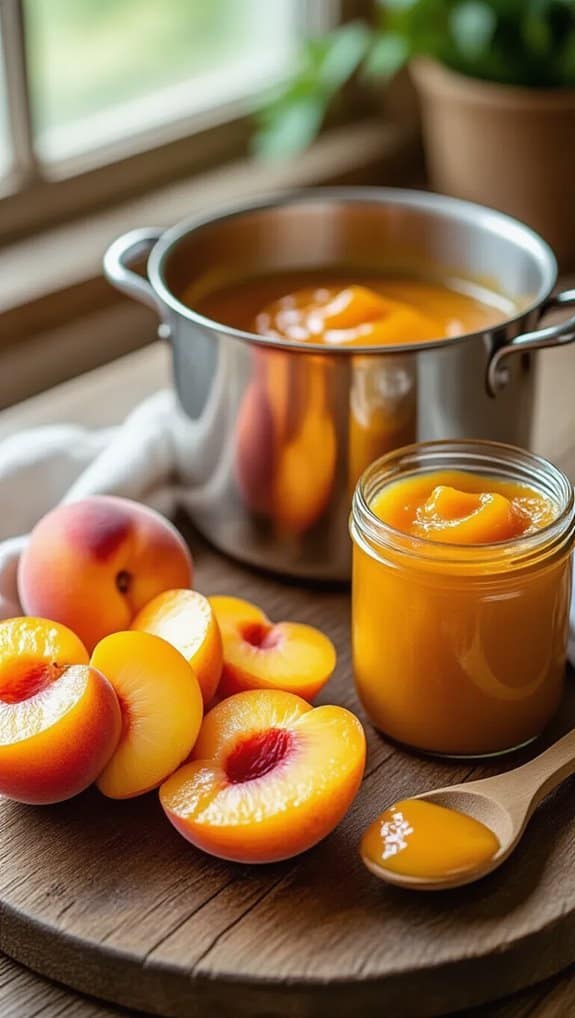
Now that you’ve selected your peaches, you’ll transform them into rich, velvety butter through careful cooking.
Start by peeling and chopping your prepared fruit into chunks, then place them in a heavy-bottomed pot with sugar and spices.
You’ll simmer this mixture for 45-60 minutes, stirring occasionally, until it reduces to a thick, spreadable consistency that coats the back of a spoon.
Prepare Fresh Peaches
Start by selecting ripe, fragrant peaches that yield slightly to gentle pressure—you’ll need about 4 pounds for a standard batch of peach butter. Wash them thoroughly under cold water and pat dry.
For efficient skinning techniques, score an X on each peach’s bottom, then blanch in boiling water for 30-60 seconds. Transfer immediately to ice water—the skins’ll slip right off.
| Task | Time | Tool Needed |
|---|---|---|
| Blanching | 30-60 seconds | Large pot |
| Ice bath | 2 minutes | Bowl with ice |
| Peeling | 5 minutes | Your hands |
After peeling, slice peaches in half for proper stone handling. Twist the halves apart and remove pits with a spoon’s edge. Chop the flesh into 1-inch chunks—they’ll cook down evenly this way. You’re now ready for cooking.
Cook Until Thickened
Place your prepared peach chunks in a heavy-bottomed pot or Dutch oven and add 1/2 cup of water to prevent sticking. Heat over medium-high until bubbling, then reduce to medium-low. You’ll cook for 45-60 minutes, stirring every 10 minutes.
Watch for these signs of proper peach caramelization:
- Color deepens from bright orange to amber
- Natural sugars concentrate and develop complexity
- Volume reduces by approximately half
- Mixture coats your spoon thickly
Don’t rush this process. Texture monitoring is crucial—you’re looking for a spreadable consistency that holds its shape when dropped from a spoon. Test readiness by dragging your spoon across the bottom; it should leave a clear trail that fills in slowly. The butter’s ready when it mounds slightly on a chilled plate.
Tips for Achieving the Right Consistency
While you’re cooking your peach butter, the consistency can make or break the final product. You’ll want it thick enough to coat a spoon but spreadable when cooled. The best texture testing method involves dragging a spoon through the mixture—if the trail stays visible for several seconds, you’re on track.
Don’t rush the process. Peach butter thickens considerably as it cools, so what seems runny now might be perfect later. Test by dropping a small amount on a chilled plate. If it doesn’t run, you’ve nailed it.
For batch scaling, remember that larger quantities take significantly longer to reduce. Double the recipe means more than double the cooking time since there’s more moisture to evaporate. Keep your heat consistent and stir more frequently as the butter thickens to prevent scorching. You’ll know it’s ready when it mounds slightly on the spoon and has a glossy, jam-like appearance.
Spice Variations and Flavor Combinations
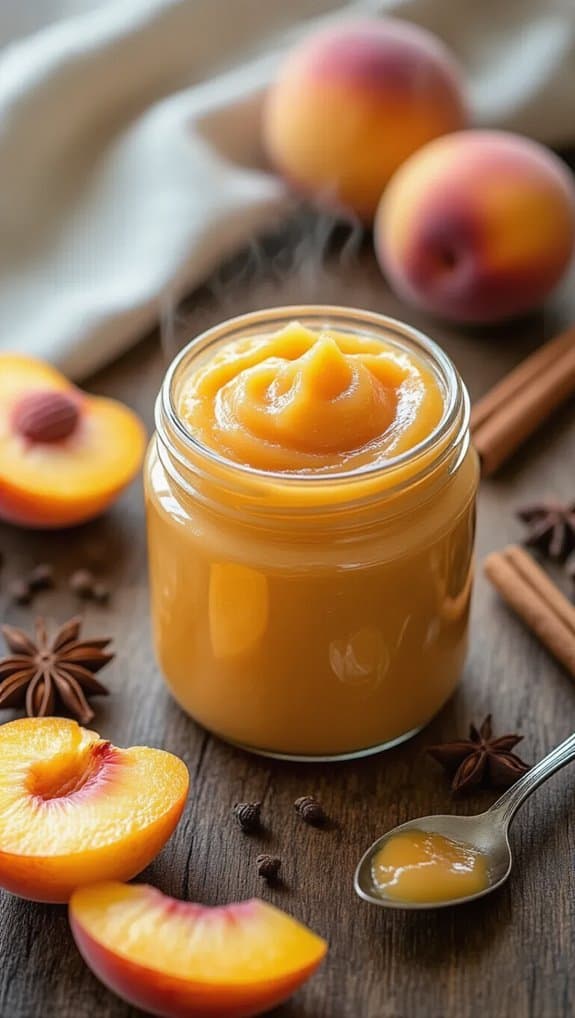
You can transform your peach butter beyond the basic recipe by experimenting with different spice combinations and flavor enhancements.
Classic warm spices like cinnamon, nutmeg, and cardamom create a cozy autumn profile, while fresh citrus zest brightens the natural peach sweetness.
For a more sophisticated twist, you’ll find that vanilla extract or a splash of bourbon adds depth and complexity to your finished spread.
Classic Warm Spice Blends
When you’re ready to elevate your peach butter beyond simple fruit sweetness, classic warm spice blends transform it into something extraordinary.
You’ll discover how traditional combinations create depth that complements peach’s natural brightness.
Start with these time-tested blends:
- Cinnamon-Nutmeg Duo – Add 1 teaspoon cinnamon and ½ teaspoon nutmeg per batch
- Autumn Quartet – Combine cinnamon, ginger, allspice, and cloves in equal parts
- Warm Cardamom Blend – Mix cardamom pods with cinnamon stick while cooking
- Peach Mole Inspiration – Incorporate cinnamon, anise, and a pinch of cayenne
You’ll achieve best results by adding whole spices during cooking, then removing them before jarring.
Ground spices work too—just use half the amount.
These blends pair beautifully with biscuits, yogurt, and roasted meats.
Citrus Zest Additions
Beyond warm spices, citrus zest brings bright, aromatic complexity that cuts through peach butter’s rich sweetness. You’ll transform your preserve by adding fresh citrus peel during the final cooking stages. This zesty infusion creates layers of flavor that complement peaches beautifully.
| Citrus Type | Flavor Profile |
|---|---|
| Lemon | Tart, bright, floral |
| Orange | Sweet, warm, fruity |
| Lime | Sharp, tropical, bold |
| Grapefruit | Bitter-sweet, complex |
Add one tablespoon of finely grated zest per four pounds of peaches. You’re aiming for subtle enhancement, not overpowering citrus notes. Incorporate the zest during the last 15 minutes of cooking to preserve volatile oils. For deeper flavor, combine different citrus varieties—lemon-orange works exceptionally well. Always use organic fruit when possible since you’re using the outer peel directly.
Vanilla and Bourbon Notes
Vanilla and bourbon frequently elevate peach butter from simple preserve to sophisticated spread.
You’ll find vanilla essence adds warmth and depth that complements the fruit’s natural sweetness, while bourbon introduces complex caramel and oak notes.
Try these flavor combinations:
- Add 2 teaspoons vanilla essence during the final cooking stage
- Stir in 3 tablespoons bourbon barrel-aged spirits after removing from heat
- Combine both for a layered flavor profile
- Mix vanilla bean paste instead of extract for visible specks
You’ll achieve the best results by adding vanilla early to infuse throughout cooking.
However, add bourbon at the end to preserve its distinctive character.
Start with less bourbon than you think you’ll need—its flavor intensifies as the butter cools and sets.
Canning and Storage Methods
Your freshly made peach butter needs to end up in proper storage to maintain its rich flavor and smooth texture for months to come.
For water bath canning, you’ll process half-pint jars for 10 minutes and pint jars for 15 minutes at sea level. Add an extra minute for every 1,000 feet above sea level.
After processing, perform vacuum testing by pressing the center of each lid. If it doesn’t flex, you’ve achieved a proper seal. Store sealed jars in a cool, dark pantry where they’ll keep for up to one year. Practice jar rotation by dating each batch and using older preserves first.
If you’re not canning, refrigerate your peach butter in airtight containers for up to three weeks.
For longer storage without canning, freeze it in freezer-safe containers, leaving half an inch of headspace. Frozen peach butter maintains quality for up to six months.
Creative Ways to Use Peach Butter
Often overlooked as merely a toast topper, peach butter transforms everyday dishes into memorable culinary experiences. You’ll discover its versatility extends far beyond breakfast spreads when you experiment with both sweet and savory applications.
Transform your appetizer game by pairing savory peach butters with cheese boards, grilled meats, or roasted vegetables. The fruit’s natural sweetness balances perfectly with herbs like thyme or rosemary you’ve mixed in.
Consider these creative applications:
- Swirl into yogurt parfaits or oatmeal
- Glaze pork tenderloin or chicken thighs
- Fill thumbprint cookies or layer cakes
- Mix into vinaigrettes for summer salads
Don’t forget about beverages—peach butter cocktails elevate your mixology skills instantly. Muddle a spoonful into bourbon smashes, blend into frozen margaritas, or stir into prosecco for effortless bellinis. You can even whisk it into barbecue sauces, creating complex flavor profiles that’ll impress dinner guests. Each spoonful adds concentrated peach essence wherever you need it.
Troubleshooting Common Problems
| Problem | Solution |
|---|---|
| Too Runny | Cook longer; add pectin |
| Grainy Texture | Lower heat; blend thoroughly |
| Separation | Stir frequently; add lemon juice |
| Mold Growth | Check seal; refrigerate after opening |
Watch for fermentation risks when your butter bubbles or smells yeasty. This happens if you don’t process jars properly or store them in warm areas. You’ll prevent spoilage by maintaining proper acidity levels with lemon juice and processing jars in boiling water for the recommended time. If you notice off-odors, discoloration, or bubbling, don’t taste it—discard the entire batch immediately.
Recipe Variations for Dietary Restrictions
- Replace butter with coconut oil for dairy-free versions
- Use maple syrup instead of honey for vegan preparations
- Add chia seeds as a pectin substitute for thickening
- Incorporate cinnamon and vanilla for depth without allergens
You’ll achieve the same smooth consistency by adjusting cooking times slightly. Sugar-free versions may require 10-15 minutes less cooking, while oil-based alternatives need constant stirring. Test consistency by dropping a spoonful on a cold plate—it should hold its shape without running.
Frequently Asked Questions
Can I Make Peach Butter in a Slow Cooker or Instant Pot?
Yes, you can make peach butter in both appliances! For a slow cooker, you’ll cook peeled, chopped peaches with sugar and spices on low for 8-10 hours, stirring occasionally.
In a pressure cooker like an Instant Pot, you’ll use the sauté function with the lid off, stirring frequently for 30-45 minutes. Both methods require cooking until the mixture thickens to a spreadable consistency. The slow cooker’s hands-off approach makes it especially convenient.
How Many Pounds of Peaches Yield One Jar of Peach Butter?
You’ll typically need 2-3 pounds of fresh peaches to yield one pint jar of peach butter.
Your exact peach yields depend on the fruit’s water content and how long you cook it down. These fruit ratios can vary slightly based on your recipe’s sugar amount and desired thickness. If you’re using very juicy peaches, you might need closer to 3 pounds per jar for the proper concentrated consistency.
Is It Safe to Reduce the Sugar Amount in Peach Butter Recipes?
You can reduce sugar in peach butter recipes, but you’ll face fermentation risks since sugar acts as a preservative.
When you cut sugar significantly, harmful bacteria might grow during storage. You’re better off using sugar substitutes like Splenda or stevia that maintain sweetness without compromising safety.
If you’re reducing regular sugar, process your jars properly and refrigerate them immediately. Don’t store reduced-sugar peach butter at room temperature for extended periods.
Can I Use Frozen Peaches Instead of Fresh Ones?
Yes, you can use frozen peaches for peach butter. The frozen texture actually breaks down faster during cooking since ice crystals rupture the fruit’s cell walls.
You’ll want to thaw them completely first and drain excess liquid. Skip adding extra water that fresh peach recipes might call for.
If you’re using sweetened frozen peaches, reduce your syrup alternatives or sugar accordingly to avoid an overly sweet final product.
How Long Does Unopened Canned Peach Butter Last?
Your unopened canned peach butter will last 12-18 months when stored in a cool, dark place.
You’ll get the best shelf stability by keeping jars away from heat and direct sunlight.
While it won’t spoil immediately after this timeframe, you might notice flavor changes as the butter ages – it’ll gradually lose its bright, fresh taste and develop darker colors.
Always check the seal before using older jars.
Conclusion
You’ve now mastered the art of making silky, spiced peach butter that’ll transform your breakfast routine and elevate your desserts. Whether you’re spreading it on warm biscuits, swirling it into yogurt, or gifting jars to lucky friends, you’ll find countless ways to enjoy this golden preserve. Don’t forget to experiment with different spice combinations and sweeteners to make it uniquely yours. Your homemade peach butter will capture summer’s essence in every spoonful year-round.


No Comments