
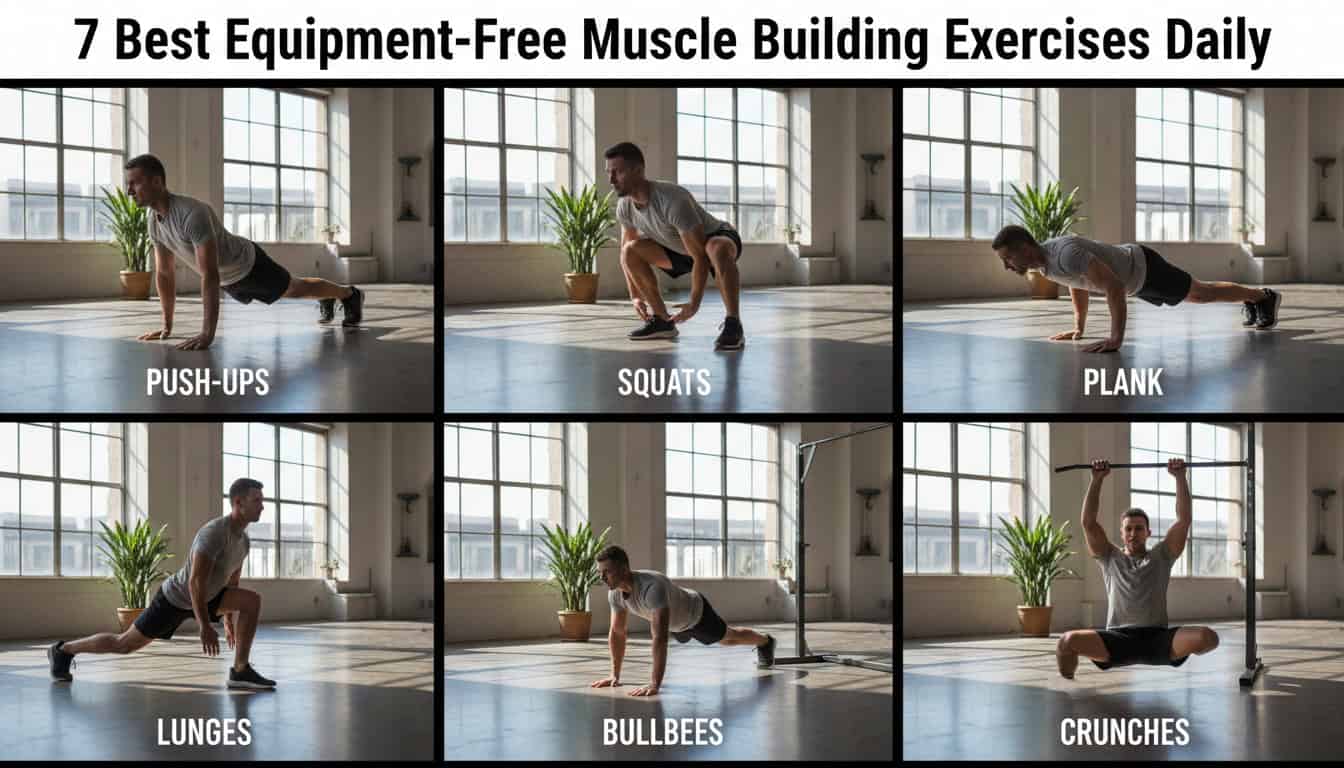
7 Best Equipment Free Muscle Building Exercises Daily
You can hit every major muscle group with just seven moves and no gear: start with push‑up variations for chest, shoulders, and triceps; add body‑weight squats to fire quads, glutes, and core; incorporate forward, reverse, and lateral lunges for balance and leg strength; hold planks and side planks to solidify core stability; do glute bridges and single‑leg bridges for posterior‑chain power; finish with towel‑row or floor‑level inverted‑row alternatives to sculpt your upper back. Keep reps progressive, rest under 45 seconds, and you’ll see gains fast, plus the next sections reveal deeper programming tips.
Table of Contents
Build a Daily Body‑Weight Full‑Body Routine
A solid daily body‑weight full‑body routine lets you hit every major muscle group without any equipment, making strength gains and staying consistent. Start with a dynamic warm‑up—jumping jacks, arm circles, hip swings—for five minutes to raise heart rate and mobilize joints. Move into a circuit: 12–15 squats, 10–12 push‑ups, 10‑12 lunges per leg, 15‑20 second planks, and 8–10 burpees. Perform each exercise with controlled tempo, pause briefly between sets, then repeat the circuit three times. Keep rest periods under 45 seconds to maintain intensity and boost metabolic stress. Track reps and aim to add one or two repetitions each session, ensuring progressive overload. Finish with a brief cool‑down—stretch hamstrings, chest, shoulders, and calves—for two minutes. By sticking to this routine daily, you’ll develop balanced strength, improve endurance, and keep muscle growth steady without ever needing a gym.
Push‑Up Mastery & Progressions for Body‑Weight Workouts
Ever wondered how to turn a simple push‑up into a powerhouse for building chest, shoulder, and triceps strength? Start with a solid plank base: hands shoulder‑width, core tight, body in a straight line. Lower until your elbows hit a 90‑degree angle, then press up explosively. To progress, add a pause at the bottom for three seconds, forcing muscle fibers to work harder. Once that feels easy, shift to decline push‑ups—feet elevated on a sturdy chair—so more weight falls on your upper chest and shoulders. For even greater challenge, try archer push‑ups, spreading one arm wide while the other stays close to the body, then alternate sides. If you crave speed, incorporate plyometric push‑ups, clapping between reps to develop power. Keep reps in the 8‑12 range, rest 60 seconds, and aim for three sets. Consistency and gradual overload will transform your push‑up game and sculpt upper‑body strength without any equipment.
Body‑Weight Squat Power: Full‑Body Strength Without Equipment
After mastering push‑up variations, shift your focus to the squat, the cornerstone of full‑body strength. Body‑weight squats engage quads, hamstrings, glutes, core, and even shoulders when you add an overhead press. Stand feet shoulder‑width apart, chest up, and sit back as if into a chair, keeping knees tracking over toes. Lower until thighs are parallel to the floor, then drive through the heels to rise, squeezing glutes at the top. To boost power, incorporate a brief pause at the bottom or explode upward into a jump, landing softly. Maintain a neutral spine throughout; avoid letting knees collapse inward.
Perform three sets of 12‑20 reps, resting 60 seconds between sets. Progress by increasing tempo, adding a pulse at the bottom, or transitioning to pistol‑style single‑leg squats once you’ve built confidence. Consistent practice will forge a solid, functional foundation for any sport or daily activity.
Lunge Variations for Leg Strength, Balance, and Mobility
Ready to level up your leg game? The forward lunge targets quads, glutes, and hamstrings while demanding balance. Step forward, lower until both knees hit 90°, keep torso upright, then push back. For extra stability, try reverse lunges: step back, land softly, and drive forward with the front heel. Add a twist by rotating your torso toward the leading leg, engaging core and hip flexors. Lateral lunges widen hip mobility; slide one foot out, bend the opposite knee, and keep the other leg straight. Elevate difficulty with walking lunges, alternating steps across the floor, or incorporate a 180° turn at the bottom for dynamic coordination. Single‑leg Bulgarian split squats mimic a lunge with the rear foot elevated on a bench or sturdy surface, amplifying glute activation. Finish with a pulse at the bottom of each lunge to boost time‑under‑tension, improving endurance and muscular endurance.
Plank Progressions to Harden Core Muscles in a Body‑Weight Routine
A solid plank is the foundation for a rock‑solid core, and progressing from the basic forearm hold to more demanding variations keeps the muscles constantly challenged. Start with a forearm plank, elbows under shoulders, body in a straight line, and hold 30‑45 seconds. Increase time, then shift to a straight‑arm plank, engaging the serratus and triceps. Add a shoulder‑tap: lift one hand, tap the opposite shoulder, alternate for 12‑15 reps per side, which forces anti‑rotational stability. Next, try a side plank: stack feet, lift hips, and hold 20‑30 seconds each side, then raise the top leg for extra oblique activation. For dynamic intensity, perform plank jacks—jump feet in and out while maintaining a rigid torso. Finally, incorporate a plank walkout: from a standing position, walk hands forward into a plank, then back, repeating 8‑10 times. Each progression overloads the core, builds endurance, and prevents plateaus without any equipment.
Glute Bridge Series for Posterior‑Chain Development
You’ll feel your core glutes fire the moment you lift your hips, setting a solid foundation for posterior‑chain strength. By adding a pause, single‑leg lift, or weighted backpack, you create a progressive load that keeps the muscles challenged. This simple series lets you build power and stability without any equipment.
Core Glute Activation
When you engage the glutes through a focused bridge series, you’ll instantly fire the posterior chain and lay a solid foundation for strength and stability. Start lying on your back, knees bent, feet hip‑width apart. Press through your heels, lift hips until your body forms a straight line from shoulders to knees, and squeeze the glutes at the top. Hold for a beat, then lower slowly. To intensify activation, add a pause at the apex, or perform a single‑leg variation, keeping the pelvis level. Keep your core braced, ribs down, and avoid arching your lower back. Each rep should feel like a deliberate hip hinge, reinforcing neuromuscular patterns that translate into better squat, deadlift, and sprint performance.
Progressive Load Progression
Building on that glute activation, you now need to keep challenging the muscles by adding progressive load to the bridge series. Start with a standard glute bridge, then place a backpack or sandbag across your hips for extra resistance. Increase the weight by 5 % each session, ensuring you can still lift with full range and maintain a tight core. Next, transition to single‑leg bridges, alternating sides, which double the load on each glute without extra equipment. Add a pause at the top—hold for two to three seconds—to boost time‑under‑tension. Finally, incorporate tempo variations: lower slowly for three counts, explode up, then pause. This systematic load escalation maximizes posterior‑chain strength while staying equipment‑free.
Doorframe Inverted Row Alternatives for Upper‑Back Strength
Ever wondered how to hit your upper‑back hard without a doorframe? You can still build a thick, powerful lats and rhomboids using simple body‑weight moves that demand no equipment. Focus on tension, range of motion, and progressive overload by adjusting lever length or tempo. Keep your core tight, shoulders retracted, and squeeze the shoulder blades together at the top of each rep. Short, explosive pulls boost power, while slow eccentrics enhance muscle growth. Switch hand positions to target different fibers and avoid plateaus.
- Towel Row Under a Sturdy Table – loop a thick towel around a table leg, lean back, and pull your chest toward the edge, feeling the stretch in your mid‑back.
- Floor‑Level Reverse Snow Angel – lie face‑down, lift arms and legs, then sweep arms overhead like a snow angel, engaging traps and rear delts.
- Super‑Man Pull‑Ups – lie on your stomach, lift torso and legs, then pull elbows toward hips, mimicking a pull‑up motion without any bar.
Frequently Asked Questions
Can I Lose Weight While Building Muscle Without Equipment?
Yes, you can shed fat while gaining muscle without gear. Stick to high‑intensity bodyweight circuits, keep protein high, stay in a slight calorie deficit, and rest enough for recovery.
How Many Minutes Should Each Exercise Be Performed Daily?
You should aim for 45‑60 minutes total, splitting it into 3‑4 minute sets per exercise, resting 30‑45 seconds between sets, and rotating muscle groups to keep intensity high each day.
Do I Need a Warm‑Up Before Body‑Weight Training?
Yes, you should warm up before body‑weight training. Spend five to ten minutes doing light cardio, dynamic stretches, and mobility drills to raise heart rate, loosen joints, and prime muscles, reducing injury risk and boosting performance.
Can I Combine These Routines With Cardio Without Overtraining?
Yes, you can mix them—just schedule cardio on alternate days or keep sessions under 30 minutes, and listen to your body; if fatigue spikes, reduce intensity or add rest.
What’s the Best Way to Track Progress Without a Gym Log?
You can track progress by taking weekly photos, measuring key body parts, noting rep counts and difficulty levels, and using a simple spreadsheet or phone app to log each session’s metrics.
Conclusion
By mixing these seven equipment‑free moves into your daily routine, you’ll hit every major muscle group, boost strength, and improve balance without ever needing a gym. Stick with the progressions, keep good form, and watch your body transform—one rep at a time.


Sorry, the comment form is closed at this time.