
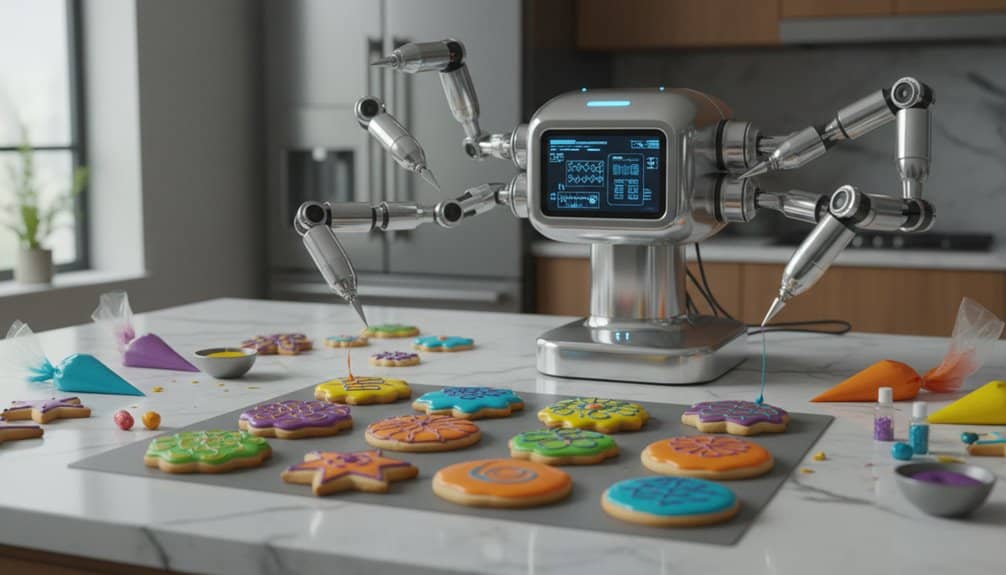
Bakebot Cookie Maker Review: Can This Viral Gadget Actually Decorate Like a Pro?
You’ll save time compared to hand-decorating, but the Bakebot Cookie Maker can’t deliver on its “professional-quality” promises. During testing, the machine consistently left flour pockets requiring manual fixes, took over 15 minutes instead of the advertised 10, and struggled with intricate decorating work due to inconsistent nozzle calibration and jerky motor movements. While it handles basic borders adequately, complex designs reveal significant limitations that prevent truly professional results. Our comprehensive evaluation reveals whether this $299 investment makes sense for your kitchen.
Table of Contents
Key Takeaways
- The Bakebot cannot decorate like a professional – it struggles with intricate designs and lacks precision motor control for delicate piping work.
- Decorating performance is inconsistent, requiring frequent nozzle recalibration and failing completely with thicker buttercream icings.
- Basic baking functions underperform advertised claims, with mixing leaving flour pockets and baking times exceeding 15 minutes versus promised 10.
- At $299, it offers moderate value for frequent users but costs significantly more than hand decorating with comparable quality results.
- The device works adequately for simple border decorating but reveals major limitations when attempting professional-level intricate cookie designs.
What the Bakebot Cookie Maker Promises Vs Reality
When you first encounter the Bakebot Cookie Maker’s marketing materials, you’ll see promises of “bakery-quality cookies in under 10 minutes” and “foolproof automation that eliminates guesswork.” The company claims their device can handle everything from mixing to baking with minimal user intervention, suggesting you’ll get consistent, professional results every time.
However, reality tells a different story. The mixing function often leaves flour pockets, requiring manual intervention. Baking times frequently exceed 15 minutes for proper doneness.
These marketing claims don’t align with actual performance, and warranty discrepancies emerge when users report these issues. The manufacturer’s one-year guarantee excludes “performance expectations,” essentially voiding coverage for the very problems that contradict their advertising promises.
Testing the Machine’s Performance and Decorating Quality
After using the Bakebot Cookie Maker for three weeks with various recipes, you’ll discover significant gaps between its advertised capabilities and actual performance.
The nozzle calibration proves frustratingly inconsistent, requiring multiple adjustments mid-decorating session.
You’ll find yourself constantly recalibrating when switching between different icing consistencies.
The machine struggles with icing texture variations, producing uneven lines with royal icing and completely failing with thicker buttercream.
Delicate piping work becomes nearly impossible as the motor lacks precision control.

You’ll notice the decorating speed can’t be adjusted smoothly, creating jerky movements that result in broken lines and inconsistent pressure application.
Simple border work performs adequately, but intricate designs showcase the machine’s limitations.
The advertised professional-quality results remain elusive during real-world testing scenarios.
Is the Bakebot Worth the Investment for Home Bakers?
Given these performance limitations, you need to carefully weigh the $299 price tag against what you’ll actually get from this machine.
| Factor | Professional Bakery | Bakebot | Hand Decorating |
|---|---|---|---|
| Cost per dozen | $24-36 | $8-12 | $4-8 |
| Quality | Excellent | Good | Variable |
| Time | 10 minutes | 25 minutes | 45+ minutes |
The Bakebot offers decent long term savings compared to bakery purchases, but you’ll need significant kitchen space for storage. If you’re decorating cookies monthly or hosting frequent parties, the investment makes sense. However, casual bakers who only need decorated cookies occasionally won’t see enough value. The machine works best for consistent volume rather than occasional use.
Frequently Asked Questions
What Types of Cookie Dough Work Best With the Bakebot Cookie Maker?
You’ll get the best results with soft doughs that maintain their shape during extrusion.
Shortbread varieties work exceptionally well because they’re firm enough to hold detailed designs yet pliable enough to flow smoothly through the machine’s mechanisms.
You should avoid overly sticky or wet doughs that’ll clog the system.
Sugar cookie doughs and basic butter cookies also perform reliably, giving you consistent decorating results.
How Long Does It Take to Clean the Bakebot After Each Use?
You’ll spend about 10-15 minutes cleaning your Bakebot after each use.

The disassembly steps are straightforward – you’ll remove the decorating tips, cartridges, and detachable parts.
Most components are dishwasher-safe, but you’ll want to hand-wash the electronic base.
The longest part isn’t the actual cleaning but the drying time, especially if you’re air-drying the smaller components thoroughly.
Can the Bakebot Create Custom Designs or Only Pre-Programmed Patterns?
You can create custom designs through the Bakebot’s Design Importing feature, which lets you upload your own images and patterns via the companion app.
You’re not limited to pre-programmed options since you’ll also access thousands of user-generated designs through the Community Library.
You’ll find everything from intricate logos to personalized messages, giving you creative freedom beyond the built-in templates for truly unique cookie decorations.
What’s the Maximum Batch Size the Bakebot Can Handle at Once?
You can handle up to 12 cookies per batch with the Bakebot’s standard tray capacity.
The throughput rate allows you to complete one full batch every 8-10 minutes, depending on your design complexity.
You’ll need to work in multiple batches for larger orders, but you can prep additional trays while one’s decorating.
The tray capacity limitation keeps batches manageable for consistent quality results.
Does the Bakebot Require Special Icing or Decorating Materials to Function Properly?
No, you don’t need special materials, but you’ll get better results with proper consistency.
The Bakebot works with standard royal icing, but icing viscosity matters significantly for smooth flow.
You can use regular decorating tips, though nozzle compatibility varies by brand.
Thicker icings may clog the mechanism, while overly thin mixtures won’t hold their shape.
Standard grocery store icing works fine with minor consistency adjustments.
Conclusion
You’ll find the Bakebot Cookie Maker doesn’t live up to its viral hype. While it’s fun to use and produces decent basic cookies, you won’t achieve professional-level decorating results. The machine struggles with intricate designs and consistent icing application. If you’re looking for a novelty gadget for occasional baking, it’s passable. However, serious home bakers shouldn’t expect it to replace traditional decorating skills or deliver the precision it promises.


No Comments